St Agnes
Virgin and martyr of Rome · Feast: 21 January
Word for the day
“But God chose what is foolish in the world to shame the wise; God chose what is weak in the world to shame the strong;” 1 Corinthians 1:27
Life
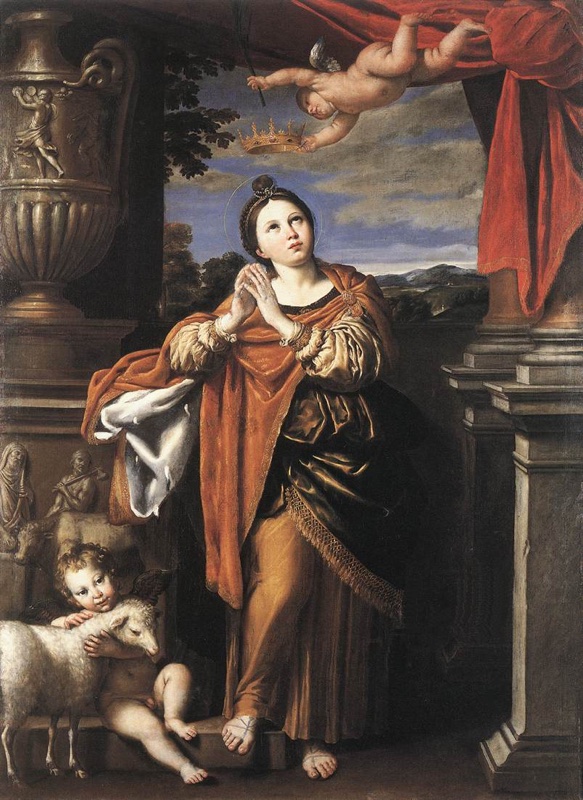
Agnes was a young girl of Rome who was put to death for her faith, probably during the persecution of Diocletian in the early fourth century; some scholars place her death earlier, in the third century. St Ambrose, writing within a century of her death, says she was twelve years old. Her name is in the Roman Canon of the Mass.
We know about her from early witnesses: Ambrose, Pope Damasus, who wrote verses for her tomb, and the poet Prudentius. They agree that she was very young, that she refused to give up her consecration to Christ, and that she died bravely. They differ on the manner of her death: Ambrose speaks of the sword, Damasus of fire. Later Acts add dramatic details that historians regard as legendary.
She was buried on the Via Nomentana outside Rome. In the fourth century Constantina, a daughter of the emperor Constantine, built a basilica near her tomb, and the church of Sant'Agnese still stands there today. Her name recalls the Latin word for lamb, agnus, and the Greek word for pure, hagne.
On her feast two lambs are blessed in Rome, and their wool is later used to weave the pallium, the woollen band the Pope gives to metropolitan archbishops as a sign of communion with him and of the shepherd who carries the lost sheep.
Lessons
Strength in weakness
God showed His power in a young girl.
Belonging to Christ
She would not give away a heart given to Him.
Courage of the young
Age is no limit to holiness.
Purity
She kept her love undivided for Christ.
Stories
Too young to be punished (history)
St Ambrose writes that Agnes was too young to be punished, yet ripe for victory, and that she went to her death more gladly than a bride to her wedding.
The lambs of St Agnes (history)
Each year on 21 January two lambs are blessed at Rome, and their wool is used to weave the pallia of archbishops.
Hair like a cloak (legend)
The later Acts say that when Agnes was exposed to shame, her hair grew long to cover her, and that a man who tried to harm her was struck blind and then healed through her prayer.
Words of the saint
She was too young to be punished, yet she was ripe for victory.
St Ambrose, On Virgins, in substance
Homily
1. God chooses the weak
A child put the powerful to shame.
2. An undivided heart
She belonged wholly to Christ.
3. The lamb and the shepherd
Her lambs remind the Church of the Good Shepherd.
Dear friends, St Agnes was only a girl, about twelve years old according to St Ambrose, when she died for Christ in Rome. The judges expected her to be afraid. Instead she stood firm. Ambrose wrote that she was too young to be punished, yet ripe for victory.
St Paul says: God chose what is weak in the world to shame the strong (1 Corinthians 1:27). The power of Rome was shamed by the courage of a child. Holiness does not depend on age, strength or position. It depends on love for Christ.
Agnes had given her heart to Christ, and she would not take it back, even when threatened with death. Today young people face other pressures: to follow the crowd, to give up purity, to hide their faith. Agnes shows that it is possible to belong wholly to Christ.
Every year on her feast two lambs are blessed in Rome, and their wool is used for the pallium of archbishops, a sign of the Good Shepherd. Let us pray for our young people, that they may be strong in faith like Agnes, and let us support them with our example and our prayer. Amen.
Prayer
Almighty, ever-living God, who choose what is weak in the world to confound the strong, grant that we, who celebrate the heavenly birthday of St Agnes, may follow her constancy in the faith. Amen.