St Antony the Great
Abbot, father of monks · Feast: 17 January
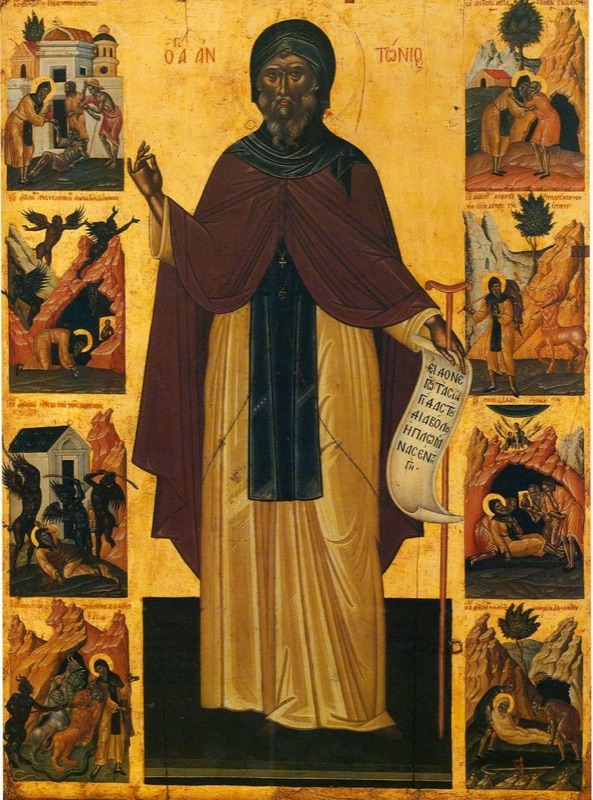
Word for the day
“Jesus said to him, “If you wish to be perfect, go, sell your possessions, and give the money to the poor, and you will have treasure in heaven; then come, follow me.”” Matthew 19:21
Life
Antony was born around 251 in a village of Middle Egypt, to Christian parents who owned land. When he was about eighteen or twenty his parents died, leaving him to care for his younger sister. Some months later he heard in church the Gospel words: if you wish to be perfect, go, sell your possessions, and give to the poor. He took them as spoken to him. He gave away his land, entrusted his sister to a community of consecrated virgins, and began a life of prayer, work and fasting near his village.
Seeking greater solitude, he lived for a time in a tomb, and then for about twenty years alone in an abandoned fort in the desert near the Nile. There he struggled against temptations, which his biographer describes as attacks of demons. Around 305 he came out, calm and full of grace, and many people came to learn from him. Communities of hermits grew up around him, and he became known as the father of monks.
During the persecution of 311 he went to Alexandria to encourage the Christians in prison and in the mines, hoping to be a martyr himself, but he was not arrested. Afterwards he withdrew to the inner mountain near the Red Sea, where the Monastery of St Antony still stands. He came to Alexandria once more to support the faith of Nicaea against the Arians. He died in 356 at the age of about a hundred and five.
Soon after his death St Athanasius of Alexandria wrote his Life, which spread quickly in East and West and made the monastic life known everywhere. Antony is honoured in all the ancient Churches, including the East Syriac and West Syriac traditions, on 17 January. In the West he became a patron of farmers and animals.
Lessons
Taking the Gospel literally
One reading of the Gospel changed his whole life.
The battle within
The spiritual life includes struggle against temptation.
Humility
Only humility escapes the snares of the enemy.
Prayer that serves
The hermit came out to support martyrs and the true faith.
Stories
The Gospel in church (history)
Athanasius tells that Antony, thinking about the first Christians who sold everything, entered church just as the Gospel of the rich young man was read, and went out at once to give away his land.
Augustine and the Life of Antony (history)
In his Confessions, Augustine tells how a friend described the Life of Antony to him in Milan, and how that story moved him deeply in the days before his conversion.
Antony and Paul the Hermit (legend)
St Jerome's Life of Paul tells that the aged Antony visited the older hermit Paul in the desert, and that a raven brought them a whole loaf instead of the usual half. Most scholars regard this story as legend.
Words of the saint
I saw the snares of the enemy spread over all the earth, and I asked: who can escape them? And I heard a voice say: humility.
St Antony, Sayings of the Desert Fathers, in substance
Homily
1. The word heard in church
God still speaks through the Gospel read in the liturgy.
2. The desert of the heart
We too must fight against temptation.
3. Humility is the way
Only the humble pass through the snares.
Dear friends, St Antony was a young man of Egypt with land, money and a family to look after. One day in church he heard the Gospel: if you wish to be perfect, go, sell your possessions, and give the money to the poor, and you will have treasure in heaven; then come, follow me (Matthew 19:21). He believed that Christ was speaking to him, and he obeyed.
Do we listen like that when the Gospel is read in church? Antony did not treat it as an old story. He let it change his life. The same word is read to us every time we gather for the Eucharist. Let us ask for ears that hear and hearts that obey.
Antony went into the desert, and there he met not only silence but struggle. He fought temptations, which his biographer describes as attacks of demons. The desert showed him what is inside the human heart. We too have deserts: times of loneliness, temptation and dryness. Antony teaches us to hold on to prayer and to trust in Christ.
He once saw the snares of the enemy spread over the whole world and asked who could escape them. A voice answered: humility. Many came to him for advice, and he sent them away with peace. Let us ask St Antony to teach us to listen to the Gospel, to fight temptation with prayer, and to walk humbly with our God. Amen.
Prayer
O God, who called St Antony the Abbot to serve you in the desert by a wonderful way of life, grant through his prayers that, denying ourselves, we may always love you above all things. Amen.