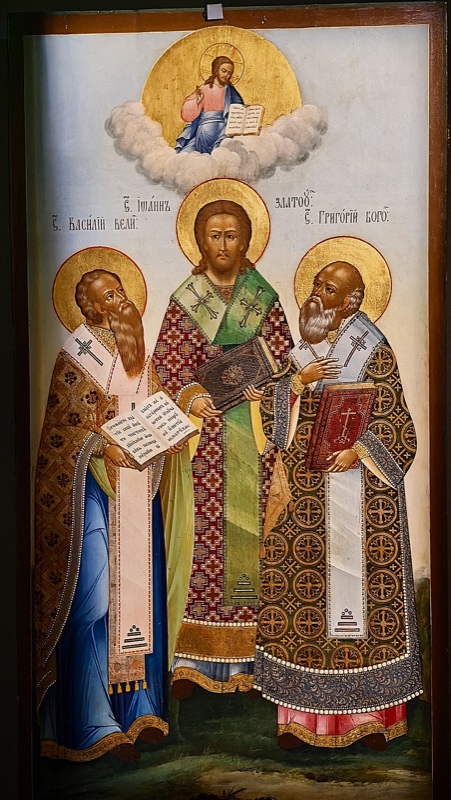
Sts Basil the Great and Gregory Nazianzen
Bishops and Doctors of the Church · Feast: 2 January
Word for the day
“But speaking the truth in love, we must grow up in every way into him who is the head, into Christ,” Ephesians 4:15
Life
Basil and Gregory were both born around 329 or 330 in Cappadocia, in present-day Turkey. Basil came from a family of saints: his grandmother Macrina, his parents, his sister Macrina and his brothers Gregory of Nyssa and Peter of Sebaste are all honoured as saints. Gregory was the son of the bishop of Nazianzus, also named Gregory, and his mother Nonna. The two young men met as students at Athens and became lifelong friends.
After his studies Basil was baptised, visited the monks of Egypt, Palestine, Syria and Mesopotamia, and began a life of prayer and work in a community near his family estate at Annesi. Gregory joined him there for a time. Basil's rules for monks, written as answers to questions, shaped monastic life in the East for centuries. In 370 he became bishop of Caesarea. He resisted the pressure of the Arian emperor Valens, defended the divinity of the Son and of the Holy Spirit, and built outside the city a great centre of care for the poor, the sick, travellers and lepers.
Gregory, a gentle and sensitive man who loved solitude, was ordained priest by his father almost against his will. In 379 he was called to Constantinople, where the Catholic faith had few followers. In a small chapel he named Anastasia, Resurrection, he preached the five Theological Orations on the Holy Trinity, and the Eastern tradition has called him the Theologian ever since. He presided for a time over the Council of Constantinople in 381, but resigned for the sake of peace and returned home to pray and write poetry.
Basil died on 1 January 379, according to the traditional date, and Gregory around 390. Their writings, together with those of Gregory of Nyssa, helped the Church to express the faith in the Trinity that we profess in the Creed. A eucharistic liturgy bears Basil's name, and Basil and Gregory are honoured among the great Doctors of the Church in East and West. The Roman calendar keeps their feast together because of their friendship.
Lessons
Friendship in Christ
Their friendship helped both of them to grow in holiness.
Faith that thinks
They used their learning to serve the truth of the Trinity.
Love for the poor
Basil's care for the sick and the hungry was part of his faith.
Humility in office
Gregory gave up a great see for the sake of peace.
Stories
One soul in two bodies (history)
In his funeral oration for Basil, Gregory recalls their student days in Athens: they knew only two roads, one to the church and one to the schools, and they seemed to have one soul in two bodies.
Perhaps you have never met a bishop (history)
Gregory records that when the prefect Modestus threatened Basil with confiscation, exile and death, Basil replied that he owned almost nothing, that every land was God's, and that death would only bring him sooner to God. When the prefect said that no one had ever spoken to him like that, Basil answered: perhaps you have never met a bishop.
A new city of mercy (history)
Outside Caesarea Basil built a large complex with a hospital, a hostel for travellers and care for lepers. People called it the new city, and later the Basileiad. Gregory says Basil himself tended the sick.
Words of the saint
The bread you keep belongs to the hungry; the coat in your wardrobe belongs to the naked.
St Basil the Great, Homily on the rich fool, in substance
We seemed to have one soul in two bodies.
St Gregory Nazianzen, Oration 43, in substance
Homily
1. Two friends, one road
Holy friendship leads to God.
2. The truth of the Trinity
They taught what we profess in the Creed.
3. Truth lived in love
Basil served the poor; Gregory gave up honour for peace.
Dear friends, at the start of the new year the Church gives us two friends: Basil and Gregory. They met as students in Athens, and Gregory later wrote that they seemed to have one soul in two bodies. They knew only two roads: the road to the church and the road to the schools.
Their friendship was not only pleasant company; it was a shared journey towards God. They studied together, prayed together and lived for a time as monks together. A true friend helps us become better and holier. Let us thank God for such friends, and ask to be such a friend for others.
Both became bishops in a time of confusion, when many denied that the Son and the Holy Spirit are truly God. They defended the faith we profess every Sunday in the Creed. Yet their faith was not only in words. Basil built a city of mercy for the sick and the poor, and Gregory, when quarrels arose, gave up the great see of Constantinople for the sake of peace.
St Paul tells us to speak the truth in love and so grow up into Christ (Ephesians 4:15). That is the lesson of these two saints. Let us begin this year by holding firmly to the truth of our faith, by serving the poor, and by being faithful friends who help one another towards heaven. Amen.
Prayer
O God, who were pleased to give light to your Church by the example and teaching of Sts Basil and Gregory, grant that in humility we may learn your truth and put it faithfully into practice with love. Amen.