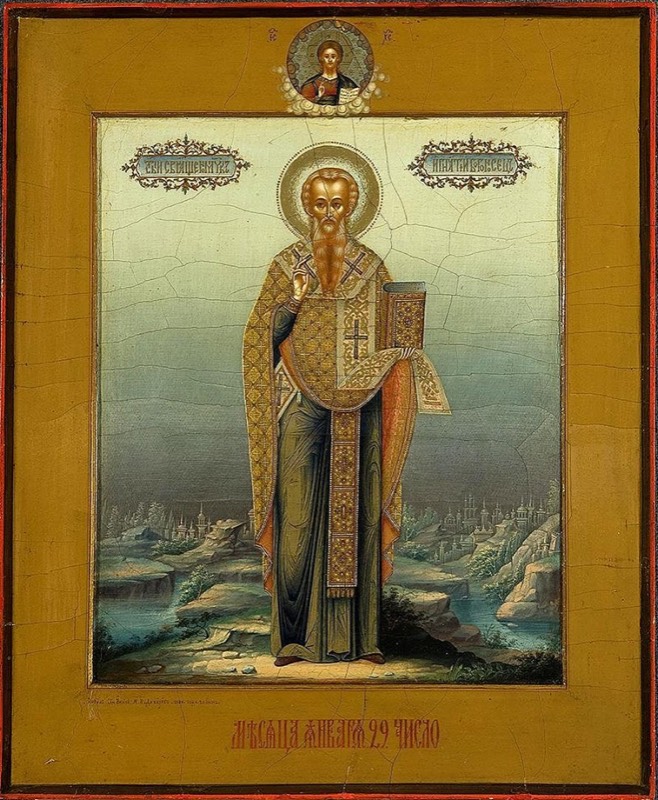
St Ignatius of Antioch (Mar Ignatius Noorono)
Bishop and martyr · Feast: 29 January
Word for the day
“Very truly, I tell you, unless a grain of wheat falls into the earth and dies, it remains just a single grain; but if it dies, it bears much fruit.” John 12:24
Life
Ignatius was bishop of Antioch in Syria, the city where the disciples were first called Christians (Acts 11:26). According to the historian Eusebius, he was the third bishop there, after St Peter and Evodius. He also called himself Theophoros, God-bearer, and the Syriac tradition names him Noorono, the fiery one.
Under the emperor Trajan he was arrested and taken under military guard to Rome to be thrown to wild beasts. On the journey through Asia Minor, at Smyrna and Troas, he wrote seven letters: to the Churches of Ephesus, Magnesia, Tralles, Rome, Philadelphia and Smyrna, and to St Polycarp, bishop of Smyrna. These letters are among the most precious writings of the early Church.
In them Ignatius urges Christians to stay united with their bishop, presbyters and deacons, and to gather around the one Eucharist, which he calls the medicine of immortality. He defends the true humanity of Christ against those who said that He only seemed to suffer. He is the first known writer to use the expression the Catholic Church. To the Christians of Rome he begged that they not try to save him from martyrdom.
He died in Rome around the year 107, torn by beasts in the arena. The Latin Church keeps his memorial on 17 October; the Malankara Church remembers him on 29 January. The patriarchs of Antioch in the Syriac tradition take the name Ignatius in his honour.
Lessons
United with the bishop
Ignatius saw the unity of the Church gathered around the bishop and the Eucharist.
The medicine of immortality
The Eucharist is the food of eternal life.
Fiery love
He longed to be with Christ more than to live.
Christ truly suffered
Our salvation is real, because His flesh was real.
Stories
God's wheat (history)
To the Romans Ignatius wrote that he was God's wheat, to be ground by the teeth of wild beasts so that he might be found the pure bread of Christ.
Ten leopards (history)
He describes his guards as ten leopards, who grew worse the more kindly they were treated, and says he was learning discipleship through their ill treatment.
The child Jesus took in his arms (legend)
A later legend says that Ignatius was the child whom Jesus took in his arms and set among the disciples (Mark 9:36). There is no evidence for this.
Words of the saint
I am the wheat of God, and am ground by the teeth of the wild beasts, that I may be found the pure bread of Christ.
St Ignatius of Antioch, Letter to the Romans 4
Homily
1. The grain of wheat
Dying with Christ bears fruit (John 12:24).
2. One Church, one Eucharist
Unity around the bishop and the altar.
3. Fire of love
Ignatius was eager for Christ.
Dear friends, St Ignatius was bishop of Antioch, the city where the followers of Jesus were first called Christians. Around the year 107 he was arrested and taken to Rome to die in the arena.
On the way he wrote seven letters. He begged the Christians of Rome not to save him, saying he was God's wheat, to be ground by the teeth of beasts to become the pure bread of Christ. He had understood the words of Jesus: unless a grain of wheat falls into the earth and dies, it remains just a single grain; but if it dies, it bears much fruit (John 12:24).
In his letters Ignatius asks Christians to remain united with their bishop and to gather around the one Eucharist, which he calls the medicine of immortality. Division weakens the Church; unity around Christ makes it strong.
Let us ask St Ignatius for his fiery love: love for Christ, love for the Eucharist, love for the unity of the Church. And let us pray for Christians who are persecuted for their faith today. Amen.
Prayer
Lord God, you made St Ignatius of Antioch burn with love for your Son even to martyrdom; through his prayers help us to love the unity of your Church, to hunger for the Bread of Life, and to give our lives for you. Amen.