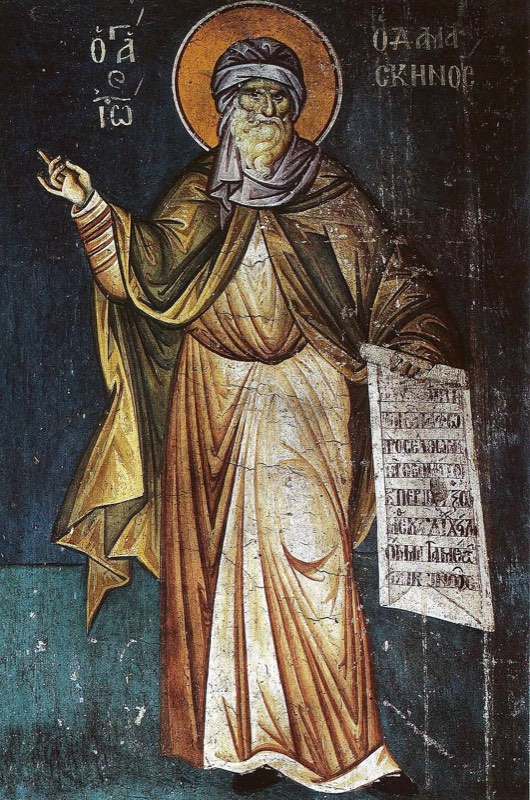
St John of Damascus
Monk, theologian and hymn writer, Doctor of the Church · Feast: 4 December
Word for the day
“And the Word became flesh and lived among us, and we have seen his glory, the glory as of a father's only son, full of grace and truth.” John 1:14
Life
John was born around 675 in Damascus into a Christian family that served in the financial administration of the Muslim caliphs. He received a fine education and himself held office at the court.
Around the beginning of the eighth century he left public life and became a monk at the monastery of Mar Saba near Jerusalem, where he was ordained a priest. There he prayed, studied and wrote.
When the Byzantine emperor Leo III began to forbid and destroy holy images, John wrote three famous defences of the icons. He argued that since the invisible God became visible in Christ, who took flesh, we may make images of Christ and the saints, honouring them without worshipping them. His great work The Fount of Knowledge sums up the faith of the Greek Fathers, and many of his hymns are still sung in the Eastern Churches.
He died around 749 at Mar Saba. Pope Leo XIII declared him a Doctor of the Church in 1890.
Lessons
Because God became visible
The Incarnation is the foundation of sacred images.
Honour, not worship
We venerate images; we adore God alone.
Faith that sings
Theology can become hymns.
Stories
Defender of icons (history)
From the safety of the monastery, outside the emperor's control, John wrote that he did not worship matter, but the Creator of matter who became matter for his sake.
Homily
1. God made Himself visible
The Word became flesh (John 1:14).
2. Icons and the faith
Images help us remember and pray.
3. A theologian who prayed
Study joined to worship.
Dear friends, St John of Damascus was a Christian who held office in the court of the caliphs, and then left everything to become a monk near Jerusalem.
In his time, an emperor ordered holy images to be destroyed. John defended them with a simple argument: in Christ the invisible God became visible. Because the Word became flesh (John 1:14), we can paint His face. When we honour an icon, our honour goes to the person it shows.
Our Church loves the holy images, the Cross and the vestments, because they help us remember the mysteries of salvation. But we never worship images; we adore God alone.
John also wrote hymns still sung in the East. His theology was prayer. During this fast, let us look at an icon of Christ or of Mary and pray before it, giving thanks that God has shown us His face. Amen.
Prayer
Lord, through the prayers of St John of Damascus, may the true faith he taught be our light, and may we always honour the mystery of your Word made flesh. Amen.