St Josaphat
Eastern Catholic Archbishop of Polotsk, martyr for the unity of the Church · Feast: 12 November
Word for the day
“That they may all be one. As you, Father, are in me and I am in you, may they also be in us, so that the world may believe that you have sent me.” John 17:21
Life
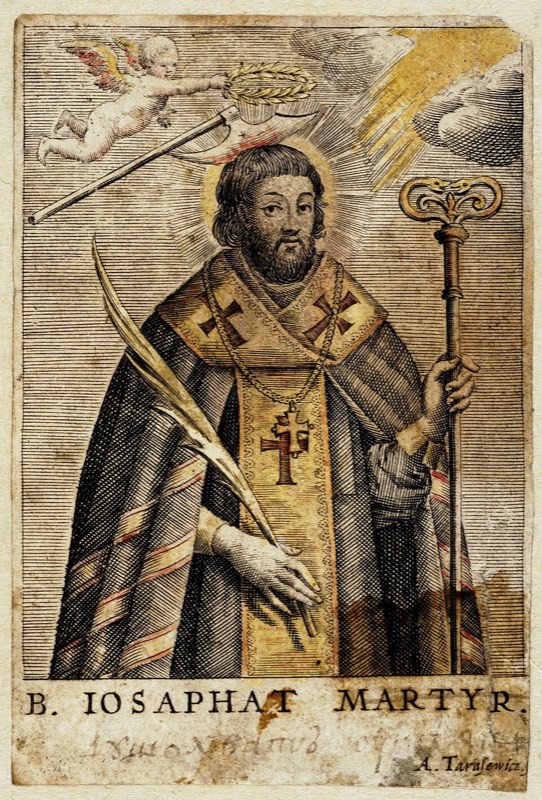
John Kuntsevych was born around 1580 in Volodymyr in Volhynia (in present-day Ukraine), in a family of the Byzantine rite. In 1596, by the Union of Brest, many bishops of the Ruthenian Church entered into full communion with Rome while keeping their own Eastern liturgy and traditions. As a young man John embraced this union with conviction.
In 1604 he became a monk of the Order of St Basil at the monastery of the Holy Trinity in Vilnius, taking the name Josaphat. He was known for his prayer, his fasting and his preaching. He became archimandrite, and in 1618 Archbishop of Polotsk. He restored churches, taught the catechism, cared for the poor and worked tirelessly to bring Christians of his region into the unity of the Catholic Church while defending the Eastern liturgy.
Feelings ran high among those who opposed the union. On 12 November 1623, in Vitebsk, a mob broke into his residence and killed him. He was beatified in 1643 and canonised in 1867, the first Eastern Catholic to be canonised through a formal process of the Roman Curia. Since 1963 his relics have rested in St Peter's Basilica in Rome.
Lessons
Unity is worth a life
Josaphat lived and died for Christ's prayer that all may be one.
Eastern and Catholic
He shows that one can be fully Catholic while keeping one's own Eastern liturgy and heritage; a lesson dear to the Syro-Malabar and Syro-Malankara Churches.
Love even the enemy
Tradition remembers that he asked his people not to harm his attackers.
Stories
A martyr for communion (history)
Josaphat was killed in Vitebsk in 1623 by opponents of the Union of Brest, and his body was thrown into the river Dvina. It was later recovered and venerated.
Homily
1. That they may all be one
Jesus prayed for the unity of his disciples (John 17:21). Josaphat gave his life for that prayer.
2. Eastern and fully Catholic
He kept the Byzantine liturgy while living in full communion with Peter: a mirror for the Syro-Malabar and Syro-Malankara Churches.
3. Love even the attacker
Tradition remembers that he asked his people not to harm those who came to kill him.
Dear friends, on the night before he died Jesus prayed: that they may all be one, as you, Father, are in me and I in you, so that the world may believe (John 17:21). Division among Christians wounds that prayer. St Josaphat gave his life to heal it.
He was a monk and archbishop of the Byzantine tradition who embraced full communion with the Bishop of Rome while keeping his Eastern liturgy, spirituality and customs. For us in Kerala this is a familiar story: the Syro-Malabar and Syro-Malankara Churches are fully Catholic and proudly Eastern. Josaphat shows that this is not a compromise but a gift.
Opponents of unity killed him in 1623. Tradition says he asked his people not to harm his attackers. Let us pray today for the unity of all Christians, love our own liturgical tradition, and refuse to speak with contempt of any other Church. Unity begins in the way we speak. Amen.
Prayer
Lord, stir up in your Church the Spirit that filled St Josaphat when he laid down his life for the sheep. Through his prayers, may we be strengthened by the same Spirit and not be afraid to give our lives for others. Amen.