St Juan Diego Cuauhtlatoatzin
Indigenous layman of Mexico, messenger of Our Lady of Guadalupe · Feast: 9 December
Word for the day
“he has brought down the powerful from their thrones, and lifted up the lowly;” Luke 1:52
Life
Juan Diego Cuauhtlatoatzin was born around 1474 among the Chichimeca people near present-day Mexico City. He was baptised as an adult by Franciscan missionaries in the 1520s, together with his wife, and walked long distances to attend Mass and catechism.
In December 1531, according to the tradition of the Church in Mexico, the Virgin Mary appeared to him on the hill of Tepeyac, speaking to him in his own Nahuatl language and asking that a church be built there. The bishop, Fray Juan de Zumárraga, asked for a sign.
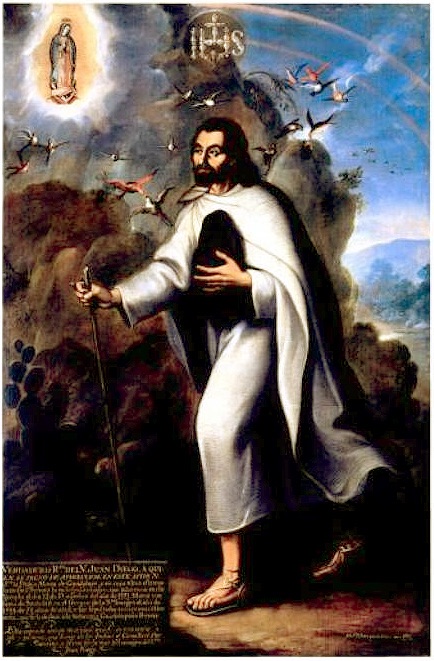
On 12 December Mary told Juan Diego to gather flowers on the hilltop, though it was winter. He carried them in his tilma, a cloak of cactus fibre, to the bishop. When he opened it, the flowers fell out and an image of Our Lady was seen on the cloth. That tilma is venerated today in the Basilica of Guadalupe.
Juan Diego spent the rest of his life near the chapel built at Tepeyac, caring for it and telling pilgrims of the Virgin's message. He died in 1548. Pope John Paul II canonised him in Mexico City in 2002.
Lessons
God chooses the humble
Mary sent a poor indigenous man to the bishop.
Faith in one's own culture
Mary spoke his language and wore the dress of his people.
Perseverance
Juan Diego returned to the bishop again and again.
Care for the sick
He hurried to find a priest for his dying uncle.
Stories
The roses in winter (tradition)
According to the tradition, Mary told Juan Diego to gather flowers from the frozen hilltop and carry them to the bishop in his tilma. When he opened it, the image of the Virgin appeared on the cloth.
Am I not here, who am your mother? (tradition)
When Juan Diego took another road to avoid Mary because his uncle was dying, she met him and comforted him with words remembered in the Nican Mopohua account: am I not here, who am your mother? His uncle was healed.
Homily
1. A messenger from the poor
God chose a humble layman to speak to the bishop.
2. Mary speaks our language
The Gospel enters every culture.
3. Obedience and perseverance
Juan Diego kept going even when he was not believed.
Dear friends, St Juan Diego was a poor indigenous man in Mexico, baptised as an adult, who walked many miles to attend Mass. In 1531, according to the tradition of the Church in Mexico, the Virgin Mary appeared to him on the hill of Tepeyac and sent him to the bishop with a message.
Notice whom Mary chose: not a rich Spaniard or a learned priest, but a humble layman of a conquered people. As Mary sang in the Magnificat, God lifts up the lowly (Luke 1:52).
Mary spoke to him in his own language and appeared with the features and dress of his people. The Gospel is not foreign to any culture. Christ wants to be at home in every people, in Mexico, in India and everywhere.
Juan Diego was not believed at first, but he persevered, and his tilma with the image of Our Lady became a sign for millions. Let us ask him to help us carry God's message humbly and faithfully, even when we are not believed. Amen.
Prayer
Lord, through St Juan Diego you showed your love for the humble and the poor; grant that, following his example, we may welcome Mary's message and bring Christ to every people. Amen.