St Jude Thaddeus, Apostle
One of the Twelve, patron of difficult and desperate causes; feast kept with St Simon the Zealot · Feast: 28 October
Word for the day
“But you, beloved, build yourselves up on your most holy faith; pray in the Holy Spirit; keep yourselves in the love of God; look forward to the mercy of our Lord Jesus Christ that leads to eternal life.” Jude 20–21
Life
Jude was one of the twelve apostles whom Jesus chose after spending the whole night in prayer on the mountain (Luke 6:12–16). Luke calls him “Judas son of James”; Matthew and Mark name, in the same place in their lists, an apostle called Thaddaeus, and the Church has long understood these to be the same man. That is why he is known as Jude Thaddeus. The Gospels take care to distinguish him from Judas Iscariot, who betrayed the Lord.
John's Gospel keeps one question of his, asked at the Last Supper: “Lord, how is it that you will reveal yourself to us, and not to the world?” (John 14:22). Jesus answered that the Father and the Son will come and make their home with everyone who loves him and keeps his word (John 14:23). After the Ascension, Jude was with Mary and the other apostles in the upper room, devoted to prayer as they waited for the Holy Spirit (Acts 1:13–14).
The short Letter of Jude in the New Testament is written by “Jude, a servant of Jesus Christ and brother of James” (Jude 1). Tradition has attributed it to the apostle; some scholars think of another Jude, a relative of the Lord. The letter urges Christians to “contend for the faith that was once for all entrusted to the saints” (Jude 3), asks mercy for those who waver, and ends with one of the most beautiful hymns of praise in the Bible (Jude 24–25).
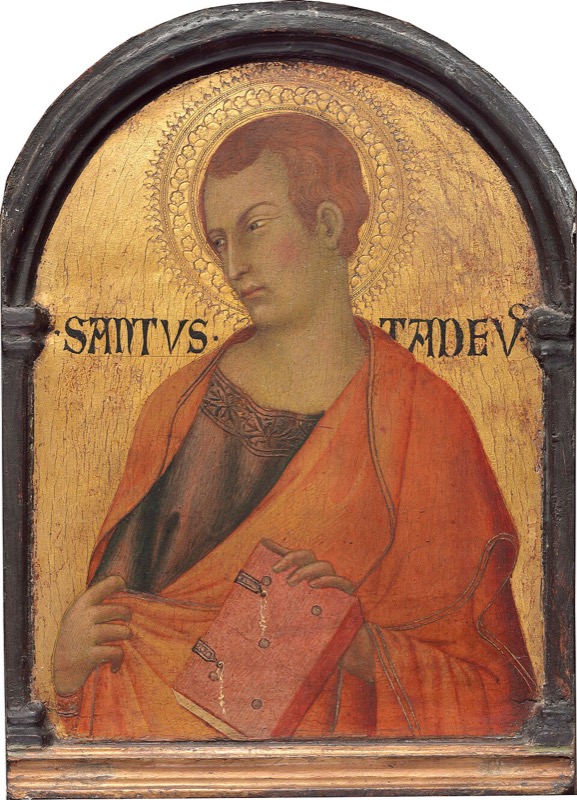
According to ancient tradition, Jude preached the Gospel in Mesopotamia and Persia together with Simon the Zealot, and both died as martyrs there. This is why the Roman calendar keeps their feast together on 28 October. Their relics are venerated in St Peter's Basilica in Rome. In art Jude is usually shown with a club, an axe or a halberd, the instrument of his martyrdom according to tradition, and often with a medallion bearing the face of Christ.
Popular devotion has made him the patron of difficult and desperate causes. A common explanation is that, because his name sounded like the traitor's, Christians for centuries seldom prayed to him, so that he came to be invoked when every other help seemed to have failed. In Kerala, as in many parts of the world, great crowds come to his shrines and to the weekly novena in his honor, bringing their burdens of sickness, debt, unemployment and family trouble.
Lessons
An apostle who asked
Jude's one recorded question led Jesus to promise that God makes his home in those who love him (John 14:22–23).
Hidden but faithful
Little is written about him, yet he gave his whole life. Holiness does not need fame.
Guard the faith, show mercy
His letter asks us to contend for the faith and to have mercy on those who waver (Jude 3, 22).
No cause is hopeless with God
True devotion to Jude leads us to Christ, for nothing will be impossible with God (Luke 1:37).
Stories
The question at the Last Supper (history)
On the night before he died, Jesus spoke of showing himself to his disciples. Jude asked why only to them and not to the whole world. Jesus answered that the Father and he would come and make their home in everyone who loves him and keeps his word (John 14:22–23).
The face of Christ sent to Edessa (legend)
An ancient legend tells that King Abgar of Edessa, who was sick, wrote to Jesus asking him to come and heal him. After the Ascension, a disciple named Thaddaeus was sent to him; the king was healed and many in Edessa believed. Eusebius records an early form of the story in the fourth century; later versions add that Thaddaeus carried a cloth bearing the face of Christ. The story is legendary, but it explains why St Jude is so often shown with the face of Christ on his breast.
The forgotten saint (tradition)
Devotion to St Jude spread widely in later centuries. It is often said that St Bridget of Sweden (fourteenth century) was told in prayer to turn to him with great confidence. Ever since, people who had lost hope have prayed to him, and many have given thanks for help received. That is why so many newspapers carry small notes of thanks to St Jude.
Words of the saint
“Now to him who is able to keep you from falling, and to make you stand without blemish in the presence of his glory with rejoicing, to the only God our Savior, through Jesus Christ our Lord, be glory, majesty, power, and authority, before all time and now and forever. Amen.”
Jude 24–25
“Lord, how is it that you will reveal yourself to us, and not to the world?”
St Jude, John 14:22
The Letter of Jude invites us to live our faith with coherence, building ourselves up in it and praying in the Holy Spirit.
Pope Benedict XVI, General Audience on Sts Simon and Jude, 11 October 2006, in substance
Homily · Feast sermon: the forgotten saint and the God who comes to live with us
1. The saint who was forgotten
He carried the same name as the traitor, and for centuries few prayed to him. God loves to raise up what others pass by (Psalm 118:22).
2. One honest question
Lord, why to us and not to the world? Jesus answers: we will come and make our home with those who love me (John 14:22–23). God does not solve our problems from far away; he comes to live in our house.
3. Contend for the faith, without giving up
Jude writes to Christians in hard times: build on your faith, pray in the Spirit, keep yourselves in God's love, wait for his mercy (Jude 3, 20–21).
4. Devotion that leads to Christ
Jude carries the face of Christ on his breast. True devotion includes Confession, the Holy Mass / Holy Qurbana, perseverance and thanksgiving; it never uses threats or chain prayers.
5. Become a St Jude for someone
Hope does not disappoint us (Romans 5:5). Visit, help and pray with one person who has lost hope.
Dear brothers and sisters, today the Church remembers two apostles, St Simon the Zealot and St Jude Thaddeus. In our land few feasts draw such crowds as this one. People come to St Jude carrying burdens they can no longer carry alone: an illness the doctors cannot cure, a debt that keeps growing, a son who cannot find work, a daughter whose marriage is breaking, a court case that never ends, a child far away who no longer calls. They come because they have heard that St Jude is the saint of hopeless cases. Some of you are here today with such a burden. Let us ask: who is this apostle, and what does he want to teach us?
Jude was chosen by Jesus after a whole night of prayer on the mountain (Luke 6:12–16). His name was Judas, a good and proud name in Israel, the name of the patriarch Judah. But after that terrible night of betrayal, the same name became a shadow. The Gospel writers are careful to say: Judas, not Iscariot (John 14:22). Imagine carrying for your whole life the name of the man who sold the Lord. Perhaps that is why, for many centuries, few Christians prayed to him. The saint who was forgotten became the saint of the forgotten. This is God's way: the stone that the builders rejected has become the chief cornerstone (Psalm 118:22). If you feel forgotten today, by your family, by society, even by God, look at St Jude. God does not forget.
The Gospel keeps only one sentence from Jude's lips. At the Last Supper he asked: Lord, how is it that you will reveal yourself to us, and not to the world? (John 14:22). Perhaps he wanted Jesus to show himself in power, to astonish the crowds, to defeat the enemies. Jesus answered with a quieter and deeper promise: those who love me will keep my word, and my Father will love them, and we will come to them and make our home with them (John 14:23). This is the heart of our faith. Jude does not lead us to a God who solves problems from far away, like an official who signs a file. He leads us to a God who comes to live in our house, in our sickness, in our debt, in our sorrow. Before he changes our situation, he wants to make his home in our heart.
Later Jude wrote a short letter to Christians who were living in hard times, confused by false teachers and tempted to give up. He told them to contend for the faith that was once for all entrusted to the saints (Jude 3). And he gave them four simple instructions: build yourselves up on your most holy faith; pray in the Holy Spirit; keep yourselves in the love of God; look forward to the mercy of our Lord Jesus Christ (Jude 20–21). These are not magic formulas. They are the road of a Christian who does not give up: stay rooted in the faith of the Church, keep praying even when the heavens seem silent, remain in God's love, and keep waiting for his mercy. Then he adds: have mercy on some who are wavering (Jude 22). The one who has received hope must pass it on.
So let us honor St Jude in the right way. A novena is not a coin put into a machine to get what we want. It is nine days, or nine weeks, of walking with God in faith. True devotion to St Jude brings us to Confession, to the Holy Mass / Holy Qurbana, to the Word of God and to works of charity. It perseveres when the answer is slow. It gives thanks when help comes, and it trusts when the answer is different from what we asked. Let us also be clear: chain prayers that threaten misfortune if we do not copy them, or promise success if we publish them a certain number of times, are not Catholic faith; they are superstition. Look at the images of St Jude: on his breast he carries the face of Christ. He never points to himself. He always points to Jesus.
Dear friends, with God no cause is hopeless. Hope does not disappoint us, because God's love has been poured into our hearts through the Holy Spirit (Romans 5:5). And today let each of us become a St Jude for someone else. Somewhere near you is a person who has lost hope: a neighbor in debt, a young person without work, a family in the hospital corridor. Visit them, help them, pray with them. Let us end with the words that close St Jude's letter: to him who is able to keep you from falling, and to make you stand without blemish in the presence of his glory with rejoicing, be glory, majesty, power and authority, now and forever (Jude 24–25). St Jude and St Simon, pray for us. Amen.
Homily option 2 · In the light of the Word: build yourselves up in faith (Jude 20–25)
1. Build on your most holy faith
Faith is a house built day by day on the rock of Christ (Jude 20; Matthew 7:24).
2. Pray in the Holy Spirit
When we do not know how to pray, the Spirit prays in us (Jude 20; Romans 8:26).
3. Keep yourselves in God's love
Abide in my love (John 15:9): stay where his love can reach you.
4. Mercy for those who waver
Have mercy on those who doubt; pull them back gently (Jude 22–23).
5. He is able to keep you from falling
Our strength is not our own; God holds us up (Jude 24).
Dear friends, the Letter of St Jude is one of the shortest books of the Bible, only one chapter. Yet at its end it gives a complete little program for the Christian life: but you, beloved, build yourselves up on your most holy faith; pray in the Holy Spirit; keep yourselves in the love of God; look forward to the mercy of our Lord Jesus Christ that leads to eternal life (Jude 20–21).
Build yourselves up. Faith is not a feeling that comes and goes; it is a house built day by day. Jesus said that the wise man built his house on rock, and when the rain fell and the floods came, it did not fall (Matthew 7:24–25). We build with prayer, with Scripture, with the Sacraments, with the teaching of the Church. When the storm comes, it is too late to begin the foundation.
Pray in the Holy Spirit. Often we do not know what to ask, or our prayer feels dry. St Paul says that the Spirit helps us in our weakness, for we do not know how to pray as we ought (Romans 8:26). Then keep yourselves in the love of God. Jesus said: abide in my love (John 15:9). We cannot make God love us; he already does. But we can stay where his love reaches us, or we can walk away from it into sin.
Jude also asks us to have mercy on some who are wavering, and to save others by snatching them out of the fire (Jude 22–23). Around us are people whose faith is shaking: a friend who has stopped going to Church, a young person full of doubts. Do not condemn them. Pray for them, listen to them, and gently bring them back.
And finally, the beautiful praise: to him who is able to keep you from falling (Jude 24). Our perseverance does not depend on our strength. God is able to keep us. On this feast let us thank him for the faith that the apostles handed down to us, and at this Holy Mass / Holy Qurbana let us offer ourselves to him who is able to keep us from falling. Amen.
Homily option 3 · For those who carry heavy burdens: hope when all seems lost
1. Bring everything to God
Do not worry about anything, but in everything by prayer let your requests be made known to God (Philippians 4:6).
2. Hope is not wishful thinking
Suffering produces endurance, character and hope, and hope does not disappoint (Romans 5:3–5).
3. God answers in his own way
My grace is sufficient for you (2 Corinthians 12:9): sometimes he removes the burden, sometimes he gives strength to carry it.
4. Give thanks, then give help
The healed leper returned to give thanks (Luke 17:15–16); our gratitude becomes help for others.
Dear brothers and sisters, many of you have come today with a heavy heart. You have prayed, you have tried everything, and still the door has not opened. Some have walked here on foot, some have lit candles, some have made a vow. St Jude understands. That is why he is called the patron of difficult and desperate causes. But what does God want to say to you today?
First: bring everything to God. St Paul writes: do not worry about anything, but in everything by prayer and supplication with thanksgiving let your requests be made known to God (Philippians 4:6). Nothing is too small or too shameful to bring to him: the debt you hide from your relatives, the addiction in your home, the fear in the night. St Jude prays with you, but it is to God that he leads you.
Second: Christian hope is not wishful thinking. St Paul says that suffering produces endurance, endurance produces character, and character produces hope, and hope does not disappoint us, because God's love has been poured into our hearts (Romans 5:3–5). Hope is not the certainty that everything will go as I want. It is the certainty that God loves me and will not abandon me, whatever happens.
Third: God answers in his own way. Sometimes he removes the burden quickly, and we come back with flowers and thanksgiving. Sometimes, as with St Paul, he says: my grace is sufficient for you, for power is made perfect in weakness (2 Corinthians 12:9). Then he does not take away the cross, but he gives us the strength to carry it, and he carries it with us. Both are answers. Both are love.
Finally: when help comes, do not forget to give thanks. Of the ten lepers healed, only one came back to thank Jesus (Luke 17:15–18). And let your gratitude become help for others. The best thanksgiving to St Jude is not only a notice in the newspaper, but a hand stretched out to someone who is where you were. Go in peace, and know that you are not alone. St Jude, pray for us. Amen.
Prayer
Lord God, through the apostles you brought us to the knowledge of your name. By the prayers of St Jude Thaddeus and St Simon, make your Church grow in faith and love; and give to all who are burdened and without hope the help they need, and the grace to trust in you always. Through Christ our Lord. Amen.