St Martin of Tours
Soldier, monk and Bishop of Tours · Feast: 11 November
Word for the day
“I was naked and you gave me clothing, I was sick and you took care of me, I was in prison and you visited me.” Matthew 25:36
Life
Martin was born around 316 at Sabaria in Pannonia (today Szombathely in Hungary), the son of a Roman army officer, and grew up in Pavia in Italy. Drawn to Christ as a boy, he became a catechumen, but as an officer's son he was enrolled in the army at fifteen. His life was written by his friend Sulpicius Severus, who knew him personally.
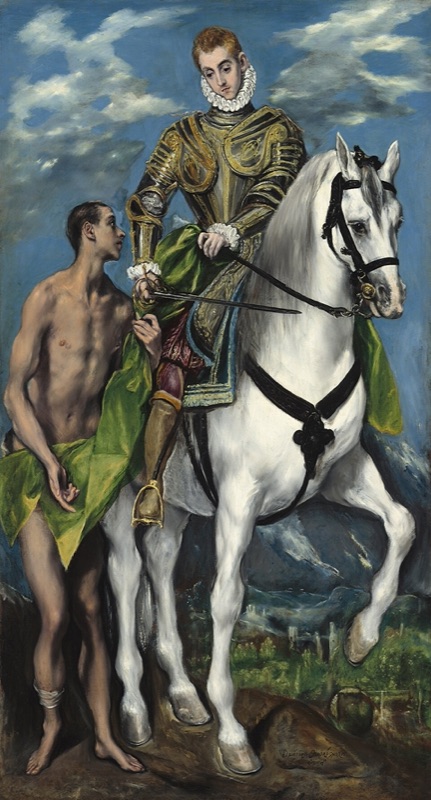
At Amiens, on a freezing winter day, Martin cut his military cloak in two and gave half to a poor man begging at the city gate. That night, Sulpicius tells us, he saw Christ in a dream wearing the half-cloak and saying that Martin, still a catechumen, had clothed him. Martin was baptised soon afterwards. He later left the army, saying he was now a soldier of Christ, and became a disciple of St Hilary of Poitiers. Around 361 he founded at Ligugé one of the first monasteries in Gaul.
In 371 the people of Tours made him their bishop, against his wishes. He lived as a monk at Marmoutier outside the city, travelled through the countryside preaching to the rural people, and cared for the poor and prisoners. He died at Candes on 8 November 397 and was buried at Tours on 11 November. He was one of the first saints honoured who was not a martyr.
Lessons
Share what you have
Martin did not give the whole cloak; he gave what he could at once, and Christ accepted it as given to himself.
Seeing Christ in the poor
His dream is a living commentary on Matthew 25: whatever we do to the least, we do to Christ.
Humble authority
Even as a bishop he kept the simple life of a monk and served the people himself.
Stories
The divided cloak (tradition)
At the gate of Amiens Martin shared his cloak with a freezing beggar and that night saw Christ wearing it. The story comes from his contemporary biographer Sulpicius Severus.
Betrayed by the geese (legend)
A later legend says that Martin hid in a goose pen to avoid being made bishop, but the cackling geese gave him away. This is why goose is eaten on St Martin's Day in parts of Europe.
Words of the saint
Lord, if your people still need me, I do not refuse the work; your will be done.
St Martin of Tours on his deathbed, as reported by Sulpicius Severus, in substance
Homily
1. Half a cloak
Martin gave what he could at that moment. Generosity does not wait until we have plenty.
2. You did it to me
I was naked and you clothed me (Matthew 25:36). That night Martin saw Christ wearing his cloak.
3. A soldier of Christ
He left one army to serve another: a monk and bishop who kept the simple life and served the poor himself.
Dear friends, on a freezing day at the gate of Amiens a young Roman soldier saw a beggar shivering. He had no money with him, only his military cloak. So he took his sword, cut the cloak in two, and gave half away. That night, his biographer tells us, Martin saw Christ in a dream wearing that half-cloak.
Jesus had said: I was naked and you gave me clothing (Matthew 25:36). Martin did not give the whole cloak; he gave what he could at that moment, and Christ received it as given to himself. Generosity does not wait until we have plenty. It begins with the half-cloak we have now.
Martin later became a monk and a bishop, yet he kept the simple life of a monk and went himself to the poor and the prisoners. Let us be like him this week: give one warm garment, one meal, one hour of company to someone in need, and remember whom we are really clothing. Amen.
Prayer
Lord God, St Martin of Tours glorified you by his life and by his death. Renew in our hearts the wonders of your grace, so that neither life nor death may separate us from your love. Amen.