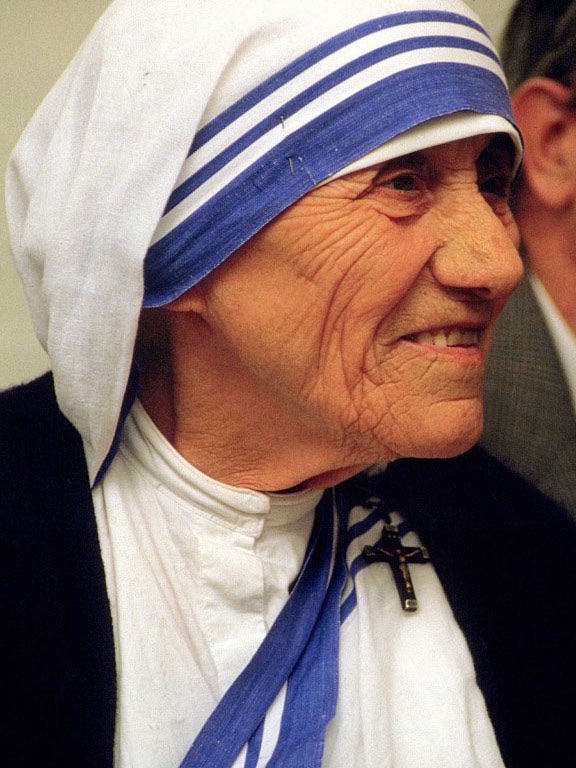
St Teresa of Calcutta (Mother Teresa)
Founder of the Missionaries of Charity · Feast: 5 September
Word for the day
“After this, when Jesus knew that all was now finished, he said (in order to fulfill the scripture), “I am thirsty.”” John 19:28
Life
Agnes Gonxha Bojaxhiu was born on 26 August 1910 in Skopje. At eighteen she joined the Sisters of Loreto and came to India in 1929, where she taught for many years at St Mary's School in Kolkata.
On 10 September 1946, on a train to Darjeeling, she received what she called a “call within the call”: to serve Christ in the poorest of the poor. In 1948 she began work in the slums, and in 1950 founded the Missionaries of Charity. She opened a home for the dying at Kalighat, homes for abandoned children, lepers and the sick, and her sisters spread throughout the world. In every chapel of her congregation the words of Jesus on the Cross are written beside the crucifix: “I thirst.”
She received the Nobel Peace Prize in 1979. After her death it became known that for many years she had lived in deep interior darkness, without feeling God's presence, yet faithful in prayer and service. She died in Kolkata on 5 September 1997, was beatified in 2003 and canonised by Pope Francis on 4 September 2016.
Lessons
Jesus thirsts for love
Behind all her work was Jesus' cry “I thirst”: thirst for souls and for love.
Small things with great love
She taught that what matters is not the size of the work but the love put into it.
See Christ in the poor
She served Jesus “in the distressing disguise of the poorest of the poor”.
Faithful in darkness
Even without consolation she kept praying and loving; faith is more than feelings.
Stories
The first patient (history)
In her early days she found a dying woman on a Kolkata street, partly eaten by rats and ants, whom a hospital would not take. She stayed with her until she died. Out of such encounters grew the home for the dying at Kalighat, Nirmal Hriday.
“Love begins at home” (history)
Receiving the Nobel Prize, she asked that the money for the banquet be given to the poor, and spoke of the poverty of loneliness in rich countries, urging families to love one another first at home.
Words of the saint
“The fruit of silence is prayer. The fruit of prayer is faith. The fruit of faith is love. The fruit of love is service. The fruit of service is peace.”
St Teresa of Calcutta
“We ourselves feel that what we are doing is just a drop in the ocean. But the ocean would be less because of that missing drop.”
St Teresa of Calcutta
Homily · The saint's life and message
1. A call within the call
10 September 1946, on a train to Darjeeling.
2. The poorest of the poor
Kalighat, abandoned children, lepers, the dying.
3. I thirst
Jesus' thirst for love and souls (John 19:28).
4. Faithful in darkness
Years of interior darkness, lived with a smile.
Dear brothers and sisters, St Teresa of Calcutta, Mother Teresa, is known all over the world. Yet her greatness was in very small things done with great love.
Agnes Bojaxhiu came from Skopje to India in 1929 as a Loreto sister and taught for many years in Kolkata. On 10 September 1946, travelling by train to Darjeeling, she heard what she called a call within the call: to serve Christ in the poorest of the poor. In 1950 she founded the Missionaries of Charity.
She opened a home for the dying at Kalighat, homes for abandoned children, the sick and lepers. In every chapel of her congregation are written the words of Jesus on the Cross: I thirst (John 19:28). She believed that Jesus thirsts for our love, and that we satisfy His thirst by loving Him in the poor.
After her death we learned that for decades she lived in deep interior darkness, without feeling God's presence, yet she kept smiling and serving. Her faith was not a feeling; it was a choice. Let us ask her to help us do small things with great love, and to remain faithful even in darkness.
Homily option 2 · In the light of the Word: I thirst
1. The thirst of Jesus
On the Cross Jesus said: I thirst (John 19:28).
2. Give me a drink
Jesus asked the Samaritan woman (John 4:7).
3. You gave me drink
I was thirsty and you gave me something to drink (Matthew 25:35).
4. Rivers of living water
Christ satisfies our thirst (John 7:37–38).
Dear friends, among the last words of Jesus on the Cross was: I thirst (John 19:28). Mother Teresa placed these words beside the crucifix in every chapel of her congregation. She believed that Jesus thirsts not only for water but for love and for souls.
At the well of Samaria Jesus said to a woman: give me a drink (John 4:7). The Son of God asks for our love. He waits for it, as a beggar waits. Mother Teresa answered that request every day in prayer and in service.
Jesus said: I was thirsty and you gave me something to drink (Matthew 25:35). In the dying man on the street, the leper and the abandoned child, Mother Teresa saw Jesus in what she called His distressing disguise. When she gave them water, she gave it to Christ.
And Jesus also said: let anyone who is thirsty come to me; out of the believer's heart shall flow rivers of living water (John 7:37–38). Mother Teresa could serve so much because she drank first from Christ in the Eucharist and adoration. Let us do the same: receive Him at the Holy Mass / Holy Qurbana, then give Him to others.
Homily option 3 · For young people and families: love begins at home
1. Love begins at home
Mother Teresa's advice to families.
2. Small things with great love
Faithfulness in little things.
3. The poverty of loneliness
The unloved in our own homes.
4. Smile
A smile is the beginning of love.
Dear families, when people asked Mother Teresa how they could help her work, she often said: love begins at home. Before going to Kolkata, find your own Kolkata: the lonely, the forgotten, the unloved in your own family.
She said that the greatest poverty in the West is loneliness and the feeling of being unwanted. That poverty exists in our homes too: an elderly parent who no one talks to, a teenager who feels misunderstood, a spouse who feels taken for granted. Give them time and attention.
She also said: we cannot all do great things, but we can do small things with great love. Washing dishes, helping with homework, listening to a sad friend, visiting a sick neighbour: these are not small if done with love.
Young people, Mother Teresa said that a smile is the beginning of love. Smile at your parents, your siblings, the person no one notices in class. And pray every day, even briefly, because she said the fruit of prayer is faith, and the fruit of faith is love, and the fruit of love is service.
Prayer
Lord Jesus, you thirst for love on the Cross. Through the prayers of St Teresa of Calcutta, give us eyes to see you in the poor, hands to serve you, and hearts that do small things with great love. Amen.