St Basil the Great
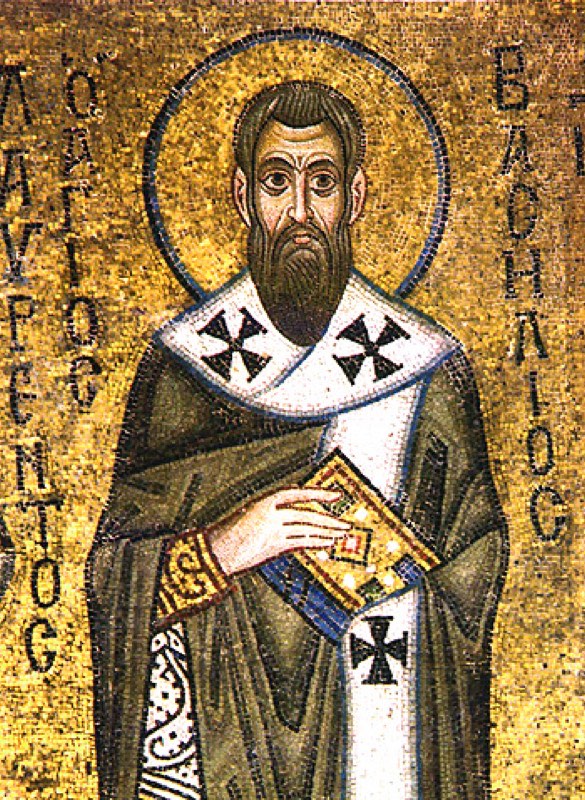
| Time | Born about 330 (some say 329), died 1 January 379 (the year is debated) |
|---|---|
| Where | Caesarea in Cappadocia (today Kayseri, Turkey); Pontus (today northern Turkey); studies at Constantinople (today Istanbul) and Athens (Greece) |
| What he was | Bishop, monk, theologian, preacher, founder of houses of mercy |
| Language | Greek |
| Known as | Basil the Great; in Syriac usage Mar Baselios; "father of Eastern monasticism" |
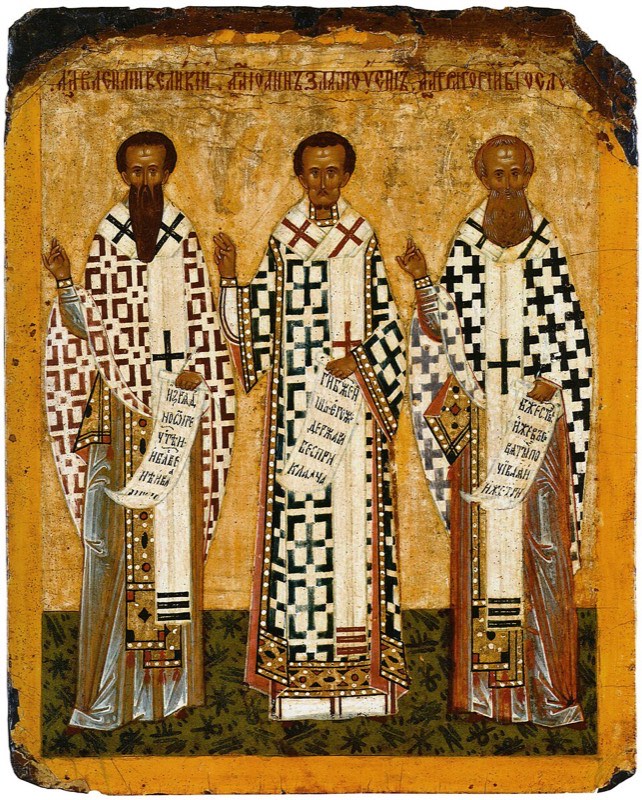
| Honoured | Saint. Doctor of the Church, one of the four great Eastern Doctors recognized by St Pius V in 1568. Latin Church: 2 January, with St Gregory Nazianzen (from the 13th century to 1969 it was 14 June). Byzantine tradition: 1 January, and 30 January with St Gregory and St John Chrysostom as the Three Holy Hierarchs. Syro-Malankara calendar: 2 January, Mar Baselios and Mar Gregorios. |
His life
A family of saints. Basil was born about 330 at Caesarea in Cappadocia. Benedict XVI calls his home "a true domestic Church". His father, Basil the Elder, taught rhetoric. His mother, Emmelia, was the daughter of a martyr. His father's family had fled to the mountains of Pontus during the persecution under Maximinus and lived in hiding for about seven years. His grandmother, St Macrina the Elder, passed on the faith she had received from the circle of St Gregory the Wonderworker. There were ten children. Among those honoured as saints are his sister St Macrina and his brothers St Gregory of Nyssa, St Peter of Sebaste and Naucratius.
Athens. He studied at Caesarea, then at Constantinople, then at Athens, the university of the Greek world. There he met St Gregory Nazianzen. Gregory saved him from the hazing that new students suffered. Their friendship became famous. In Gregory's words at Basil's funeral they "seemed to have one soul, inhabiting two bodies" (Oration 43, 20). Gregory says Basil knew rhetoric, grammar, philosophy, astronomy, geometry and medicine.
The awakening. He came home proud of what he knew. His sister Macrina, already living as a nun, was a challenge to him, and the Bishop Dianius also moved him. He later wrote: "Much time had I spent in vanity", and then, "like a man roused from deep sleep, I turned my eyes to the marvellous light" (Letter 223, 2). He gave up his career and went to see the monks in Egypt, Palestine, Syria and Mesopotamia.
Monk in Pontus. About 358 he settled by the river Iris in Pontus, near his family's estate at Annesi, where his mother and Macrina were already leading a community of women. He invited Gregory to join him. According to the old tradition, the two gathered the Philocalia, an anthology from Origen. He began writing rules for community life.
Priest. In 360 he went to Constantinople with the delegates of Cappadocia. In about 363 Bishop Eusebius of Caesarea ordained him a priest. The two soon had trouble, and Basil went back to Pontus. In about 365 he returned to help, when the Emperor Valens was pressing the Arian cause. From then on he was in effect leading the diocese. In about 364 he had written his three books Against Eunomius. In a time of severe famine he gathered the hungry and served them food with his own hands (Oration 43, 34 to 36).
Bishop, 370. In 370, with strong help from Gregory Nazianzen, he was elected Bishop of Caesarea. This made him metropolitan of Cappadocia, with influence over much of Asia Minor. Some bishops who had opposed him gave way under his patience. He dealt firmly with clerical conduct, with simony and with the faith.
The prefect, about 371 or 372. Valens sent his prefect, Modestus, to make Basil give way. He threatened confiscation, exile, torture and death. Gregory reports the reply, in substance. What can you take from a man who has only a few books and rags? Exile means nothing to him, since all the earth is God's. Death, he said, would be "my benefactor" (Oration 43, 49). The prefect was astonished and told the Emperor that this bishop could not be moved. Soon afterwards Valens came to the church himself at the Epiphany. Gregory says the Emperor, seeing the crowd and the calm of the bishop, nearly collapsed while making his offering (43, 52). Gregory says that their later meeting softened the persecution (43, 53).
The new city. Outside Caesarea he built what Gregory calls "the new city" (43, 63), later called the Basiliade. It took in travellers, the poor and the sick. It had workshops for training. Basil treated those with leprosy as brothers, says Gregory. Benedict XVI calls it "virtually a 'city' of mercy" and "the origin of the modern hospital structures". Historians discuss how far it was the first of its kind. Still, the Basiliade became a model widely followed.
Friends lost. His later years had their sorrows. In 372 Cappadocia was split, and Bishop Anthimus of Tyana claimed metropolitan rights over part of it. To hold the ground Basil made Gregory bishop of the small town of Sasima. Gregory never took up the post and felt hurt. His old teacher in the ascetic life, Eustathius of Sebaste, broke with him over the divinity of the Holy Spirit after a long dialogue in June 372.
Writing to the West. He tried for years to bring the East and West together, writing to St Athanasius (for example, Letters 80, 82) and to the bishops of the West (Letter 90). Rome, under Pope Damasus, backed Paulinus at Antioch, while Basil backed Meletius. This caused him real pain, and he complained about it, but he stayed in communion with Rome.
Last years and death. About 375 he wrote On the Holy Spirit. Weakened by illness and hard living, he died on 1 January 379, or thereabouts, since historians disagree on the exact date. He was not yet fifty. Gregory says that on his deathbed he ordained those around him, and that his last words were "Into your Hands I commend my spirit" (43, 78 to 79). Tens of thousands followed the coffin. He was buried in the tomb of his fathers. Two years later, the Council of Constantinople confirmed the faith for which he had fought.
The world he lived in
Cappadocia is the high inland plateau of today's central Turkey. It was a land of small towns and large estates, with cold winters and sometimes hunger. Caesarea was its capital. In the Church it stood at the head of many dioceses.
The Arian crisis was now in its later stage. The Council of Nicaea had confessed in 325 that the Son is of one being with the Father. The Emperor Valens favoured those who said only that the Son was "like" the Father. A more radical party, led by Aetius and Eunomius, said the Son was simply unlike the Father. And some, called Pneumatomachians, which means "fighters against the Spirit", denied that the Holy Spirit is God. The East was split into many parties, and Antioch had rival bishops.
Basil, St Gregory Nazianzen and St Gregory of Nyssa, known together as the Cappadocian Fathers, did the patient work of bringing this confusion to clarity. Their language of one being and three Persons was received at the Council of Constantinople in 381.
It was also the age of the first monks. Men and women were leaving the cities for the desert, and bishops did not always know what to do with them. Basil himself was both monk and bishop, and he brought the two together.
What he taught
- One God in three Persons. Benedict XVI credits him with helping to formulate the doctrine of the Trinity: one God, who is love, in three Persons who form the deepest unity. His letters help fix the difference between ousia (being) and hypostasis (person).
- The Son is God. Against Eunomius, who thought that God's essence could be fully known and that the Son was unlike the Father, Basil holds that the Son is God as the Father is God (Against Eunomius). God's being is beyond our full grasp, and we know him from his works.
- The Holy Spirit is God. This is his great book. The Spirit is to be "equated and glorified with the Father and with the Son", in the Pope's summary. Basil uses both forms of praise, "with the Holy Spirit" and "in the Holy Spirit", and defends both. The Spirit is the source of holiness, "light perceptible to the mind" (On the Holy Spirit 9, 22), who makes us spiritual and leads us to share in God (9, 23). Basil was careful and did not use the bare phrase "the Spirit is God" in that book, for pastoral reasons, and St Gregory Nazianzen defended that care (Oration 43, 68 to 69). The Catechism takes up his words on the Spirit and heaven (CCC 163, 736).
- Tradition. Some things in the Church's life come from the written teaching, others "delivered to us in a mystery by the tradition of the apostles" (On the Holy Spirit 27, 66). He warns that rejecting them would wound the Gospel.
- Creation shows the Creator. His homilies on the six days of creation take delight in the natural world. Gregory says that when he read them, "I am brought into the presence of the Creator" (Oration 43, 67).
- Your wealth is not only yours. This is the Basil many remember. Benedict XVI gathers his words: all people are brothers and sisters; the rich are stewards of what they have; those who love their neighbour "must possess no more than his neighbour"; "All the destitute look to our hands just as we look to those of God when we are in need". In famine he reminded them "not to be more cruel than beasts", who share pasture and food.
- The Eucharist. The Pope notes that he recommended frequent, even daily, Communion. It keeps "the memory of the One who died and rose for us" (Moralia 80, 22). His anaphora has become part of the Church's prayer.
- Angels. "Beside each believer stands an angel as protector and shepherd leading him to life" (Against Eunomius 3, 1, quoted in CCC 336).
- Why we obey God. He names three ways: as a slave, in fear; as a hired worker, for wages; or as a child, out of love for the one who commands. The Catechism quotes it on charity (CCC 1828).
- Christians and culture. In his Address to Young Men he tells them to study the Greek poets and thinkers as bees visit flowers: take what is good and leave the rest. "Virtue alone is an inalienable good" (Ad Adolescentes, as quoted by Benedict XVI).
How he taught
He preached to working people. The homilies on creation were given to people who would soon leave for work. They are full of fish, birds and vines. He preached against greed in a time of hunger.
He organised life. He taught monks and bishops through rules, letters and canons. Three of his letters became rules of Church order, the Canonical Letters. His letters number 366.
He prayed with his people. Gregory calls him a wise reformer of the liturgy. Under his care people learned to love the Psalms and to sing them even at night (Homily on Psalm 1).
He wedded monks to the Church. "He reconciled most excellently and united the solitary and the community life," says Gregory (43, 62). He placed cells for solitaries near community houses, so that prayer would not be cut off from people. His monks ran schools and hospitals and served the poor. Benedict XVI stresses that this monasticism was open to the local Church and not closed in on itself.
He described the good pastor. In the Moralia (80) the minister is an "apostle and minister of Christ", "steward of God's mysteries", "herald of the Kingdom", and also "a loving doctor, father and nurse", as well as a builder of God's temple and a farmer of God.
His works
Doctrine
Against Eunomius, about 364. Three books are his; books 4 and 5 are doubtful.
On the Holy Spirit, about 375, to his friend Amphilochius of Iconium. Complete.
Scripture
Homilies on the Six Days of Creation (Hexaemeron), nine homilies. Complete.
Homilies on the Psalms, thirteen.
Commentary on Isaiah 1 to 16. Doubtful.
Commentary on Job. Lost.
Sermons
About twenty-four sermons, doctrinal, moral and in honour of saints, including I Will Pull Down My Barns and Against the Rich (homilies 6 and 7), In Time of Famine, and the sermon against usury (on Psalm 14). Eight were put into Latin by Rufinus.
Address to Young Men on how to benefit from Greek literature.
A set of 24 moral sermons is a later compilation by Simeon Metaphrastes.
Monastic and moral
Moralia (Morals), a set of rules made from 1,553 New Testament verses.
Asceticon: the 55 Longer Rules and 313 Shorter Rules. Reached the West through Rufinus. St Benedict calls Basil "our holy father". The exact authorship of some drafts is debated.
On the Judgment of God, and On Faith, prefaces to the above.
On Baptism. Usually accepted.
Letters
366 letters, about two thirds from his years as bishop. Includes the Canonical Letters (188, 199, 217), almost certainly genuine. The exchange with Julian and with Libanius is probably not genuine; that with Apollinaris is uncertain.
Liturgy and anthology
Anaphora of St Basil, in Greek and Coptic forms. The core may go back to his time or be earlier, and his link to the text is debated, though the Pope says he bequeathed it.
Philocalia of Origen, a selection made, according to tradition, with St Gregory Nazianzen.
A short taste
"All the destitute look to our hands just as we look to those of God when we are in need." (Quoted by Benedict XVI, General Audience, 1 August 2007)
"Much time had I spent in vanity." (Letter 223, 2, tr. Blomfield Jackson)
What the Popes and the Church say of him
Benedict XVI gave two General Audiences on him, on 4 July and 1 August 2007. He calls him "a man who truly lived with his gaze fixed on Christ", and he draws out Basil's care for the poor, his love of the liturgy, and his open monasticism. He also recalls his counsel to the young.
St John Paul II marked his sixteenth centenary with the Apostolic Letter Patres Ecclesiae in 1980, and wrote that many people think that "the essential structure of the life of the Church, monasticism, was established, for all time, mainly by St Basil; or that, at least, it was not defined in its more specific nature without his decisive contribution" (n. 2, as quoted by Benedict XVI).
St Pius V counted him among the four great Doctors of the East in 1568.
The Catechism quotes him on angels, on charity and on the Spirit (CCC 336, 1828, 163, 736).
The liturgy. The Byzantine Churches use the Liturgy of St Basil about ten times a year, including the Sundays of Lent. The Coptic Church uses a form of the anaphora regularly. St Benedict, the father of Western monks, points his monks to "our holy father Basil" (Rule 73).
Why he matters today
He joined things we keep separating. He was a contemplative who built a hospital, a thinker who cared about the price of grain, a monk who ran a diocese, and a man of great learning who honoured Greek poets and the Bible together.
When he speaks about the coat in the wardrobe or the grain in the barn, he speaks to us. The Catholic social teaching that followed, from the universal destination of goods to the option for the poor, finds an early voice in him.
He shows that holding on to the faith can cost friendships, and that it can be done without bitterness. He worked for the unity of the Church to the end of his life, and he did not live to see the Council of 381 confirm the faith he defended.
Sit with this
- What do I have that someone else needs? What would Basil say about it?
- When did I last wake up, "like a man roused from deep sleep", and what did I then see?
- Do I obey God as a slave, as a hired worker, or as a child?
Timeline
| Year | Event |
|---|---|
| about 330 | Born at Caesarea in Cappadocia |
| 350s | Studies at Constantinople and Athens; friendship with St Gregory Nazianzen |
| about 358 | Settles as a monk in Pontus, near Annesi |
| about 363 | Ordained priest |
| about 364 | Against Eunomius |
| about 365 | Returns to Caesarea |
| 370 | Bishop of Caesarea (traditionally 14 June) |
| about 371 to 372 | Faces the prefect Modestus; Valens at the Epiphany |
| 372 | Division of Cappadocia; Sasima; dialogue with Eustathius at Sebaste |
| about 375 | On the Holy Spirit |
| 379 | Dies, 1 January (date debated) |
| 381 | Council of Constantinople |
| 1568 | St Pius V counts him among the great Eastern Doctors |
| 1980 | St John Paul II, Patres Ecclesiae |
| 2007 | Benedict XVI's General Audiences, 4 July and 1 August |
Sources: Benedict XVI, General Audience, 4 July 2007 and 1 August 2007; Catholic Encyclopedia, St Basil the Great; New Catholic Encyclopedia, via Encyclopedia.com; St Gregory Nazianzen, Oration 43; St Basil, On the Holy Spirit and Letters, tr. Blomfield Jackson (Nicene and Post-Nicene Fathers, series 2, vols 7 and 8); Catechism of the Catholic Church; Patriarchate of Antioch, on the ten celebrations; Wikipedia for calendars, with the above checked first. Dates for the early Fathers are approximate.