St Clement of Rome
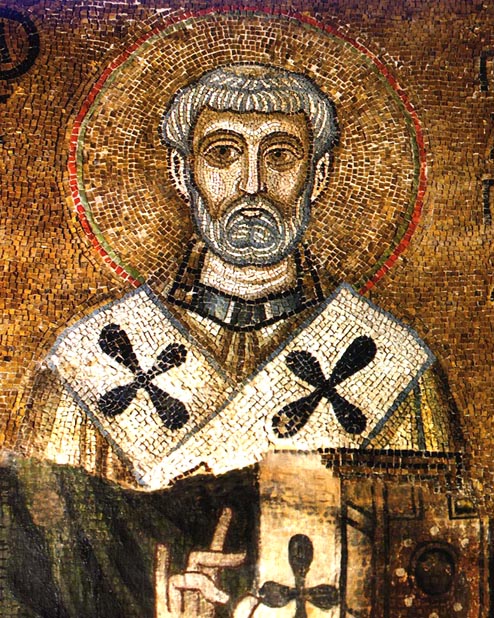
| Time | Bishop of Rome in the last years of the first century. Eusebius counts nine years, from about 92 to about 100. His birth date is not known. |
|---|---|
| Where | Rome, Italy. A later legend places his exile and death in the Crimea, on the Black Sea. |
| What he was | Bishop of Rome, third successor of St Peter after Linus and Anacletus; first of the writers called the Apostolic Fathers |
| Language | Greek |
| Known as | Clement of Rome; Pope St Clement I; Clemens Romanus |
| Honoured | Saint. Latin Church: 23 November, as Pope and Martyr; named in the Roman Canon. Byzantine Churches: late November. He is not a Doctor of the Church. |
His life
Honesty comes first. We know very little of Clement's life. The Catholic Encyclopedia says plainly that nothing is known of his life and death beyond a few witnesses. What we do have is his letter, and the memory of those who lived soon after him.
What the early witnesses say
- St Irenaeus of Lyons, about 180, gives the list of Roman bishops: Linus, then Anacletus, then Clement, "in the third place from the apostles". He adds that Clement had seen the Apostles and spoken with them, so that their preaching still rang in his ears (Against Heresies 3.3.3).
- Tertullian, about 200, says the Church of Rome records that Peter himself ordained Clement (Prescription against Heretics 32).
- Eusebius of Caesarea, in the fourth century, says that Clement succeeded Anencletus in the twelfth year of Domitian, and handed on the office to Evarestus in the third year of Trajan, after nine years (Church History 3.15 and 3.34). That is roughly from 92 to 100.
- St Jerome calls him the fourth bishop of Rome after Peter, if Linus was second and Anacletus third, and notes that most Latins of his day thought Clement came straight after Peter (On Illustrious Men 15).
Why the lists differ
Old lists do not always agree. Some name Cletus and Anacletus as if they were two men. Most scholars now take them as one. Others put Clement directly after Peter, which may explain the story in St Epiphanius that Peter ordained him, that he stood aside for a time, and that he took up the office later. Epiphanius himself was unsure. Benedict XVI gives the plain order that the Church has kept from Irenaeus: Peter, Linus, Anacletus, Clement. The Roman Canon of the Mass names them in this order too, with Cletus for Anacletus.
Who was he?
Three guesses are often repeated. None is certain.
- Paul's fellow worker. St Paul names a Clement in Philippians 4:3. Origen, Eusebius, Epiphanius and Jerome took this to be the same man. The Catholic Encyclopedia thinks Paul's Clement was probably a Philippian. The question stays open.
- The consul Flavius Clemens. A nineteenth-century idea made him the consul of the year 95, a cousin of Domitian who was put to death. The ancients never say this, and it is now thought unlikely.
- A former slave's family. Bishop Lightfoot, the great English scholar, noticed how deeply the letter knows the Old Testament. He suggested a man of Jewish family, perhaps a former slave of the imperial household or the son of one. This remains a guess.
The trouble at Corinth
The one firm event in his life is the letter. In the Church of Corinth, a few people had risen up and removed their elders from office, though these men had served without blame (chapters 3, 44, 47). St Paul had faced factions in the same city a generation before. News reached Rome. The Church of Rome wrote a long letter, and the early Church always named Clement as the man who wrote it. Benedict XVI, following the opening words on sudden calamities (1:1), takes these to be the persecution of Domitian, and dates the letter just after the emperor's death, immediately after 96.
Three men carried the letter: Claudius Ephebus, Valerius Bito and Fortunatus. They were to come back quickly with news of peace (chapters 63 and 65).
Did it work? About 170, Bishop Dionysius of Corinth wrote to Rome to say that his Church still read aloud on Sundays the letter sent through Clement. That is a strong sign of how the Corinthians came to receive it.
His death: what we know and what is legend
We do not know how he died. Rufinus, about 400, is the first writer we have who calls him a martyr. Benedict XVI puts it carefully: later witnesses from the fourth to the sixth century give him the title of martyr. The Latin calendar honours him as Pope and Martyr.
A Greek story, no older than the fourth century according to the Catholic Encyclopedia, tells more. In it, Trajan banishes Clement to the Crimea. He brings water to two thousand thirsty Christians, the people are converted, and many churches are built. Then he is thrown into the sea tied to an iron anchor. That is why Christian art so often shows him with an anchor. Read this as a pious legend, not as history. Pope Zosimus shows that a basilica of St Clement already stood at Rome by 417, and Jerome also knew of a church at Rome that kept his name.
His relics
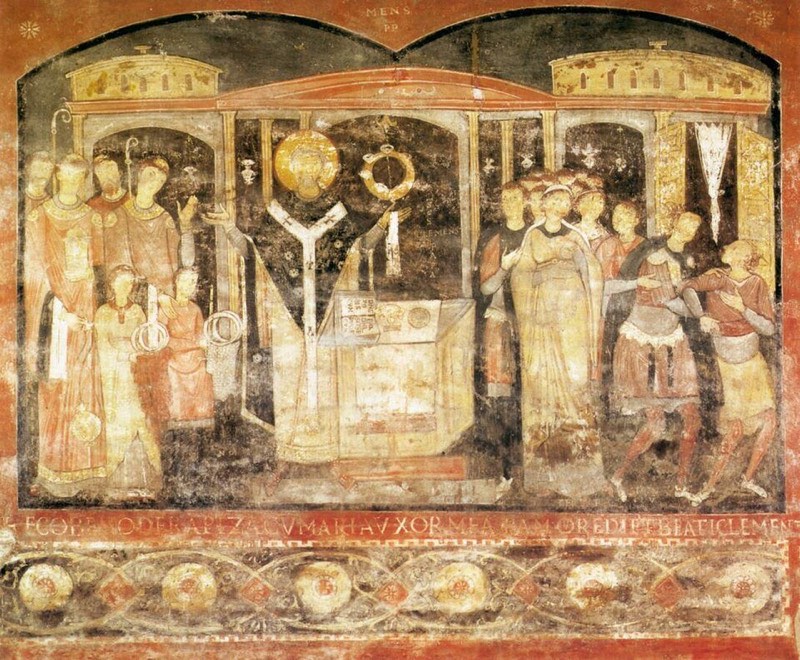
About 861, St Cyril and St Methodius, the later Apostles of the Slavs, were on their mission to the Khazars and stayed at Kherson in the Crimea. There they found bones and an anchor, believed to be those of Clement. They kept them with them on their later journeys, and about 867 or 868 brought them to Rome and gave them to Pope Hadrian II, who laid them in the basilica of San Clemente. St John Paul II tells this story in Slavorum Apostoli (4), with the careful words "what they believed to be" his burial church. The Catholic Encyclopedia trusts the story of the carrying but doubts whether the bones can be proved to be his. San Clemente still venerates Clement today, with St Ignatius of Antioch, and St Cyril was buried there too.
The world he lived in
Rome. The capital of an empire. Its Christians were a small body, many of them poor or of slave background, some in the imperial household. Clement could remember, or had heard from those who remembered, the deaths of Peter and Paul under Nero. He calls them "the greatest and most righteous pillars" and speaks of a great crowd of others who suffered, including women (chapters 5 and 6).
Domitian. The emperor reigned from 81 to 96. Eusebius records that in his fifteenth year Flavia Domitilla, a relative of the consul Flavius Clemens, was exiled for her witness to Christ (3.18). How wide this persecution was, historians debate. Clement's own letter says only that sudden troubles had come upon the Roman Church.
Corinth. A busy Greek port and a Roman colony, with a Church founded by St Paul. It knew Paul's letters, and Clement tells them to take them up again (chapter 47).
The Church's order. The first witnesses to Jesus were dying. A new question pressed on everyone: who now holds the charge they left? In Clement's letter the words "bishop" and "presbyter" are used quite close to each other, and scholars debate how exactly one man's office and the group of elders were related at Rome in those years. Lightfoot read the letter as an early step on the road to papal authority; Harnack thought that Rome was then still led by a group of elders. Catholic teaching sees here, with Benedict XVI, a first exercise of the primacy of Rome.
What he taught
- God's grace comes first. We are not made righteous by our own wisdom or holy deeds, but by faith, through which God has justified all from the beginning (32). So should we sit idle? God forbid: "let us hasten" to every good work (33). Benedict XVI calls this the link between the good news of salvation and the duty of a moral life.
- Humility and love are the cure. Division comes from envy (3 to 6). The cure is lowliness like that of Christ, who came not in pride but in humility, as Isaiah 53 foretold (16). He has a hymn to love, which echoes St Paul (49 and 50).
- God is a God of order. The sky, the seasons and the sea keep peace under his command (20). So the Church also has its own good order, in which each serves in his own place (37, 38, 40, 41). He uses the image of an army and of the human body, and calls his readers to be one (46).
- The apostolic succession. God sent Christ, Christ sent the Apostles, and the Apostles appointed men to serve, giving instruction that other approved men should follow them (42 and 44). This is the oldest clear witness to the succession outside the New Testament. Those who served blamelessly should not be pushed out (44). The Second Vatican Council cites this passage (Lumen Gentium 20), and so does the Catechism (861).
- The word "lay". In 40:5 he uses the Greek laikos for a member of the people of God. Benedict XVI notes this as its first appearance in Christian writing. It does not set people against the clergy; it describes one living body with different services.
- The resurrection. Day and night, the sown seed, and the Scriptures all point to the resurrection, of which Christ is the first fruits (24 to 27).
- Christ the High Priest. Through him we look up to heaven (36). He is the protector and helper of our weakness, and our prayer goes through him (36, 61, 64).
- One God, one Christ, one Spirit. "Have we not one God and one Christ? Is there not one Spirit of grace poured out upon us?" (46).
- Repentance and the first step. God has given every generation a chance to repent (7 and 8). The one who is the cause of a quarrel should be ready to leave, saying in effect, "if this is my fault, I will go, only let the flock be at peace" (54). Those who began the rebellion are asked to submit and repent (57).
- Prayer for rulers. He prays for those who govern on earth, that they may use their power in peace and gentleness (60 and 61). See below.
- Women as models of courage. Rahab (12), the women who died for the faith (6), and Judith and Esther (55) are all held up as examples.
A word on the phoenix. In chapter 25 Clement speaks of the phoenix, the bird that rises from its own ashes, as a real creature in Arabia, and takes it as a sign of the resurrection. Many in his world believed in it. He was using the natural knowledge of his day. The teaching is the resurrection, not the bird. The Church has condemned nothing in the letter.
How he taught
He wrote as a brother. The letter does not give his name. It opens: "The Church of God which sojourns at Rome, to the Church of God sojourning at Corinth". He often says "we", and adds that he writes to remind himself as well (7).
He reasons from Scripture. The Old Testament fills the letter, in long quotations: Cain and Abel, Noah, Abraham, Lot, Rahab, Job, Moses, David. He knows St Paul, above all 1 Corinthians, and draws much from the Letter to the Hebrews. Eusebius reports that some in his day thought Clement had translated Hebrews, and he leans that way himself (3.38). This stays a guess.
He looks at the world. He points to the harmony of nature (20), and he uses examples from outside the Bible, such as rulers who gave themselves up to save their people (55). The Greek is correct and dignified.
He ends in prayer. Benedict XVI points out that Clement adds what Paul's letters do not have: a "great prayer" that nearly closes the letter (59 to 61). The argument turns into worship. Praise of the Creator gives way to petitions for the hungry, the sick, the fallen, the prisoners and the rulers.
His works
Certainly his
Letter to the Corinthians (First Clement). In Greek, 65 chapters. Benedict XVI says it is the only writing certainly his. In the name of the Roman Church, about 96. Dates as early as about 70 have been argued by a few scholars, for example T. J. Herron, and later ones by others, but the date near 96 is the most widely held.
How the letter reached us
Codex Alexandrinus, 5th century, with a leaf lost near the end; Codex Hierosolymitanus of 1056, found by Philotheos Bryennios in 1873 and published in 1875, the first complete copy; a Latin version in an 11th-century manuscript at Namur, published by Germain Morin in 1894; a Syriac manuscript at Cambridge, found in 1876; Coptic papyri published in 1908 and 1910.
Under his name, not his
Second Letter to the Corinthians: really an ancient sermon by an unknown author. Eusebius and Jerome already doubted it.
Two Letters to Virgins: survive in Syriac; known to Epiphanius and Jerome, but not by the author of the Corinthian letter.
Clementine Homilies and Recognitions: a romance with Clement as its hero, from later centuries.
Five letters in the False Decretals: two earlier letters to St James, three forged by Pseudo-Isidore.
Church books linked to him
The Apostolic Constitutions, the Apostolic Canons, the Testament of Our Lord, and a West Syriac anaphora have all been ascribed to him. None is his. The very use of his name shows how highly he was honoured, as Benedict XVI notes.
Some Churches read the letter almost as Scripture. It stands in Codex Alexandrinus alongside the Bible, and Eusebius says it was publicly read in many Churches. It was not received into the New Testament.
A short taste
"Love unites us to God." "Love admits of no schisms: love gives rise to no seditions: love does all things in harmony." (Letter to the Corinthians 49; Roberts and Donaldson's translation in the Ante-Nicene Fathers)
"Who then among you is noble-minded? Who compassionate? Who full of love?" (chapter 54, same translation)
What the Popes and the Church say of him
Benedict XVI, General Audience, 7 March 2007. He began his series on the Apostolic Fathers with Clement. His chief points:
- The letter is "a first exercise of the Roman primacy after St Peter's death".
- When Clement explains the succession, he shows that the structure of the Church is sacramental and not political. God's gift comes before our decisions.
- The Church is not a place of confusion. Each serves according to the vocation received.
- The prayer for rulers is the oldest prayer for political institutions after the New Testament. Christians, knowing that persecution would continue, prayed for the very authorities who had condemned them, as Jesus prayed on the Cross.
- Praying for rulers shows both respect and limit. The Pope's words: "Caesar is not everything." Authority is given by God, and must be used "devoutly in peace and meekness" (61:2).
The Second Vatican Council cites him in Lumen Gentium 20 on the bishops as successors of the Apostles.
The Catechism cites chapters 42 and 44 at paragraph 861.
St John Paul II, in Slavorum Apostoli (1985), tells how Cyril and Methodius recovered his relics. They found them at Kherson and presented them to Pope Hadrian II.
In the Mass. The Roman Canon names him before the consecration, among Linus, Cletus and Sixtus.
Why he matters today
- For a parish in a quarrel. Few writings speak so directly to a divided parish or community. Clement does not begin with blame. He reminds them who they are, shows what envy does, and asks those at fault to take the first step.
- For those who hold office. Authority is a service handed down, not a prize. He asks the one who causes trouble to be ready to stand aside.
- For the whole Church. He is an early witness that one Church cares for another, and that the Church of Rome spoke to another in love.
- For citizens. He shows how to pray for rulers, including ones we do not trust, without bowing before them as gods.
- For anyone who prays. His great prayer may still be prayed, as Benedict XVI asks us to do.
Sit with this
- Is there a quarrel near me in which I could take the first step, even if I am only part of the cause?
- When did I last pray, by name, for those who govern, including those I do not agree with?
- Where do I serve in the Church, and do I serve there as in one body, not as a rival?
Timeline
| Date | Event |
|---|---|
| About 64 to 67 | Peter and Paul die at Rome under Nero; Clement's letter remembers them (5) |
| About 92 | Clement becomes bishop of Rome, in the twelfth year of Domitian, according to Eusebius |
| 81 to 96 | Reign of Domitian, with troubles for the Christians at Rome |
| About 96 | Letter to the Corinthians, just after Domitian's death, according to Benedict XVI |
| About 99 to 100 | Clement's death, in the third year of Trajan by Eusebius's count; how he died is not known |
| About 170 | Dionysius of Corinth reports that his Church reads the letter on Sundays |
| About 180 | Irenaeus names him third after the Apostles |
| About 400 | Rufinus is the first known writer to call him a martyr |
| 417 | Basilica of St Clement at Rome is mentioned by Pope Zosimus |
| About 861 | St Cyril finds bones and an anchor in the Crimea |
| About 867 to 868 | He and St Methodius bring them to Rome; Pope Hadrian II places them at San Clemente |
| 1873, 1875 | Bryennios finds and publishes the first complete Greek copy of the letter |
| 2007 | Benedict XVI's General Audience on him, 7 March |
Sources: Benedict XVI, General Audience of 7 March 2007; Letter to the Corinthians (Ante-Nicene Fathers, New Advent); Catholic Encyclopedia, Pope St Clement I; Irenaeus, Against Heresies 3.3; Eusebius, Church History, book 3 and book 4; Jerome, On Illustrious Men; Tertullian, Prescription against Heretics; John Paul II, Slavorum Apostoli; Lumen Gentium; Catechism 861; Basilica of San Clemente; manuscript details checked in Wikipedia, First Epistle of Clement; New Catholic Encyclopedia (on encyclopedia.com) for the dates of the Crimea find. Early dates are approximate.