St Cyprian of Carthage
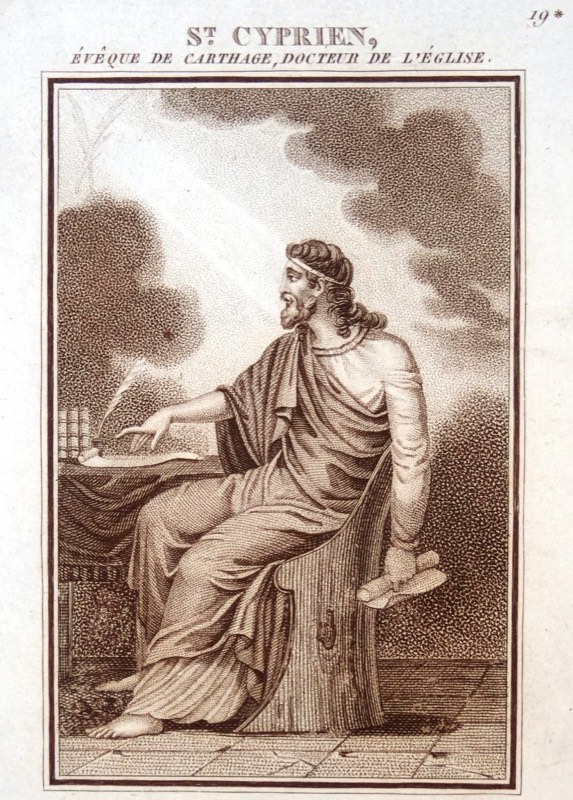
| Time | Born about 210 (the year is not recorded). Died 14 September 258 |
|---|---|
| Where | Carthage, the great city of Roman Africa, near today's Tunis in Tunisia. Exile at Curubis, today Korba, Tunisia |
| What he was | Lawyer and teacher of speech making, then convert, priest, Bishop of Carthage from about 248 or 249, and martyr |
| Language | Latin |
| Known as | The bishop of unity. His deacon and first biographer calls him the first bishop in Africa to receive the crown of martyrdom |
| Honoured | Saint and martyr. Latin Church: 16 September, kept together with Pope St Cornelius, and named with him in the Roman Canon of the Mass. Eastern Orthodox: 31 August. Syro-Malankara calendar: 16 September. Church of England: 15 September. He is not among those formally named Doctors of the Church |
His life
The successful pagan. Thascius Cyprianus was born into a rich pagan family, in Carthage according to Benedict XVI, though some scholars say only that it was somewhere in North Africa. No one recorded the year. He became a famous speaker and pleader in the courts, with wealth, standing and gardens of his own. Later he called his youth a time of darkness.
Conversion, at about 35. An old priest named Caecilianus led him to the faith. Cyprian took the priest's name into his own, and when Caecilianus was dying he left his wife and family in Cyprian's care. Even as a catechumen Cyprian chose a life of chastity, gave most of his income to the poor and sold his property, gardens included. Friends later bought the gardens back for him. He was baptised about 246, probably at Easter. A few months later he described it in a work to his friend Donatus: "a second birth restored me to a new man" (To Donatus 3 to 4, as quoted by Benedict XVI).
Bishop within about three years. He was soon made a priest. Between 248 and early 249 the people chose him as Bishop of Carthage, the chief see of Latin Africa. He accepted unwillingly. Five priests opposed him, and their resistance never quite ended. From his conversion to his martyrdom there were only about thirteen years, and everything we remember him for belongs to them.
Persecution under Decius, 250. After a long peace many Christians had grown comfortable, and Cyprian himself says so. In January 250 the emperor Decius ordered everyone to offer sacrifice to the gods. Pope Fabian was martyred at Rome on 20 January. About that time Cyprian went into hiding near Carthage. Some, including clergy at Rome, took this for desertion. He answered that a shepherd must stay alive to guide his flock, and he governed by letter for some fourteen months. He sent money for prisoners, encouraged those in chains, and stopped the pay of clergy who had run away.
The fallen. In Carthage most gave way. Some sacrificed. Thousands more bought a false certificate (libellus) saying that they had. These were the lapsi, "the fallen". When the storm passed, most begged to come back. Some confessors, who had suffered bravely, handed out pardons in their own name, and the five priests readmitted people at once with no penance. At Rome the priest Novatian took the opposite view, that the Church could not take such people back at all.
The middle way, 251. Cyprian came back in spring 251 and held a council of African bishops at Carthage in April. It judged each case on its merits. Those who had only bought a certificate could return after penance. Those who had sacrificed would do lifelong penance and receive Communion at death. He read to the bishops his treatise On the Unity of the Church, and wrote On the Lapsed about the same time. Rival bishops arose at Carthage from both sides, Fortunatus from the lax party and Maximus from the strict. When a new persecution threatened, a later council (in 252 or 253; the sources differ) gave Communion to all who were doing penance, so that they would be strong for the test.
Standing by Pope Cornelius. When Novatian set himself up as rival Bishop of Rome in 251, Cyprian waited for reliable report from African bishops who had been present, then recognised Cornelius and held the African Church to him. They wrote to each other as friends. Cornelius was exiled in 253 and died in exile, and Cyprian honoured him as a martyr.
The plague. From about 252 an epidemic swept Carthage. Pontius the deacon says that people fled the sick and even threw out the bodies of their own relatives. Cyprian gathered the Christians and told them that doing good only to one's own was no great thing, and that they must care also for pagans and for those who persecuted them. They did so, each according to his means. He wrote On Mortality to steady frightened people. Pagans blamed Christians for the disaster, and he replied in To Demetrianus. In one crisis, when Christians in Numidia were carried off by raiders, he sent the bishops a hundred thousand sesterces that the Carthage faithful had collected for ransom (Letter 62).
The dispute with Pope Stephen, 255 to 257. The Church in Africa baptised anew anyone who came over from a heretical group, holding that there could be no true Baptism outside the Church. Rome received such people with the laying on of hands. African councils in 255 and spring 256 upheld the African custom, with 31 bishops and then, by Cyprian's own count, 71. Stephen ordered that nothing be changed from what had been handed down, and he threatened to break communion. He refused to receive the African envoys. A larger council met at Carthage in September 256, and each bishop gave his vote aloud. Cyprian's letters of this time speak sharply. Firmilian of Caesarea in Cappadocia took his side, and more sharply still. Stephen died in 257 and his successor, Sixtus II, was on good terms with Cyprian. The quarrel was dropped without any break, and the two sides never formally settled it in their lifetime. Stephen's practice is the one the Church kept.
Exile, 257. The emperor Valerian began a new persecution. On 30 August 257 the proconsul Paternus questioned Cyprian. The record of this survives. He said that he was a Christian and a bishop and that he prayed day and night for all people and for the emperors. He would not name his priests. He was sent to Curubis, on the coast. The day he arrived, according to Pontius, he dreamed of a judge writing out a sentence, and of himself asking for a day's delay.
The last days, August and September 258. A year later he was allowed back to his gardens. News came that Pope Sixtus had been killed at Rome on 6 August with deacons, under a new edict against the clergy (Letter 80). Friends urged him to escape. When the proconsul sent for him to Utica he hid for a while, saying that a bishop should die in his own city and among his own people. When the proconsul returned he came out. On 13 September soldiers took him to the house of an officer, and crowds of Christians stayed all night in the street outside.
The martyrdom, 14 September 258. Next morning the new proconsul, Galerius Maximus, questioned him at the villa of Sextus. Told to sacrifice, he refused. Sentence was read from a tablet: death by the sword. According to the proconsular Acts his only answer was "Thanks be to God". The crowd cried out that they wanted to be beheaded with him. He was led to an open place with trees, where people climbed the branches to see. He took off his cloak, knelt and prayed, and gave his outer garment to the deacons. He told his friends to give the executioner twenty five gold pieces, and bound his own eyes. Two of the clergy tied the cloth for him. The faithful laid cloths on the ground to catch his blood. At night they carried his body by torchlight to the cemetery of Macrobius Candidianus, on the Mapalia road.
The world he lived in
Carthage was the second city of the Latin West, a rich port and the seat of the Roman proconsul of Africa. Christians there were many and the bishop of the city led the bishops of a wide region. They met in council often, and each spoke in turn.
The middle of the third century was a time of crisis for Rome: civil wars, border raids, inflation and disease. Emperors looked for someone to blame or for the old gods to help. Decius's edict of 250 was the first to reach everyone in the empire at once, and it was aimed at apostasy more than at death. Valerian's of 257 and 258 aimed at the leaders and the wealthy. Between them Christians had a few years of uneasy peace.
The great earlier writer of Carthage was Tertullian, who had died a generation before. Cyprian read him every day, according to St Jerome, who heard it from an old man who had known Cyprian's secretary. Cyprian's style is calmer and his temper more pastoral, and he never followed Tertullian into schism.
What he taught
- The Church is one. This is the heart of his teaching. Christ's seamless robe is its figure (On the Unity 7). "God is one and Christ is one, and his Church is one", and "Unity cannot be severed" (On the Unity 23, as quoted by Benedict XVI).
- The Church is our mother. "No one can have God as Father who does not have the Church as mother" (On the Unity 6). The Catechism quotes this at paragraph 181.
- Unity rests on Peter. Christ builds on one so as to show that the Church is one (On the Unity 4). He calls Rome "the throne of Peter" and "the chief church whence priestly unity takes its source" (Letter 59, 14). At the same time he held that all bishops share one episcopate, and that each answers to God for his own church. On the Unity 4 survives in two forms, and scholars still debate how they relate. See "His works" below.
- The bishop and the people belong together. "The bishop is in the Church, and the Church in the bishop" (Letter 66, 8). He would decide nothing large without his clergy and people, and he asked for their consent.
- No salvation outside the Church. The saying is his (Letter 73, 21), and he said it in strong words against those who broke away. It has to be read with the Church's own explanation in the Catechism, paragraphs 846 to 848: all salvation comes from Christ through his Body, and those who through no fault of their own do not know the Gospel or the Church, yet seek God sincerely, can also attain salvation.
- Mercy with truth. Against laxity on one side and hardness on the other, he taught that the fallen can return, but through true repentance (On the Lapsed).
- Baptism is a new birth. His own story in To Donatus is the witness. Infants should not be kept waiting even until the eighth day, as a council of 66 bishops told Bishop Fidus (Letter 64).
- The Eucharist makes us one. The Lord's cup is to be offered as the Lord did, with wine mixed with water and not water alone. Water stands for the people and wine for the blood of Christ, and once mixed they cannot be parted (Letter 63, 13). He speaks of the Eucharist as the sacrifice of the Lord.
- Prayer is "our" prayer. We do not say "my Father". "We pray not for one, but for the whole people" (On the Lord's Prayer 8). God is the hearer "not of the voice, but of the heart" (4).
- Works of mercy. Almsgiving is a Christian's daily work (On Works and Alms), and care in a plague reaches enemies as well.
- Do not fear death. For the believer it is a going home (On Mortality).
Where the Church did not follow him
On Baptism by heretics he was mistaken, and the Church has said so in her practice and in her teaching, as at the Council of Trent. Baptism given with water in the name of the Trinity, with the intention of doing what the Church does, is true Baptism, whoever gives it, and it cannot be repeated (Catechism 1256, 1272). St Augustine, who loved Cyprian, wrote at length to correct him and praised him at the same time: he held to the unity of the Church even while he disagreed. Benedict XVI says only that Cyprian "staunchly defended" African tradition before Rome. No one has counted this against his holiness. The Church honours him as a martyr, with Cornelius.
How he taught
He wrote as a bishop with a problem to solve. Benedict XVI calls him "little inclined to theological speculation". He wrote "above all for the edification of the community".
He had the training of a great public speaker. His Latin is full, balanced and clear, and later Christian writers admired it. He argues from Scripture first of all, often in long strings of texts. He gathered such texts into handbooks for others to use. He uses homely pictures for large truths: one sun with many rays, one tree with many branches, one spring with many streams (On the Unity 5).
He also taught by letter. More than any other source from the third century, his letters let us watch a bishop at work: ordering money for prisoners, answering a question about a difficult priest, consoling people in the mines.
His works
Treatises that are surely his
- To Donatus: his conversion, and the state of the world.
- On the Dress of Virgins: counsel to consecrated women.
- On the Lapsed: the fallen, and true penance.
- On the Unity of the Catholic Church: his best known work.
- On the Lord's Prayer: a line by line teaching.
- To Demetrianus: reply to pagans who blamed Christians for disasters.
- On Mortality: on death, in the plague.
- On Works and Alms: on giving.
- On the Good of Patience: patience as God's own virtue.
- On Jealousy and Envy: on rivalry among Christians.
- To Fortunatus: Scripture texts to prepare for martyrdom.
- Testimonies to Quirinus: three books of Scripture texts arranged by subject.
Letters
The collection holds 81 letters. Sixty two are his own, three more are in the name of his councils, and the rest are written to him, including those from Cornelius and Firmilian. Letter numbers differ between editions. On this page they follow the numbers used by Benedict XVI and the standard Vienna edition. The older English translation counts differently: its Letter 62 is Letter 63 here.
Letter 55 on the fallen, and Cornelius and Novatian · Letter 59 to Cornelius · Letter 62 on ransom for captives · Letter 63 on the Eucharist · Letter 64 on infant Baptism · Letter 66 on the bishop and the Church · Letters 69 to 74 on Baptism by heretics · Letter 76 to those in the mines · Letter 80 on the death of Sixtus · Letter 81, his last.
Council record
The Opinions of the Bishops records the votes of the September 256 council.
Disputed
That Idols Are Not Gods is accepted by St Jerome and St Augustine and printed in all editions, and scholars are divided.
On the Unity 4. This chapter survives in two forms. One speaks of "the primacy given to Peter" and "the chair of Peter". The other speaks of Peter as the sign of unity, and of all the Apostles as equal in power. The Catholic scholar Maurice Bévenot argued that Cyprian wrote both, the second during his dispute with Stephen. Others read them otherwise, and the debate continues. A later combined text, once printed in many editions, is not original.
Not by him, though once printed under his name
On Spectacles and On the Good of Chastity (probably Novatian) · In Praise of Martyrdom · Against the Jews · To Novatian · On Rebaptism (written against his view) · On Dice Players · On Mounts Sinai and Sion · Reckoning of Easter (243) · On the Singleness of Clerics · The Double Martyrdom · The Supper of Cyprian and a few poems and prayers.
About him
Life and Passion of St Cyprian by his deacon Pontius, who shared his exile · the Proconsular Acts of his trial and death.
A short taste
"No one can have God as Father who does not have the Church as mother." On the Unity 6, as quoted by Benedict XVI, 6 June 2007.
"For God is the hearer, not of the voice, but of the heart." On the Lord's Prayer 4, in the same audience.
What the Popes and the Church say of him
Benedict XVI gave him a whole General Audience on 6 June 2007. He praises Cyprian as "severe but not inflexible" with the fallen, and "deeply human" in urging help for pagans during the plague. Then he adds a personal word: "I am particularly fond of his treatise on the 'Our Father', which has been a great help to me in understanding and reciting the Lord's Prayer better." He places Cyprian at the root of the tradition that sees the heart as the proper place of prayer.
The Catechism of the Catholic Church quotes him on the Church as mother (paragraph 181).
The Mass. The Roman Canon names him among the martyrs, right after his friend Cornelius. It has done so for many centuries, and his feast with Cornelius still stands on the general Roman calendar on 16 September.
In the early Church. St Augustine preached on his feast day, and his cult was already widespread across Africa by the fourth century. Churches stood over his tomb and over the place of his death. They later fell into ruin. Several cities of the West have claimed part of his relics, and these claims have not been proved.
Why he matters today
When people have failed. Every age has its fallen: those who gave way under pressure, or who left, and want to come home. Cyprian shows a way that is neither pretending nothing happened nor shutting the door.
When the Church is divided. He teaches us to treat unity as Christ's gift and our duty. His own life adds a further lesson. He disagreed hard with a Pope, on a matter where he was wrong, and he never broke communion.
When disease comes. His words in the plague have an obvious echo. A Christian does not run from the sick, and care reaches beyond one's own.
When we pray. Each time we say "Our Father" we are, in his phrase, praying "for the whole people".
Sit with this
- Is there someone who has fallen away whom I have written off, or someone I have welcomed back too lightly, without any care for those they hurt?
- When I say "Our Father", who is in that "our"?
- Have I ever hurt the unity of a family, a parish or the Church to prove that I was right?
Timeline
| Year | What happened |
|---|---|
| about 210 | Born, probably at Carthage, to a rich pagan family |
| about 246 | Baptised, at about 35. Soon after, To Donatus |
| 248 or early 249 | Chosen Bishop of Carthage |
| January 250 | Edict of Decius. Pope Fabian martyred. Cyprian goes into hiding |
| April 251 | Back at Carthage. Council on the fallen. On the Unity and On the Lapsed |
| 251 | Cornelius and Novatian at Rome. Cyprian recognises Cornelius |
| about 252 | Plague. On Mortality. Care for the sick of all religions |
| 253 | Cornelius exiled, and dies |
| 254 | Stephen becomes Pope |
| 255 to 256 | Councils at Carthage on Baptism by heretics. Dispute with Stephen |
| August 257 | Stephen dies. Sixtus II succeeds. Valerian's persecution begins. Cyprian exiled to Curubis |
| 6 August 258 | Pope Sixtus II martyred at Rome |
| 14 September 258 | Cyprian tried and beheaded at Carthage |
Sources: Benedict XVI, General Audience of 6 June 2007; Catholic Encyclopedia, St Cyprian of Carthage; Pontius the Deacon, Life and Passion of St Cyprian; Cyprian's letters and treatises (Ante-Nicene Fathers, vol. 5); a translation of the Proconsular Acts; Catechism of the Catholic Church. Other feast dates outside the Latin Church were checked only in reference works; the Syro-Malankara day is from the official Panchangam 2026-27.