St Cyril of Jerusalem
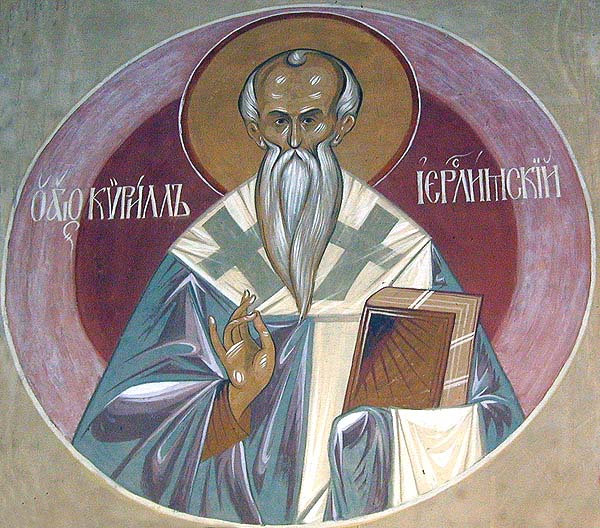
| Time | Born about 315, died probably 18 March 386 (Benedict XVI gives 387) |
|---|---|
| Where | Jerusalem and the Holy Land (today Israel and the Palestinian territories); exile at Tarsus (today Turkey) and elsewhere |
| What he was | Bishop of Jerusalem, catechist, three times an exile |
| Language | Greek |
| Known as | The great catechist of the Church's first centuries |
| Honoured | Saint. Doctor of the Church, named by Pope Leo XIII in 1883. Latin Church: 18 March (optional memorial). Byzantine tradition: 18 March, with 7 May for the cross of light. Syriac usage: Mar Kurilos, 18 March in the Syro-Malankara calendar. Syro-Malabar calendar: 18 March. |
His life
Beginnings. Very little is known of his early years. He was born about 315 at Jerusalem or nearby, and had a strong literary education, soaked in the Bible. According to St Jerome, Bishop Maximus ordained him a priest, and later sources say Macarius had ordained him deacon about 335. As a priest he was already trusted with teaching those preparing for Baptism.
The holy places. Cyril grew up in a city being changed before his eyes. Constantine had built a great basilica over Calvary and the Lord's tomb, and pilgrims were coming from far away. Cyril could stand in that basilica and say to his hearers, in the old translation: "You see this spot of Golgotha!" (Catechesis 13, 23).
Bishop, under a cloud. He became bishop about 348, some say about 350, when Maximus died or was removed. He was ordained by Acacius, Metropolitan of Caesarea in Palestine, who sided with the Arians. This gave his enemies a reason for suspicion. Jerome tells a hostile story that he gained the see by giving up his priesthood under an agreement. Socrates, the church historian, says that Acacius drove out Maximus. Scholars read these stories with caution. Later events cleared Cyril's name, as we shall see.
The cross of light, 351. A letter to the Emperor Constantius II, written early in his time as bishop, reports a cross of light in the sky over Golgotha, stretching towards the Mount of Olives, in May after Pentecost. Most scholars accept the letter, though some have doubted it. The Greek Church still remembers this on 7 May.
Quarrel with Acacius. He soon fell out with Acacius. The quarrel was partly over faith and partly over jurisdiction, since Cyril claimed that his see did not stand under Caesarea. Acacius found his charge in a famine. Cyril was accused of selling church goods. Ancient historians say he sold sacred ornaments, and one tale says a gold-threaded robe given by Constantine. If the charge is true, it looks as though he did so to feed the hungry.
First exile, 357. A synod under Acacius deposed him, and he took refuge at Tarsus with Bishop Silvanus.
Back, and out again, 359 to 361. The Council of Seleucia, 359, restored him and deposed Acacius, and Cyril seems to have returned. In 360 Constantius reversed this and he went into exile again. In 361 the Emperor Julian let the exiled bishops go home, and Cyril returned.
Long exile, 367 to 378. The Emperor Valens banished the bishops Julian had restored. Cyril was away for about eleven years, the longest of his exiles. Benedict XVI counts three exiles in about twenty years.
Return and peace. He came back in 378 after Valens's death, to a city torn by quarrels. St Gregory of Nyssa visited about 380 and found the faith sound, but the people divided. Benedict XVI says Cyril restored unity and peace among his flock.
Constantinople, 381. He took part in the Second Ecumenical Council and accepted the Nicene word homoousios, "of one being" with the Father. The bishops wrote to Pope Damasus in 382 and honoured him in plain words. Theodoret preserves the letter: "the right reverend and most religious Cyril is bishop, who was some time ago canonically ordained" by the bishops of the province, and he "has in several places fought a good fight against the Arians". This settled the question of his ordination and of his faith.
Death. He died in Jerusalem, probably on 18 March 386. Benedict XVI gives 387, and Socrates another year. John succeeded him as bishop.
The world he lived in
Jerusalem in the fourth century was at once small and famous. The bishop had a small city and a worldwide audience. Christians from everywhere came to walk where the Lord had walked. The city's liturgy, moving from holy place to holy place, became known across the world. St Cyril is one of our best windows on it.
The Arian crisis was at its height. Arius of Alexandria had taught that the Son was a creature. The Council of Nicaea condemned this in 325, but the argument went on. Bishops who disliked the word homoousios were not all Arians. Many feared that it could blur Father and Son. Cyril stood among these moderate bishops in his younger years. He condemned the Arian teaching, but he did not use the Nicene word in his lectures.
Meanwhile the catechumenate was at its full strength. Adults came to the Church in large numbers. They signed up at the start of Lent, heard long instruction every day, were baptized at Easter, and learned what had happened to them only afterwards. Those lessons were bound by the discipline of the secret: what was said was not to be repeated to pagans or to those not yet baptized.
What he taught
- The Creed is the whole of Scripture in a few lines. "The most important points collected out of all the Scripture make up one complete teaching of the Faith" (Catechesis 5, 12). He asks the catechumens to learn it by heart and not on paper, "engraving it by the memory upon your heart". The Catechism cites this passage (CCC 186).
- Christ the Son is truly God. The lectures on the Creed (nn. 6 to 18) are aimed at Arian teaching. He says the Son is "like the Father in all things". Before 381 he did not use the word homoousios, and he did not call the Holy Spirit "God" in so many words, though he taught that the Spirit is to be honoured with the Father and the Son. The Catholic Encyclopedia judges his teaching sound in substance, lacking only the explicit Nicene language, which he later accepted.
- The Old Testament leads to Christ. Benedict XVI calls Cyril's reading of the two Testaments "symphonic". The promises point to Christ, and Christ opens them. This is typology.
- Faith and morals go together. The Pope stresses that teaching and behaviour belong together in Cyril. Doctrine reaches the soul and moves it to leave the old pagan ways for the new life given in Baptism.
- Baptism is death and birth. "That water of salvation was at once your grave and your mother" (Second Mystagogical Catechesis 4, as quoted by Benedict XVI). The candidate strips, is anointed, goes down into the water three times, and comes up new.
- Chrism. The anointing after Baptism makes the Christian one anointed with Christ (Catechesis 21, the third mystagogical catechesis).
- The Eucharist is the Body and Blood of Christ. The fourth mystagogical catechesis argues from the Lord's own word and from Cana: he changed water to wine, so why doubt that he changes wine into his Blood? "The seeming bread is not bread, though sensible to taste, but the Body of Christ" (22, 9, tr. Gifford). The Catholic Encyclopedia finds this teaching on the Real Presence clear. Some modern writers, reading words like "figure", have argued otherwise.
- The Holy Spirit makes the gifts holy. "We beseech the merciful God to send forth His Holy Spirit upon the gifts lying before Him; that He may make the Bread the Body of Christ, and the Wine the Blood of Christ" (23, 7). This is one of the clearest early witnesses to the epiclesis.
- The Church is catholic. "It is called Catholic then because it extends over all the world" (18, 23). He adds that she teaches all that is necessary, reaches every class of people, and heals every kind of sin.
- Prayer for the dead. The fifth mystagogical catechesis explains that at the Liturgy we pray for the living and for the departed (23, 9 and following), and it goes through the Our Father line by line.
- The Second Coming. He preaches on the Lord's two comings (lecture 15), in words the Latin Office of Readings has long used in Advent. Some of his lines on the end show the anxieties of his time. His reading of the events of his day as signs of the end has not been made the Church's.
Limits. Cyril gave the shorter Old Testament list, though he quoted the deuterocanonical books as Scripture, and he did not name Revelation among the books of the New Testament (Catechesis 4). The Church had not yet settled these questions for all; later it did. On the Trinity, he stands with those who came slowly but truly to the word Nicaea had chosen. The Church has honoured him as a Doctor, and has not charged him with error.
How he taught
On the spot. His lectures were given in the Basilica of the Holy Sepulchre itself. He points to the rock, the tomb and the place of the Cross. "We see this holy Golgotha, which stands high above us", he says (13, 39, in substance). He also speaks of the wood of the Cross that had been "distributed piecemeal from hence to all the world" (13, 4).
Step by step. He takes one line of the Creed at a time. He first welcomes people: "You have been caught in the nets of the Church" (Procatechesis 5, as quoted by Benedict XVI). He warns them to take this seriously. He gives them practical advice, such as how to behave in the assembly, what to do while waiting, and how to avoid gossip.
From rite to mystery. This is the famous method. The newly baptized first go through the rites, in the dark, at the Easter Vigil. Only then, in Easter week, does he explain them. What did the oil mean? Why did you face west and then east? The experience comes first, and then the meaning. The Pope calls this catechesis integral, engaging body, soul and spirit, and says it "remains emblematic for the catechetical formation of Christians today".
Plainly. He speaks in simple Greek, seemingly without a prepared text, and his words were written down by listeners. It feels like a kind teacher talking to adults who are afraid of getting it wrong.
With care for how we receive. He gives one of the most beautiful of all instructions: "make your left hand a throne for the right, as for that which is to receive a King" (23, 21). He asks people to take care that not a crumb falls. Today's local rules for Communion belong to each Church, and this passage is simply a window on his.
His works
Little survives from Cyril beyond his lectures. St Jerome, in Lives of Illustrious Men 112, names only the Catecheses, written as a young man. The full list is short.
Catecheses
Procatechesis, the welcome. Complete.
Eighteen Lenten lectures for candidates for Baptism, given about 350 (some say 348, others earlier as a priest). Nn. 1 to 5: repentance, Baptism, summary of the faith. Nn. 6 to 18: the Creed of Jerusalem. Complete. Given without a text and written down by listeners, the manuscripts indicate.
Mystagogical Catecheses
Five lectures for the newly baptized in Easter week: on the renunciation, Baptism, Chrism, the Body and Blood of Christ, and the Liturgy. Authorship disputed. Manuscripts holding both sets name Cyril for the Lenten lectures and give no author for these five. Manuscripts holding these five alone name his successor John, or both Cyril and John. No manuscript names Cyril alone as their author. Many modern scholars incline to John or to John's revision of Cyril's work, and date them to the 370s or 380s. Others, such as Alexis Doval, argue for Cyril.
Others
Letter to the Emperor Constantius, on the cross of light, 351. Generally accepted, questioned by some.
Homily on the Paralytic at the Pool of Bethesda (John 5). Survives.
Three small fragments.
Benedict XVI speaks of 24 catecheses, following the older tradition that all belong to Cyril, and this page keeps that tradition while noting the debate. Whoever spoke the five last lectures, they show the faith and practice of the Church of Jerusalem in the late fourth century.
A short taste
"Make your left hand a throne for the right, as for that which is to receive a King." (Catechesis 23, 21, tr. Gifford)
"That water of salvation was at once your grave and your mother." (Second Mystagogical Catechesis 4, quoted by Benedict XVI, 27 June 2007)
What the Popes and the Church say of him
Benedict XVI gave a General Audience on him on 27 June 2007. He recalls the exiles and the doubts about his faith, and notes that the Synodal Letter of 382 recognized his orthodoxy, the legitimacy of his ordination and his merits as a pastor. He then presents the lectures as a single, systematic teaching on rebirth through Baptism, whose summit is mystagogy, leading the neophyte "from the rite to the mystery". He says that catechesis belongs to the whole life of the community.
Leo XIII named him a Doctor of the Church in 1883.
The bishops' letter of 382, after the Council of Constantinople, is the early public defence of him.
The Catechism cites his lecture on the Creed (CCC 186).
Catechists today owe him much. The Rite of Christian Initiation of Adults, restored after the Second Vatican Council, has a final period called mystagogy, the name of his method.
Why he matters today
He is a friend to every parish that teaches adults. He takes people seriously enough to demand a lot from them, and kindly enough to explain each step.
He reminds us that the Liturgy teaches. We don't simply explain the sacraments before we enter them. We enter, and then we learn what we have received. Anyone who has ever gone home from a Mass wondering what it all meant has a friend in him.
He is also a comfort for anyone who has been misunderstood. Three times he was driven out. Friends and enemies doubted him. He kept on teaching, and in the end his brother bishops said in writing that he had fought the good fight.
Sit with this
- Could I say the Creed by heart and explain one line of it to someone who asked?
- What part of the Mass do I still not understand? Whom could I ask?
- When I come to Communion, how do I make a throne for the King?
Timeline
| Year | Event |
|---|---|
| about 315 | Born at or near Jerusalem |
| 325 | Council of Nicaea |
| about 335 | Deacon, according to later sources |
| about 348 to 350 | Bishop of Jerusalem; the Lenten lectures date from about this time |
| 351 | Letter to Constantius on the cross of light |
| 357 | Deposed; first exile, at Tarsus |
| 359 | Council of Seleucia restores him |
| 360 | Second exile |
| 361 | Returns under Julian |
| 367 to 378 | Third and longest exile, under Valens |
| 381 | Attends the Council of Constantinople; accepts homoousios |
| 382 | The bishops' synodal letter defends him |
| 386 | Dies, probably 18 March (some give 385 or 387) |
| 1883 | Leo XIII names him a Doctor of the Church |
| 2007 | Benedict XVI's General Audience on him, 27 June |
Sources: Benedict XVI, General Audience, 27 June 2007; Catholic Encyclopedia, St Cyril of Jerusalem; Catechetical Lectures, tr. E. H. Gifford (Nicene and Post-Nicene Fathers, series 2, vol. 7); Theodoret, Ecclesiastical History 5, 9; St Jerome, Lives of Illustrious Men 112; on the authorship dispute, A. J. Doval, Cyril of Jerusalem, Mystagogue (2001) and reviews in the Journal of Early Christian Studies; Wikipedia for dates and calendars, checked against the above where possible. Dates for the early Fathers are approximate. Syro-Malabar and Syro-Malankara days: the official calendars (Syro-Malabar Liturgical Calendar, Second Set; Syro-Malankara Panchangam 2026-27).