The Didache: The Teaching of the Twelve Apostles
| Time | Most scholars today place it at about the end of the first century; some earlier parts may be older, and some scholars date the final form into the second century. The date is debated. |
|---|---|
| Where | Unknown. Many think of Syria (today Syria, Lebanon and southern Turkey). Egypt has also been proposed. There is no firm evidence. |
| What it is | A short handbook for a Christian community: how to live, baptise, fast, pray, celebrate the Eucharist and receive travelling teachers. It is a book and not a person, and its author is unknown. |
| Language | Greek. It runs to sixteen short chapters. |
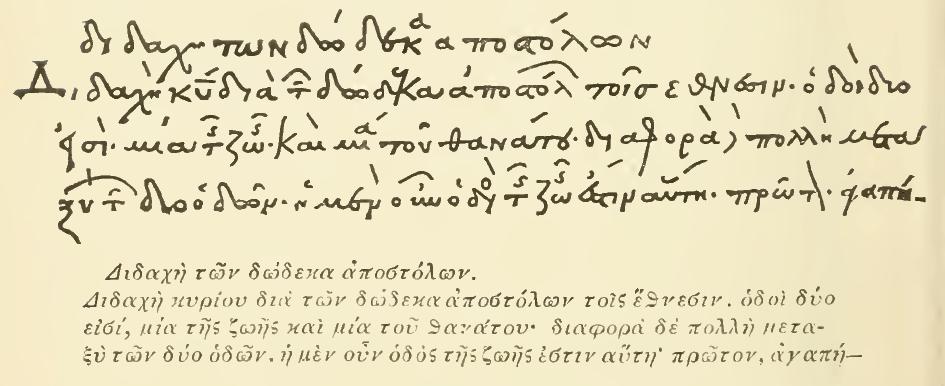
| Known as | "Didache" is Greek for "teaching". Its two titles in the manuscript are "Teaching of the Twelve Apostles" and "Teaching of the Lord through the Twelve Apostles to the Nations". |
| Honoured | Being a book, it has no feast. It is not part of the Bible. The Church values it as a very early witness: St John Paul II called it "the most ancient non-biblical Christian writing" (Evangelium Vitae 54), and the Catechism cites it. |
The story of the book
For most of Christian history, the Didache was a name without a text. Writers of the early centuries mentioned it or echoed it, and then it dropped out of sight. Scholars knew that some book of this title had existed, and they could see traces of it in later works, but no one had a copy.
Found in 1873. Philotheos Bryennios, a Greek Orthodox metropolitan and scholar, found it in a small manuscript volume in the library of the Holy Sepulchre house at Constantinople (today Istanbul, Turkey). The same volume held the letters of St Clement of Rome, which he published in 1875. The scribe, a man named Leon, finished the volume in 1056, as his closing note says.
Published in 1883. It took Bryennios ten years to bring out the Didache itself, in Constantinople. The effect among scholars was immediate, and a flood of studies followed, Catholic, Orthodox and Protestant. A facsimile of the pages appeared in 1887. The manuscript is now kept by the Greek Orthodox Patriarchate in Jerusalem, and is often called Hierosolymitanus 54, or simply H54.
Other pieces of evidence. This is the only complete copy, and it is nearly a thousand years later than the work itself. There are smaller witnesses. An old Latin version of the moral section, chapters 1 to 5, was published by J. Schlecht in 1900. The later Church order called the Apostolic Constitutions took over much of the Didache and reworked it.
Who wrote it. We do not know. The title does not mean that the Twelve wrote it down themselves. It means that the community understood this teaching as coming from the Lord through the apostles. Many scholars think it was put together in stages, by one or more editors using older material. The moral section looks especially old and may rest on a Jewish teaching for those who wished to walk in God's ways.
The world it came from
The Didache shows us a Church very close to its Jewish roots. These are believers who think in the language of Israel's Scriptures. Over the Eucharistic cup they give thanks for "the holy vine of David". They speak of Jesus as God's "Servant", a title used in the first preaching of the apostles. They keep the old rhythm of prayer three times a day and of fasting twice a week. They shout Maran atha, an Aramaic cry meaning "Our Lord, come" or "The Lord has come".
It also shows a Church moving among the Gentiles. The longer title speaks of "the nations". The readers must be warned about things that were everywhere in the Roman world: magic, astrology, omens, food sacrificed to idols. They must also be told plainly not to do what Roman custom allowed, the killing of the unborn and of newborn children.
Local life was small and practical. Travelling apostles and prophets moved from town to town, and a host had to decide whom to trust. Local bishops and deacons were being appointed alongside them. People with a trade were expected to work. A prophet had to prove himself by how he lived. We see a Church at the moment when one form of leadership was giving way to another, and it is one of the reasons the book is so interesting.
The date. Older scholars ranged widely. Adolf Harnack in 1884 argued for about 131 to 160. Others argued for a date before 70, and in 1904 and 1905 the English scholar Bigg even proposed the fourth century. The Catholic Encyclopedia of 1908 reported that the commoner view placed it before the year 100. Most scholars today place it at about the end of the first century, some with older sources inside and some with a later final editing. No date can be proved. The honest statement is "very early, but we cannot say exactly".
Its standing in the early Church. Eusebius of Caesarea, writing in the early fourth century, lists the "Teachings of the Apostles" among books that were not accepted as Scripture (Church History 3, 25). St Athanasius and Rufinus place it with useful writings that were read, but not in the canon. So the early Church read it with respect and clearly drew a line between it and the Bible.
What it teaches
- Two ways (ch. 1 to 6). "There are two ways, one of life and one of death". The way of life is to love the God who made you and your neighbour as yourself, and not to do to others what you would not want done to you. The Catechism uses this picture of the two ways as it opens its teaching on the Christian life (CCC 1696, citing Didache 1, 1).
- Love of enemies (ch. 1). Bless those who curse you, pray for your enemies, fast for those who persecute you. These are the Lord's words from the Sermon on the Mount, placed first (see Matthew 5).
- Sharing what we have (ch. 1 and 4). Give to everyone who asks. Do not turn away from the needy. Share all things with your brother and do not call them your own: if you share what is immortal, how much more what is mortal? At the same time it warns the one who takes without need, and says that alms should "sweat in your hands" until you know to whom you are giving.
- The dignity of every child (ch. 2 and 5). "You shall not murder a child by abortion nor kill that which is begotten." St John Paul II quotes this line in Evangelium Vitae 54 and refers to it again in 61, and the Catechism cites it (CCC 2271), as evidence that the Church's teaching on life goes back to the beginning.
- Parents and those who serve (ch. 4). Teach your children the fear of God from their youth. Do not give orders in bitterness to a servant who hopes in the same God. The book accepts slavery as a fact of its day, as the society around it did, and it does not criticise it. Its command is that the master must remember that God is over both. The Church today teaches clearly against all slavery (Gaudium et Spes 27; CCC 2414).
- Baptism (ch. 7). Baptise "into the name of the Father, and of the Son, and of the Holy Spirit" (Matthew 28:19). Use "living" or running water if you can; if not, other water, cold or warm; and if there is not enough, pour water three times on the head. The baptiser, the one to be baptised, and others who can should fast beforehand. It is one of the oldest instructions we have for the sacrament, and it shows the Trinitarian form already in use.
- Fasting and prayer (ch. 8). Fast on the fourth day and on the Preparation, that is, Wednesday and Friday. Pray the Our Father three times a day. The text of the Lord's Prayer here is close to Matthew's, and it ends with a closing praise, "for Yours is the power and the glory forever". The Catechism notes this (CCC 2760 and 2767).
- The Eucharist (ch. 9, 10 and 14). Only the baptised may eat and drink, because the Lord said not to give what is holy to dogs. Prayers of thanks are given for the cup and the broken bread. The community prays that, as the bread once scattered on the hills was gathered into one, so the Church may be gathered from the ends of the earth into the Kingdom. The Catechism draws on these chapters in its teaching on Communion (CCC 1331 and 1403).
- Sunday and sacrifice (ch. 14). "But every Lord's day gather yourselves together, and break bread, and give thanksgiving after having confessed your transgressions, that your sacrifice may be pure." Anyone in a quarrel must first be reconciled. The chapter then applies Malachi 1:11, the pure offering in every place, to this gathering. It is among the earliest witnesses to the Eucharist on Sunday and to the language of sacrifice.
- Confession of sins (ch. 4 and 14). "In the church you shall acknowledge your transgressions". The book asks that sins be confessed before prayer and before the breaking of bread. It does not describe how this was done.
- Testing teachers (ch. 11 to 13). Receive a teacher who adds to righteousness and the knowledge of the Lord. A travelling apostle should stay one day, or two if need be; if he stays three, he is a false prophet. If he asks for money, he is a false prophet. A true prophet is known by his ways. A guest with a trade should work and eat; one who will not work is "a Christ-monger", making a business out of Christ.
- Bishops and deacons (ch. 15). "Appoint for yourselves bishops and deacons worthy of the Lord". They must be meek, not lovers of money, truthful and proven, and they are to be honoured together with the prophets and teachers. The book does not show the full threefold ministry that we see in St Ignatius of Antioch a little later, and scholars discuss what this means for its date and setting.
- Watchfulness (ch. 16). "Watch for your life's sake." False prophets will multiply, love will turn to hate, a deceiver will appear, and at the end the Lord will come on the clouds. It gives no date, and it asks only for readiness: "you know not the hour".
How it teaches
It is not a treatise. It is more like a handbook passed from one teacher to the next. The sentences are short, and many could be learned by heart. The voice is that of an elder speaking to a young believer: "My child, flee from every evil thing."
It works by contrast (two ways), by lists (what to avoid, what to do) and by clear rulings ("if you have not living water, baptize into other water"). It is very gentle where people are weak: "if you are able to bear all the yoke of the Lord, you will be perfect; but if you are not able, what you are able that do." And it quotes the Lord's words again and again, mostly close to Matthew's Gospel, though scholars still debate whether the author knew Matthew's written text or a shared tradition.
A hard word to read carefully. Chapter 8 tells readers not to fast "with the hypocrites", who fast on the second and fifth day of the week, the Jewish fast days of that time, and the same word is used of prayer. This echoes Matthew 6, and it reflects an argument within a community whose own roots were Jewish, as it was separating from its neighbours. It must not be read as contempt for the Jewish people. The Second Vatican Council teaches that the Jews are not to be presented as rejected or accursed by God (Nostra Aetate 4), and the Didache's own love of Israel's Scriptures and prayers shows how much it had received from them.
What is in it, chapter by chapter
| Chapters | Part | Contents |
|---|---|---|
| 1 to 4 | The way of life | Love of God and neighbour; sayings from the Sermon on the Mount; the commandments; "My child" sayings on anger, lust, omens, lying; duties in family and community; confession in church. |
| 5 | The way of death | A list of sins, including those who "turn away from him that is in want". |
| 6 | Closing the two ways | Do not let anyone lead you astray; bear what you can; keep away from food offered to idols. |
| 7 | Baptism | How and with what water; fasting before it. |
| 8 | Fasting and prayer | Wednesday and Friday; the Our Father three times daily. |
| 9 and 10 | The Eucharist | Prayers over cup and bread; the baptised alone; thanksgiving afterwards, with "Maran atha". |
| 11 to 13 | Teachers, apostles, prophets | Tests of the true and the false; welcome of travellers; first-fruits for prophets or for the poor. |
| 14 | The Lord's day | Gathering, confession, reconciliation, the pure sacrifice. |
| 15 | Bishops and deacons | Their choice and honour; correction in peace. |
| 16 | Watchfulness | Signs of the last days and the coming of the Lord. |
The only complete copy stops at "coming upon the clouds of heaven". Many scholars suspect that some closing lines have been lost.
Its relatives
Works that resemble it
The Letter of Barnabas 18 to 20 has its own form of the Two Ways. Scholars disagree on who borrowed from whom, or whether both used an older source. Echoes also appear in the Shepherd of Hermas.
Works that grew from it
The Didascalia Apostolorum draws on it, and the Apostolic Constitutions take it up and expand it. Clement of Alexandria and Origen use language like its own.
What we know, and what we do not
What is known
- The text exists, from a manuscript copied in 1056.
- Early writers knew a book of this title, and Eusebius lists it outside the accepted Scriptures.
- Its witness to Trinitarian baptism, the Sunday gathering, and Wednesday and Friday fasting can be read plainly in it.
What is less certain
- Who wrote it, where, and exactly when.
- Whether chapters 9 and 10 give the prayers of the Eucharist itself, or of a meal joined to it. They do not contain the Lord's words over the bread and cup. Chapter 14 is plainer in its language of sacrifice, and the Catechism itself draws on these chapters when it speaks of Communion.
- Its link with Matthew's Gospel and with Barnabas.
The Catholic Encyclopedia notes that the book does not speak expressly about the Real Presence. That is true, and it should not be overstated in either direction. An early handbook of practice does not explain everything that its readers held. The Church's faith in Christ's presence rests on his own words and on the whole of Tradition (CCC 1374 to 1376), including other early witnesses such as St Justin and St Ignatius.
A short taste
Two brief lines, in M. B. Riddle's translation (Ante-Nicene Fathers, volume 7):
"Even as this broken bread was scattered over the hills, and was gathered together and became one, so let Your Church be gathered together from the ends of the earth into Your kingdom" (9).
"If you are able to bear all the yoke of the Lord, you will be perfect; but if you are not able, what you are able that do" (6).
What the Popes and the Church say of it
- St John Paul II in Evangelium Vitae (1995) calls it "the most ancient non-biblical Christian writing" (n. 54) and quotes its two ways and its command about children. In n. 61 he cites it again to show how the first Christians opposed the abortion and infanticide practised in the Greco-Roman world.
- The Catechism of the Catholic Church cites it on the two ways (1696), on Communion and the holy things (1331), on "Maranatha" (1403), on the protection of the unborn (2271), and on the Lord's Prayer (2760 and 2767).
- Pope Benedict XVI gave catecheses on the great Fathers in 2007, but none is given to the Didache. It is a book without a known author, and the Church's documents mostly cite it instead of describing it at length.
The Church does not treat the Didache as Scripture, and not every practice in it binds us today. The rule about staying only two days, for example, belonged to its own time. Its value is that of a witness: it shows us how early Christians lived what they had received.
Why it matters today
It lets us hear the voice of ordinary Christian life very close to the apostles. There is little theory in it. It is about how to treat the poor, how to fast, when to pray, whom to trust, and how to make peace before coming to the altar.
It shows that some things we might think of as later additions were there from the beginning: baptism in the name of the Trinity, the Our Father prayed daily, Sunday as the Lord's day, the rule that the baptised alone receive, confession of sins before worship, and a firm rejection of killing the unborn and the newborn.
It also speaks to us about money and peace in the Church. This very early book already warns against the preacher who asks for money, and it asks every Christian to bring those in a quarrel to peace.
Sit with this
- The Didache begins with two ways. Which way did my choices walk today?
- Have I someone to reconcile with before I next go to the altar?
- The bread was gathered from many hills. Whom do I find it hard to think of as part of the one loaf?
Timeline
| Date | Event |
|---|---|
| About the end of the first century | Most scholars' date for the Didache. Parts may be older, and the final form may be later. |
| Early 4th century | Eusebius lists it outside the accepted Scriptures. |
| 4th century | St Athanasius and Rufinus mention it among useful books outside the canon. The Apostolic Constitutions rework it. |
| 1056 | Leon the scribe finishes the manuscript that preserves it. |
| 1873 | Philotheos Bryennios finds it at Constantinople. |
| 1883 | Bryennios publishes it. |
| 1887 | A facsimile of the manuscript appears. |
| 1900 | J. Schlecht publishes an old Latin version of the opening chapters. |
| 1992 | The Catechism of the Catholic Church cites it. |
| 1995 | St John Paul II quotes it in Evangelium Vitae. |
Sources: the Didache, trans. M. B. Riddle, Ante-Nicene Fathers; Catholic Encyclopedia (J. Chapman, 1908), "Doctrine of the Twelve Apostles"; Evangelium Vitae 54 and 61; Catechism of the Catholic Church; Eusebius, Church History 3; Nostra Aetate 4; Wikimedia Commons, Codex Hierosolymitanus; for the fragments and present scholarly opinion on the date and place, the Wikipedia survey and the works it cites. The dates and places of the early period are debated; we have said so where it matters.