St Hilary of Poitiers
| Time | Born about 310 (some scholars say about 315), died 367 or 368 |
|---|---|
| Where | Poitiers in Roman Gaul (today France); exile in Phrygia (today Turkey); Seleucia and Constantinople (today Turkey); Milan (today Italy) |
| What he was | Convert, Bishop of Poitiers, theologian, exegete, confessor of the faith in exile |
| Language | Latin |
| Known as | The Athanasius of the West |
| Honoured | Saint. Doctor of the universal Church, named by Blessed Pius IX in 1851. Latin Church: 13 January (optional memorial; formerly 14 January). Byzantine tradition: 14 January. |
His life
A seeker from a pagan home. Hilary was born in Poitiers, probably about 310, into a wealthy family. Benedict XVI says he does not seem to have grown up in a Christian setting, and the Catholic Encyclopedia calls his family noble and very probably pagan. He received a solid education in letters and philosophy.
He tells the story of his own search at the opening of his great work On the Trinity. He first asked what a human life is for. Wealth and leisure did not seem enough. He wanted to know God. Then he met the Scriptures: God's name in Exodus 3:14, the greatness of God in Isaiah 40:12, and at last the opening of St John's Gospel, which told him more about God than he had imagined. He was baptized about 345.
Married, according to the sources. The New Catholic Encyclopedia says he was married and had a daughter named Abra. The accounts of Abra come from saints' lives written about two centuries later, and a letter from Hilary to her is generally judged not to be his. So his marriage is usually accepted, and the details of the daughter are less certain.
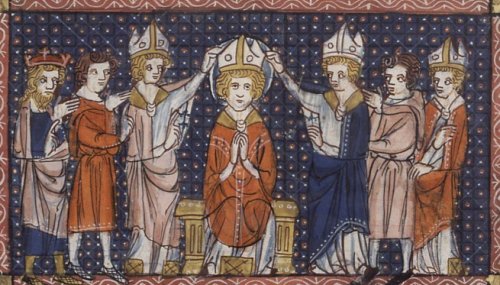
Bishop. About 353 or 354, his own city chose him as bishop. Benedict XVI gives this date; the Catholic Encyclopedia says about 350. He is the first Bishop of Poitiers of whom we have sure knowledge. In these first years he wrote his Commentary on Matthew.
Béziers and exile, 356. In 356 a synod met at Béziers (Baeterrae) in southern Gaul under Saturninus, Bishop of Arles, and was controlled by bishops friendly to the Arians. Hilary refused to condemn St Athanasius. They would not hear his defence of the faith. He later called it the "synod of false apostles". They asked the Emperor Constantius II to act, and in the summer of 356 Hilary was sent away to Phrygia in Asia Minor, where Arian ideas were strong.
Fruitful years in Asia. Exile became his school. He read the Greek theologians and came to know the Eastern bishops at first hand. He says plainly that he had never heard the Nicene Creed until he was going into exile (On the Synods 91), though he had believed what it teaches from the Gospels and the Letters. In exile he wrote On the Trinity and, about 358 to 359, On the Synods, to explain the Eastern bishops to the bishops of Gaul.
Seleucia and Constantinople, 359 to 360. In 359 he attended the Council of Seleucia, still an exile, and showed that the bishops of Gaul were not guilty of the error of Sabellius, as Eastern opinion held. He then went on to Constantinople, where he addressed a short book to the Emperor. He went on opposing the Arian party there, and they persuaded Constantius to send him home.
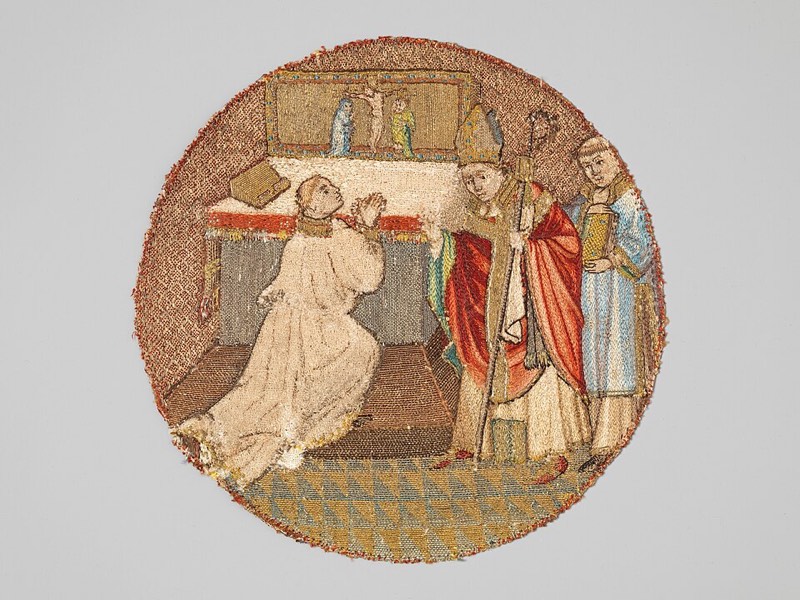
Home again, 360 or 361. He re-entered Poitiers, in the words of the Catholic Encyclopedia, in triumph. Saturninus of Arles was later deposed. St Martin, once a soldier, came back to him. Sulpicius Severus, Martin's biographer, says Hilary had wanted to ordain him deacon and Martin had refused, so Hilary made him an exorcist, an office so humble that Martin could not refuse it. After Hilary's return, about 361, Martin founded a community at Ligugé near Poitiers, one of the first monasteries in Gaul. The monastery still exists. Benedict XVI recalls that the two men met several times.
Milan, 364. He did not sit still. In 364 he went to Italy to address the harshness of the followers of Lucifer of Cagliari, then challenged Auxentius, the Arian Bishop of Milan, in public. The Emperor Valentinian ordered him to leave the city. He wrote Against Auxentius about the matter.
Last years and death. Back in Poitiers he wrote on the Psalms and on the mysteries of Scripture. He died there in 367 according to Benedict XVI. The Catholic Encyclopedia reports the two old traditions, 1 November and 13 January, with the year 368 in the Roman Breviary. His relics have an uncertain history: Le Puy claimed them, one tradition places them at Saint-Denis, and another says Protestants burned them at Poitiers in 1572.
The world he lived in
Hilary was a Roman of Gaul at the far western end of the Empire. Christians had been legal since the time of Constantine. In 325 the Council of Nicaea had condemned the teaching of Arius, a priest of Alexandria, who held that the Son of God was a creature, the highest of all, and not truly God. Nicaea confessed that the Son is of one being with the Father (in Greek, homoousios).
That did not end the argument. It went on for decades, and emperors took sides. Constantius II favoured a compromise: that the Son is "like" the Father, with no word about being. Bishops who resisted were sent away. In the West, few bishops knew Greek, and many knew little of the debate. In the East, many bishops feared that homoousios could erase the difference between Father and Son. Each half of the Church suspected the other.
This was the gap Hilary crossed. He brought Greek theology into Latin. He told Westerners that not all Easterners were heretics, and told Easterners that Westerners were not denying the three Persons. In 359 twin councils at Rimini and Seleucia were pressed towards the imperial formula. Hilary lived through that crisis, and wrote about it.
What he taught
- The Son is fully God, equal with the Father. This is the heart of On the Trinity. Benedict XVI sums up his reasoning: "God the Father, being wholly love, is able to communicate his divinity to his Son in its fullness." The Son lacks nothing that makes God to be God.
- Theology begins at the font. He builds his teaching on the Trinity on the words of Baptism: in the name of the Father and of the Son and of the Holy Spirit (Matthew 28:19; On the Trinity 2). His closing prayer asks to stay faithful to what he professed at his Baptism.
- How to read what Scripture says of Christ. Some texts speak of him as God, others of his humanity, others of his being before all time, his self-emptying, his death or his rising, as Benedict XVI explains. Read together, they do not divide him. This rule answers the Arian use of verses such as John 14:28.
- Words must serve the faith. In On the Synods he explains that "like" can be understood rightly if it means true likeness of nature: "True likeness belongs to a true natural connection" (section 89). He also explains how homoousios can be misused, and how it must be held (sections 71, 88). He defends Nicaea and yet reaches out to those on the way to it.
- Christ joined himself to all of us. Benedict XVI stresses this. Salvation comes through Christ alone, who united himself to all humanity. The way is open to all, and each must still turn personally to him.
- The Eucharist joins us to Christ. In On the Trinity 8, 13 to 14 he argues that we receive the Word made flesh, and that his flesh and blood when received bring it about that "we are in Christ and Christ in us" (Watson translation).
- Reason and faith. God's existence can be known by reason, but his nature lies beyond our grasp. "A reasonable faith is akin to reason and accepts its aid" (On the Trinity 1, 8), and "with the will to believe would come the power to understand" (1, 12).
- Baptism and what happened to Christ. He teaches that what happened in Christ shows what happens to us. The Catechism cites him on the Lord's Baptism (CCC 537, from his Commentary on Matthew).
Where his language falls short. No act of the Church condemning anything of Hilary's has been found. Scholars do point out two weak spots, and it is honest to name them. First, he seldom calls the Holy Spirit "God" in so many words, though he gives the Spirit what belongs to God. The full teaching was stated at Constantinople in 381, after his death. Second, in On the Trinity 10 he says that Christ truly underwent his Passion but without the pain that we feel. Some have heard an unbalanced view of Christ's humanity in this, and others defend him. The faith of the Creed is that Christ truly suffered. Read Hilary here with that faith in mind.
Some in his own day attacked him from the other side. Lucifer of Cagliari thought he was too gentle with those who used unsound formulas.
How he taught
From his own journey. He begins with his own search and prays as he writes. Benedict XVI says his writing keeps turning from reflection to prayer. "I owe You, as the chief duty of my life, the devotion of all my words and thoughts to Yourself," he says in On the Trinity 1, 37.
From Scripture first. He argues text by text. In his commentaries he uses allegory, drawing on the Greek tradition, and above all Origen in his work on the Psalms. In his dogmatic works he stays closer to the plain meaning.
Firm and gentle together. He could call a synod "false apostles" and could write a sharp book against an emperor. He could also ask bishops of Gaul to be slow to condemn. Benedict XVI calls this the mark of the man.
A hard style. His Latin is rich and long. St Augustine praised his eloquence. St Jerome noted that his long sentences can hide the meaning. He was among the first to try hymns in Latin. Jerome says he wrote a book of hymns, so some regard him as the first Latin Christian hymn writer. What survives was less suited to public singing than the hymns St Ambrose would write.
His works
St Jerome listed his writings in Lives of Illustrious Men 100. The list below follows Jerome and the modern catalogues. Dates are approximate.
Doctrine
On the Trinity (De Trinitate; Jerome calls it Against the Arians), twelve books, 356 to 360. His chief work, complete.
On the Synods (De synodis, also On the Faith of the Easterners), about 358 to 359. Complete.
Replies on the Synods (Apologetica responsa), answers to critics of that book. Fragments only.
Scripture
Commentary on Matthew, 353 to 355. Benedict XVI: "the oldest extant commentary in Latin on this Gospel." Complete.
Treatises on the Psalms, about 365, on 58 Psalms. Jerome already found the set incomplete.
Book of the Mysteries, on figures of Christ in the Old Testament. Known only in part, from a single manuscript at Arezzo published in 1887.
On Job, drawn from Origen. Fragments.
On the Letters to Timothy. Fragments.
On the Song of Songs. Others ascribed it to him; Jerome had not seen it. Lost.
Controversy and history
Against Valens and Ursacius (the "historical fragments"), on the history of the crisis and the councils of Rimini and Seleucia, 356 to 366. Survives in parts. The first book to Constantius may belong here.
To Constantius (the second book), 360. Complete.
Against Constantius, 360 or 361. Jerome says after the Emperor's death; modern catalogues say earlier. Complete.
Against Auxentius, about 364 to 365. Complete.
To Sallust the Prefect, or Against Dioscurus. Lost.
Against Julian. Fragments.
Hymns and letters
Book of Hymns, named by Jerome. Lost as a book. Three incomplete hymns survive in the Arezzo manuscript; authorship is not beyond doubt.
Letters to various people, named by Jerome. Lost.
Letter to his daughter Abra with the hymn Lucis largitor splendide. Handed down under his name. Generally judged spurious, though older writers accepted it.
A short taste
"I owe You, as the chief duty of my life, the devotion of all my words and thoughts to Yourself." (On the Trinity 1, 37, tr. Watson and Pullan)
His closing prayer, as Benedict XVI quotes it: "that I may keep ever faithful to what I have professed in the symbol of my regeneration" (On the Trinity 12, 57). In substance, Hilary asks to die in the faith of his Baptism.
What the Popes and the Church say of him
Benedict XVI gave a General Audience on him on 10 October 2007. He calls him a "great Father of the Church of the West" and one of the important bishops of the fourth century. He names him for his defence of Christ's divinity, his care to read Scripture soundly, and above all one quality: "This was precisely his gift: to combine strength in the faith and docility in interpersonal relations." He showed, the Pope notes, a conciliatory spirit to those on the way to the full faith. He closed with Hilary's own prayer.
Pius IX declared him a Doctor of the universal Church in 1851.
The Catechism cites him on the Lord's Baptism (CCC 537). The Latin calendar keeps him on 13 January.
Sulpicius Severus honours him as the teacher of St Martin. St Augustine and Jerome admire his learning, with the reserves noted above.
Why he matters today
He shows what can come out of a bad time. An exiled bishop did his best work in the land of his exile and learned from those he had been told were his opponents.
He shows that clarity and courtesy are not opposites. He would not give up the divinity of Christ for an emperor. He would not condemn a man for using a poor word if that man meant the true faith. Few gifts are more needed in the Church now.
He also shows that theology begins with a person's search for God. Anyone who has asked what life is for can start where he started. A Christian in the West can thank him for carrying the faith of Nicaea to the Latin world in time, and a Christian from the East can thank him for speaking well of the East.
Sit with this
- Hilary built his theology on the words of his Baptism. Do I know what I promised then, and do I renew it?
- When someone uses a word I think is wrong, do I first ask what that person means?
- What has my own "exile", a hard place I did not choose, taught me?
Timeline
| Year | Event |
|---|---|
| about 310 | Born at Poitiers (some scholars say about 315) |
| 325 | Council of Nicaea |
| about 345 | Baptized |
| about 353 to 354 | Bishop of Poitiers (some sources say about 350); Commentary on Matthew |
| 356 | Synod of Béziers; exiled to Phrygia in the summer |
| 356 to 360 | On the Trinity written in exile; On the Synods about 358 to 359 |
| 359 | Council of Seleucia; then Constantinople |
| 360 or 361 | Back in Poitiers |
| about 361 | St Martin founds the community at Ligugé |
| 364 | Confronts Auxentius at Milan; ordered out by Valentinian |
| about 365 | Treatises on the Psalms |
| 367 or 368 | Dies at Poitiers |
| 1851 | Pius IX names him Doctor of the universal Church |
| 2007 | Benedict XVI's General Audience on him, 10 October |
Sources: Benedict XVI, General Audience, 10 October 2007; Catholic Encyclopedia, St Hilary of Poitiers; New Catholic Encyclopedia, via Encyclopedia.com; On the Trinity and On the Synods (Nicene and Post-Nicene Fathers, series 2, vol. 9); St Jerome, Lives of Illustrious Men 100; Fourth-Century Christianity, catalogue of his works; Sulpicius Severus, Life of St Martin 5 to 7. Dates for the early Fathers are approximate.