St Ignatius of Antioch
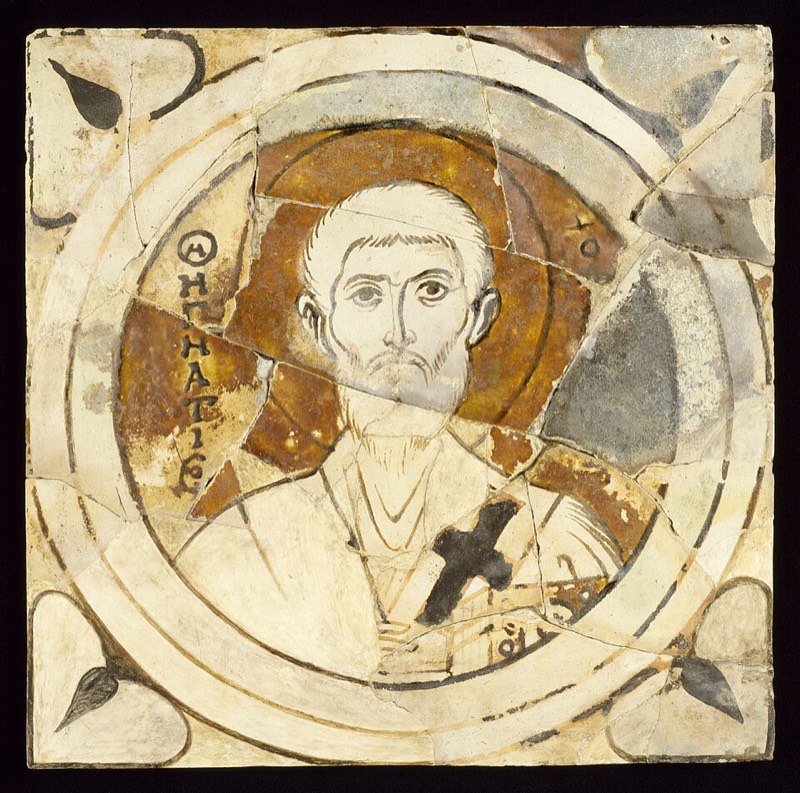
| Time | Born perhaps about 50. Bishop from about 70; martyred about 107, under Trajan (Benedict XVI's dates; other scholars give a range, see below). |
|---|---|
| Where | Antioch in Syria (today Antakya, Turkey); journey in chains through Asia Minor (Turkey), Greece and the Balkans; martyred at Rome, Italy |
| What he was | Third Bishop of Antioch, counting St Peter; martyr; one of the Apostolic Fathers |
| Language | Greek. Old versions of his letters exist in Syriac, Latin and Armenian. |
| Known as | Theophoros, "God-bearer", the name he uses himself. "Doctor of Unity" (Benedict XVI). In the Syriac tradition, Noorono, "the fiery one". |
| Honoured | Saint and martyr. Latin Church: 17 October (1 February until 1969); named in the Roman Canon. Byzantine Churches: 20 December. Syro-Malabar calendar: 17 October. Syro-Malankara calendar: 29 January. Other Syriac dates are in doubt. He is not listed as a Doctor of the Church. |
His life
Before the journey
Most of what is firm comes from the last few weeks of his life. He tells us he is called Theophoros, at the start of each letter. Eusebius names him the second bishop of Antioch after Evodius, or second in succession to Peter (Church History 3.22 and 3.36). St Jerome and Benedict XVI call him the third bishop, counting Peter. The two counts mean the same thing.
Other details are later or uncertain. Theodoret says Peter appointed him. St John Chrysostom honours him as consecrated by the Apostles themselves. The Catholic Encyclopedia thinks it probable that he, with Polycarp, heard St John. A beautiful tradition, kept in the Syriac Churches, says that he was the child Jesus placed among his disciples (Matthew 18:2 to 4). The Catholic Encyclopedia judges this unlikely. Take it as a loving memory, not as history.
The historian Socrates, in the fifth century, also says that antiphonal singing in church was ascribed to him (Church History 6.8). It too is a later report.
Arrest
We do not know the charge. He writes only that he is "bound from Syria for the common name and hope" (Ephesians 1). A later account, the Martyrium, says that Trajan, passing through Antioch, condemned him in person. The Catholic Encyclopedia allows that this text is ancient but adds later material; many historians do not accept it as it stands. Scholars also ask why he was sent all the way to Rome, and have found no fully satisfying answer.
The journey, stage by stage
- From Antioch. Probably by ship from Seleucia, then overland. The guards were ten soldiers. He calls them "ten leopards", who become worse when treated well (Romans 5).
- Laodicea to Philadelphia. He passed Philadelphia, and spoke to the Church there about divisions. He cried out in a loud voice to stay with the bishop (Philadelphians 7).
- Smyrna (today Izmir). Here St Polycarp was bishop. Delegations came to meet him: from Ephesus, Bishop Onesimus with the deacon Burrhus, Crocus, Euplus and Fronto (Ephesians 1 and 2); from Magnesia, Bishop Damas, the presbyters Bassus and Apollonius and the deacon Sotio (Magnesians 2); from Tralles, Bishop Polybius (Trallians 1). From Smyrna he wrote four letters: to the Ephesians, Magnesians, Trallians and Romans.
- The letter to Rome. It is dated late in August (Romans 10). He writes it with one request: do not try to save me.
- Troas. Philo the deacon of Cilicia and Rheus Agathopus caught up with him there, and news came that the Church at Antioch was now at peace (Philadelphians 10 and 11). From Troas, by the hand of Burrhus, he wrote to the Philadelphians, the Smyrnaeans and Polycarp. He had to leave suddenly for Neapolis (Polycarp 8), so he asked Polycarp to write to other Churches for him.
- Philippi. The Christians there received him and his fellow prisoners with love, and asked Polycarp for copies of his letters (Polycarp, Philippians 1, 9 and 13). Zosimus and Rufus, whom Polycarp names, may have been among those prisoners.
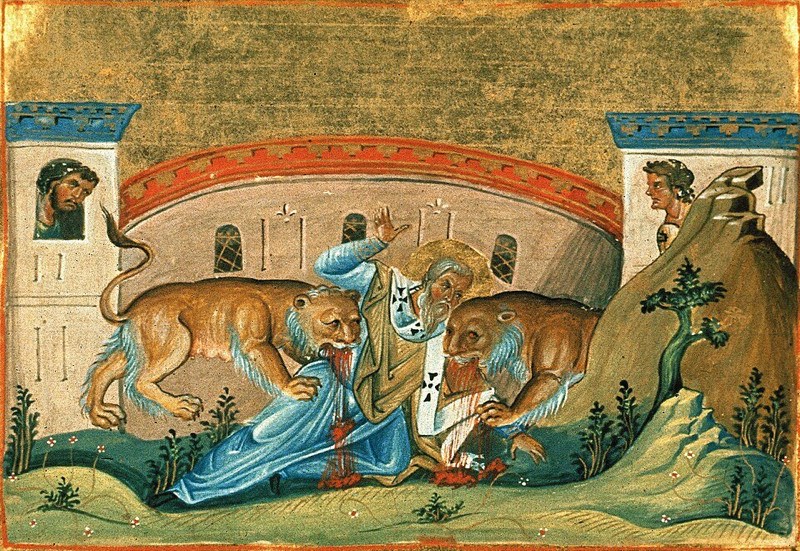
- Rome. After that the record falls silent. His letters end. Benedict XVI, with the long tradition, says that he was thrown to wild animals in the Flavian Amphitheatre, the Colosseum.
His death and relics
He wanted no tomb: "that they may become my tomb, and may leave nothing of my body" (Romans 4). But according to the Catholic Encyclopedia, Philo and Rheus Agathopus carried his remains back to Antioch; the Emperor Theodosius II later moved them to a former temple of Fortune, made into a church in his name; and in 637 they came to the basilica of San Clemente at Rome. The basilica still venerates him with St Clement.
When did he die?
Benedict XVI gives 107. In Deus Caritas Est 22 the same Pope writes "about 117". The Catholic Encyclopedia says between 98 and 117. All of these fall under Trajan, as Eusebius and the long tradition have it. A smaller number of modern scholars argue for a later date, as late as the 130s or 140s. No letter of his carries a year, so no date can be proved.
The world he lived in
Antioch. One of the three great cities of the Empire, with Rome and Alexandria. Benedict XVI recalls that the Council of Nicaea mentioned the three together. It was the capital of Roman Syria. There the disciples were first called Christians (Acts 11:26), and from there St Paul set out on his journeys.
The persecution. Christians could be denounced and put to death for the name alone. Death in the arena was public entertainment. Ignatius goes to it almost as a soldier goes to a post.
The Churches. Each city he meets has a bishop, presbyters and deacons. He is the first writer who shows this threefold order clearly and everywhere. In some places he sees it as newly threatened. Scholars debate how far the pattern had spread, since his letter to the Romans mentions no bishop at Rome.
The errors. Two troubles weigh on him. Some people, now called Docetists, said that Christ only seemed to have a body and to suffer. Others were pressing Christians to return to older observances (Magnesians 8 to 10; Philadelphians 6). This was an argument among Christians of his time about how to live now that Christ has come. Read it as that, and not as a word against the Jewish people. The Church today honours the common heritage with the Jewish people (Nostra Aetate 4).
What he taught
- Jesus Christ is God and truly man. He says "our God, Jesus Christ" (Ephesians 18) and "the passion of my God" (Romans 6). He calls him one Physician, "both made and not made; God existing in flesh" (Ephesians 7). He means that as man Christ was born in time, and that as God he has no beginning.
- "Truly". This is his word against those who said that Christ only seemed human. Christ was truly born, ate, drank, was persecuted under Pontius Pilate, was crucified, died and rose (Trallians 9 and 10; Smyrnaeans 1 to 3). If he only seemed to suffer, Ignatius asks, why am I in chains?
- Mary. He is among the earliest writers after the New Testament to speak so clearly of her. Christ is "both of Mary and of God" (Ephesians 7), conceived by Mary by the Holy Spirit (Ephesians 18), and truly born of a virgin (Smyrnaeans 1). The virginity of Mary, her giving birth and the Lord's death are "three mysteries" hidden from the prince of this world (Ephesians 19).
- The Eucharist. The Eucharist is "the flesh of our Saviour Jesus Christ", who suffered and rose (Smyrnaeans 7). The one bread is "the medicine of immortality" (Ephesians 20). "Take heed to have but one Eucharist", because there is one flesh, one cup, one altar and one bishop (Philadelphians 4). He longs for "the bread of God... the flesh of Jesus Christ" (Romans 7).
- Unity. God is one, and the Church should imitate this. "Be one" (Magnesians 7). He compares the Church to a choir, and the presbyters to strings fitted to a harp (Ephesians 4).
- Bishop, presbyters and deacons. The bishop presides in the place of God, the presbyters as the council of the Apostles, the deacons with the service of Jesus Christ (Magnesians 6; Trallians 2 and 3). Do nothing without the bishop (Smyrnaeans 8; Philadelphians 7). Without them, "there is no Church" (Trallians 3). He means this as a safeguard of unity and love, not as worldly rank.
- The Catholic Church. "Wherever Jesus Christ is, there is the Catholic Church" (Smyrnaeans 8). As Benedict XVI notes, he is the first writer we know to use "catholic" for the Church.
- The Church of Rome. He greets her with special honour as the Church that "presides over love" (Romans, greeting). He also says he gives no orders to her as Peter and Paul did (Romans 4).
- Sunday. Christians live "in the observance of the Lord's Day", the day our life rose again (Magnesians 9).
- Faith and love. "The beginning is faith, and the end is love" (Ephesians 14). Those in error show it by neglecting the widow, the orphan, the oppressed and the hungry (Smyrnaeans 6).
- Martyrdom. Discipleship ends at the cross. "Now I begin to be a disciple" (Romans 5). He is not seeking death for its own sake, nor does he hand himself in. He is already condemned, and he refuses to be saved by friends who might plead for him.
- Being a pastor. To Polycarp he gives gentle advice: heal different wounds differently, look after the widows, do not despise slaves, and stand like a beaten anvil (Polycarp 2 to 4). Marriage should be made with the bishop's approval, and those who keep chastity should not boast (Polycarp 5).
- Silence. "It is better for a man to be silent and be [a Christian], than to talk and not to be one" (Ephesians 15).
The Church has not named any error in his writing. His desire for martyrdom has troubled some readers. The Church reads it as the love of a man already condemned, and it does not ask others to seek death.
How he taught
In haste. These letters were written in chains, by a man with a guard at his elbow, and sometimes broken off. The Greek is rushed, warm and full of sudden turns. He often says that he is not giving orders, because he is only now beginning to be a disciple (Ephesians 3).
In images. Wheat and bread; a harp and a choir; stones lifted to the temple by the crane of Christ's cross, with the Holy Spirit as rope (Ephesians 9); an anvil and an athlete; a doctor's plaster; pilots and winds. Benedict XVI dwells on the harp, its strings and the choir.
By short sentences. "Love unity; avoid divisions" (Philadelphians 7). Many of his lines could be carried in the memory.
Two streams. Benedict XVI sees in him the meeting of St Paul's drive towards Christ and St John's life in Christ. Eusebius adds that he strengthened each Church on the way by homilies and warnings (3.36).
His works
The seven letters (held genuine)
From Smyrna: to the Ephesians, the Magnesians, the Trallians, the Romans.
From Troas: to the Philadelphians, the Smyrnaeans, and to Polycarp.
Listed by Eusebius (3.36) and Jerome (On Illustrious Men 16). Polycarp speaks of collecting them (Philippians 13).
How they reached us
Middle form: the seven in their plain shape; the one most scholars trust.
Long form: the seven heavily expanded, about the late fourth century.
Short Syriac form: Ephesians, Romans and Polycarp only, abridged; found by William Cureton in manuscripts obtained in 1843.
There is also an old Armenian version.
Falsely under his name
Letters added by the Long form: to Mary of Cassobola, with her reply; to the Tarsians; the Philippians; the Antiochenes; Hero the deacon. A letter of praise, the Laus Heronis, goes with them.
Latin only: two to St John, and an exchange with the Blessed Virgin Mary. None is genuine.
About him, not by him
The Martyrium of Ignatius, in more than one version, claiming to be by eyewitnesses. Ancient but not trusted as it stands.
A promised second letter to the Ephesians (Ephesians 20) was never written, as far as we know.
Are the seven genuine? From the seventeenth century some scholars disputed them, in a debate sharpened by the letters' strong support for bishops. In the nineteenth century Zahn, Lightfoot and Harnack accepted them. Most scholars agree. A few modern scholars have reopened the question of date or authorship; they remain a minority.
A short taste
"I am the wheat of God, and let me be ground by the teeth of the wild beasts, that I may be found the pure bread of Christ." (Romans 4; Roberts and Donaldson's translation in the Ante-Nicene Fathers)
"Wherever Jesus Christ is... there is the Catholic Church." (Smyrnaeans 8:2, as quoted by Benedict XVI, 14 March 2007)
What the Popes and the Church say of him
Benedict XVI, General Audience, 14 March 2007. His chief points:
- "No Church Father has expressed the longing for union with Christ and for life in him with the intensity of Ignatius."
- He is truly the "Doctor of Unity": of God, of Christ, of the Church, and of the faithful.
- His letters hold together two things that should never be set against each other: the hierarchical order of the Church and the unity of all the faithful in Christ.
- He invites us all to bring together union with Christ and service to his Church.
Benedict XVI, Deus Caritas Est 22, reads his phrase "presiding in charity" as also pointing to the Roman Church's real work of charity.
The Second Vatican Council cites him often, for example in Lumen Gentium on the Church and the bishop.
The Catechism quotes him at 830 (the word "catholic"), 834 (Rome presiding in charity), 1331 and 1405 (medicine of immortality), 1369 (the Eucharist with the bishop), 1549 and 1554 (the bishop as image of the Father), 2473 and 2474 (martyrdom).
In the Mass. The Roman Canon names Ignatius after the consecration, among the martyrs, with John the Baptist, Stephen, Matthias, Barnabas.
Why he matters today
- For our witness. This is a man whose faith could not be called theory. The letters feel near because of it.
- For the Eucharist. Within a few years of the Apostles' generation, a bishop is already speaking of the Eucharist as the flesh of Jesus.
- For Church life. He reminds a divided community that bishop and people are one choir. He reminds bishops too, by example, that they serve to the end.
- For the humanity of Christ. Christ who was truly born and truly suffered is near to anyone whose suffering is real.
- For the East and the West. A Syrian bishop greets the Church of Rome with love, and his relics rest there. He belongs to all the Churches, and the Syriac tradition keeps his name close.
Sit with this
- If I had only a few weeks and a few letters to write, what would I say to the people I love?
- Do I receive the Eucharist as the medicine he called it?
- Where am I a string out of tune in the Church's song?
Timeline
| Date | Event |
|---|---|
| About 50 | Probable birth in Syria, according to the Catholic Encyclopedia |
| About 70 | Becomes Bishop of Antioch, according to Benedict XVI |
| About 107 | Arrest, under Trajan; journey to Rome (some scholars date this up to some decades later) |
| August of that year | Writes from Smyrna to the Ephesians, Magnesians, Trallians and Romans |
| Soon after | Writes from Troas to the Philadelphians, Smyrnaeans and Polycarp; sails to Neapolis, passes Philippi |
| About 107 | Martyred in the Flavian Amphitheatre at Rome, according to the tradition Benedict XVI follows |
| Soon after | Polycarp sends his collected letters to Philippi |
| Fifth century | Theodosius II moves his relics within Antioch |
| 637 | Relics brought to San Clemente, Rome, according to the Catholic Encyclopedia |
| 1843 | Syriac manuscripts obtained, later published by Cureton |
| 1969 | Latin feast moved from 1 February to 17 October |
| 2007 | Benedict XVI's General Audience on him, 14 March |
Sources: Benedict XVI, General Audience of 14 March 2007 and Deus Caritas Est; the seven letters in the Ante-Nicene Fathers on New Advent (Ephesians, Magnesians, Trallians, Romans, Philadelphians, Smyrnaeans, Polycarp); Catholic Encyclopedia, St Ignatius of Antioch; Eusebius, Church History, book 3; Jerome, On Illustrious Men; Socrates, Church History, book 6; Catechism; Basilica of San Clemente; Malankara Catholic News Network, 29 January 2024; feast dates checked in Wikipedia, Ignatius of Antioch; Syro-Malabar Liturgical Calendar, Second Set; Syro-Malankara Panchangam 2026-27.