St Irenaeus of Lyons
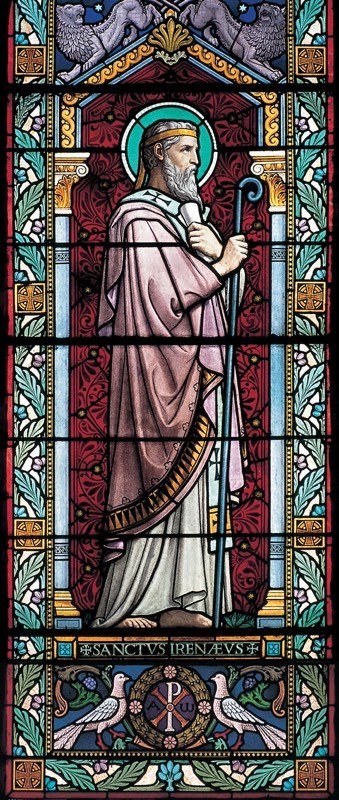
| Time | Born about 135 to 140 (Benedict XVI's date; others say earlier); died about 202 to 203 |
|---|---|
| Where | Probably born at Smyrna (today Izmir, Turkey). Priest and then bishop of Lyons (Lugdunum, today Lyon, France). |
| What he was | Priest, then Bishop of Lyons; theologian; pastor; peacemaker |
| Language | Greek. Living among the Celts, he says he was used to a "barbarous dialect" for most purposes. |
| Known as | Doctor unitatis, the Doctor of Unity. His name means "peaceful" in Greek. |
| Honoured | Saint. Declared a Doctor of the Church by Pope Francis on 21 January 2022. Roman calendar: 28 June. Byzantine tradition: 23 August. Syro-Malabar calendar: 28 June. Other Churches' calendars may differ. |
His life
Smyrna and Polycarp. Almost all that we know comes from his own words and from Eusebius of Caesarea, who preserves them in the fifth book of his Church History. Irenaeus grew up in Asia Minor (today western Turkey), in all probability at Smyrna. The year is not known. Benedict XVI says about 135 to 140. The Catholic Encyclopedia reports proposals from about 115 to about 142.
What he does tell us is unforgettable. As a boy he heard St Polycarp, Bishop of Smyrna, who had known the Apostle John and died as a very old martyr. Years later Irenaeus wrote to a boyhood friend, Florinus: "I remember the events of that time more clearly than those of recent years." He could describe the very place where Polycarp sat, how he came and went, and how he spoke of his time with John and with others who had seen the Lord. "I listened," he says in substance, and wrote these things not on paper but in his heart. This is one short chain: the Lord, John, Polycarp, Irenaeus.
To Gaul. We do not know when or why he went west. There were close links between Asia Minor and the Christians of the Rhône valley, and many in Lyons came from the East. By 177 we find him a priest of the Church at Lyons, a trading city and the chief city of the Gauls, whose bishop was the aged St Pothinus. (The English text of Benedict XVI's audience spells him Pontinus. Eusebius's form is Pothinus.)
The martyrs of 177. In that year, under the Emperor Marcus Aurelius, a terrible persecution broke out at Lyons and Vienne. The Christians were first shut out of the public places, then attacked by mobs, and then tortured and killed in the arena. The letter which describes these events is preserved by Eusebius (Church History 5, 1), and it may be among the most powerful of all early Christian texts. There was Sanctus, the deacon from Vienne. There was Maturus, a new convert. There was Attalus of Pergamum. There was Pothinus, past ninety years, who died in prison after a beating. There was Ponticus, a boy of about fifteen. And there was Blandina, a slave whom everyone feared would be too weak, and who outlasted them all. Benedict XVI gives the number as at least 48.
The errand to Rome. Irenaeus survived because he was away. While the persecution continued, the martyrs in prison sent him to Rome with a letter to Pope Eleutherius, seeking peace in the churches over the movement of Montanus. Their words of recommendation are the only description of him from people who knew him: "our brother and comrade Irenaeus", "zealous for the covenant of Christ" and "a presbyter of the church" (Church History 5, 4).
Bishop of Lyons. On his return Pothinus was dead. Irenaeus became bishop in his place, about 178. He was now responsible for a shattered community, and he lived among people who spoke another tongue. In his great work he apologises for his style, for he lives "among the Keltae" and is used to speaking "a barbarous dialect" (Against Heresies 1, preface). Benedict XVI speaks of his "missionary enthusiasm".
Against the false knowledge. A friend asked him about the teachings of the Valentinians, who were spreading into the Rhône valley. Irenaeus studied their writings and then wrote his long refutation, volume by volume, during the time of Pope Eleutherius (about 174 to 189), whom he names as the current Bishop of Rome.
Florinus and Blastus. He stayed close to events in Rome. When Florinus, the boyhood friend who had become a Roman priest, began to drift into Valentinian ideas, Irenaeus wrote to him and reminded him of Polycarp. Against Blastus, who caused a schism in Rome, he wrote On Schism.
The peacemaker and Pope Victor. Then came his finest hour as a peacemaker. About 190, Pope Victor moved to cut off the Churches of Asia from communion, because they celebrated Easter on the fourteenth day of the moon on whatever day of the week it fell, instead of on Sunday. Irenaeus held the Roman custom himself, that Easter must be kept on the Lord's day. But he wrote to Victor and urged him not to cut off whole Churches for keeping an ancient custom. He recalled that Polycarp and Pope Anicetus had differed on this and yet remained in communion, and that Anicetus had given Polycarp the honour of celebrating the Eucharist. "The disagreement in regard to the fast confirms the agreement in the faith", he wrote. Eusebius comments that he "truly was well named" (Church History 5, 24).
His death. We know nothing certain about his last years. Benedict XVI says his ministry ended in about 202 to 203, "perhaps with martyrdom". The first writer we know who calls him a martyr is Gregory of Tours, in the sixth century, so many historians are cautious. The Catholic Encyclopedia thought it unlikely.
His tomb. According to tradition he was buried in Lyon, in the Church of St John, later named after him. Calvinist troops wrecked the shrine in 1562, during the wars of religion, and the relics were lost. The crypt of Saint-Irénée, rebuilt, can still be visited.
The world he lived in
The late second century was still an age of sharp persecution, as the Lyons letter shows. But the great danger Irenaeus faced came from inside the Christian world. A wide family of movements, today called Gnostic (from gnosis, "knowledge"), was attracting serious people. Benedict XVI summarises them: the faith of the Church, they said, was mere symbolism for the simple. The initiates knew what lay behind the symbols. There were many schools, with long tales of heavenly beings. Valentinus, Ptolemy, Marcus and Marcion were among their teachers.
They had one idea in common: that the world of matter is a mistake or a fall, made by a lesser power and not by the good God. If so, then the body is a prison. The God of the Old Testament cannot be the Father of Jesus. The Word did not truly take flesh. The resurrection of the body is a misunderstanding. The bread and wine cannot carry anything holy. Irenaeus saw that this wrecked the whole faith.
In his time the list of the books of Scripture was not yet finally fixed, and no general council had yet met. The question was urgent: how do you tell the true Gospel from the many stories now in circulation? His answer has shaped Christians ever since.
Other disputes were at work too: the Montanist prophecy movement in Phrygia, and the dating of Easter. Irenaeus was personally involved in all of them, and each time, he worked for truth and for peace together.
What he taught
- One God, Creator and Father. There is no second god behind the God of creation. He made all things, matter included, and he is the Father of our Lord Jesus Christ (Against Heresies 1, 10 and all of Book 2). Benedict XVI says he "decisively claimed the original holiness of matter, of the body, of the flesh no less than of the spirit".
- The two hands of God. God needs no angels to make the world. With him are always "the Word and Wisdom, the Son and the Spirit", by whom he made all things (4, 20, 1). In other places he calls them God's hands. It is one of the earliest pictures of the Trinity at work. The Demonstration (6) lays out three articles of faith: God the Father; the Word, the Son; and the Holy Spirit.
- All things gathered up in Christ. His central idea is that of recapitulation. Christ gathers up in himself the whole of human history, and takes it through again, rightly this time. Adam fell through a tree, and Christ obeyed on a tree. "God recapitulated in Himself the ancient formation of man, that He might kill sin, deprive death of its power, and vivify man" (3, 18, 7). See Ephesians 1:10.
- God became what we are. Christ "did, through His transcendent love, become what we are, that He might bring us to be even what He is Himself" (5, preface). And "the Son of God became the Son of man, that man ... might become the son of God" (3, 19, 1). The Eastern and Western Churches alike draw on this teaching.
- Human life and God's glory. "The glory of God is a living man; and the life of man consists in beholding God" (4, 20, 7). The Catechism quotes it (CCC 294). It is often quoted loosely as "man fully alive".
- The rule of faith. The Church holds one summary of faith, received from the apostles, which is the key to reading the Scriptures (1, 10). Benedict XVI says it coincided in practice with the Apostles' Creed.
- Tradition is public, one, and alive. Against secret teachings, he says the apostles handed down what they knew in the open, through the bishops they appointed (3, 3). The Church everywhere, "as if she possessed only one mouth", teaches the same, in Germany, Spain, Gaul, the East, Egypt and Libya (1, 10, 2). And Tradition is not dead: "where the Church is, there is the Spirit of God; and where the Spirit of God is, there is the Church and every kind of grace" (3, 24, 1).
- The succession of bishops and the Church of Rome. He lists the bishops of Rome from Peter and Paul up to Eleutherius, the twelfth from the apostles. Every Church, he writes, must agree with this Church "on account of its preeminent authority" (3, 3, 2). The Latin wording here is much studied, but the Catechism quotes the passage (CCC 834) and Benedict XVI explains it as the measure of the true Apostolic Tradition.
- Four Gospels. The Gospels are four, no more and no fewer, "four pillars" of the Church (3, 11, 8). He is an early and important witness to the four Gospels as a closed set, and he is one of the first to name John's Gospel as the work of the apostle.
- One Bible, Old and New. Against Marcion, he shows that the Old and New Testaments have one author and one plan. God is patiently educating the human race over time, step by step, until it can bear his presence (Book 4).
- Mary, the new Eve. Here he builds on St Justin. As Eve, disobedient, became the cause of death for herself and all, so Mary, "by yielding obedience", became "the cause of salvation, both to herself and the whole human race". "The knot of Eve's disobedience was loosed by the obedience of Mary" (3, 22, 4). He even calls Mary the advocate of the virgin Eve (5, 19, 1). The Second Vatican Council quotes him (Lumen Gentium 56). All of this honours her only as she depends on her Son, who alone is Saviour.
- The Eucharist. He turns it into an argument for the goodness of creation and the resurrection. Bread from the earth, when it receives the invocation of God, is "no longer common bread, but the Eucharist, consisting of two realities, earthly and heavenly" (4, 18, 5). If the flesh is fed by the Lord's body and blood, how can it be incapable of eternal life (5, 2, 3)? The Eucharist itself is the offering that the prophets foretold (4, 17 and 18).
- The resurrection of the body. Book 5 is built around this. God's work is not to escape from the body, but to save it.
Where the Church does not follow him
- The thousand years. Like St Justin he expected a thousand-year reign of the saints on earth before the end (5, 32 to 36). The Church has since rejected such hopes for a kingdom within history, "even modified forms" (CCC 676). He holds it because he so firmly believes that the world of flesh will be saved.
- The age of Christ. Arguing against the Gnostic reading of the number thirty, he held that the Lord lived to more than forty years (2, 22). This is not a Church teaching, and it rests on a reading of John 8:57 that is not usually followed.
- Hard words. He is severe in controversy, and his words on his opponents are not gentle. That was the manner of the age. It need not be ours.
These points come from a pioneer whose main line was sound. Doctors of the Church are honoured for the great weight of their teaching, not because every line they wrote stands.
How he taught
He was a pastor first. He says he has no skill in rhetoric, and asks readers to receive in a kindly spirit what he writes in simplicity. His style is not elegant and his great work is long. But Benedict XVI says he was "the first great Church theologian who created systematic theology", because he saw the inner connections of the faith, from creation through to the resurrection.
His method is simple. First he lets the Gnostics speak. Book 1 sets out their system so carefully that for centuries it was one of our chief sources about them, and modern finds of Gnostic texts have confirmed much of it. Then he shows from reason how it falls apart. Then he goes to the Scriptures, the apostles and the Lord's own words.
He likes homely images. The heretics, he says, are like one who takes a beautiful image of a king, made of precious jewels, and rearranges the gems to make a dog or a fox (1, 8). Tradition is a precious deposit in a good vessel which renews its youth by the Spirit (3, 24, 1). Christ, the perfect bread of the Father, offered himself to us as milk, because we were like infants (4, 38).
He was gentle with people even when he was fierce with ideas. His letter to Pope Victor shows him standing up for those whose custom he did not share.
His works
Surviving whole
Against Heresies, more fully The Detection and Overthrow of the False Knowledge, in five books. Written in Greek; whole only in an early, very literal Latin translation, with much of Book 1 and other portions in Greek through later writers, and Books 4 and 5 also in Armenian. Book 1 sets out the Gnostic systems. Book 2 refutes them by reason. Book 3 answers from the apostles. Book 4 from the Lord's words and the Old Testament. Book 5 treats the resurrection and the last things.
Surviving whole, found late
Demonstration of the Apostolic Preaching, addressed to a friend, Marcian. A short summary of the faith from Old Testament prophecy. Eusebius names it, but it was lost until December 1904, when Dr Karapet Ter-Mekerttschian found an Armenian copy in Yerevan (Armenia). He published it in 1907. Benedict XVI calls it the oldest "catechism of Christian doctrine".
Lost, known from fragments or by name
On Knowledge, against the Greeks. On Monarchy (or That God Is Not the Author of Evil), to Florinus. On the Ogdoad, against Valentinian teaching. On Schism, to Blastus. A letter to Pope Victor on the date of Easter, of which Eusebius preserves a part, and other letters on this. A volume of various Discourses (Eusebius 5, 26). Some small fragments survive in later writers.
Not his
Four "fragments" published by C. M. Pfaff in 1715, said to come from Turin, were shown by Harnack to be Pfaff's own forgery. Some other late pieces under his name are doubtful.
A short taste
From the Ante-Nicene Fathers translation (Roberts and Rambaut):
"The glory of God is a living man; and the life of man consists in beholding God" (Against Heresies 4, 20, 7).
"Where the Church is, there is the Spirit of God; and where the Spirit of God is, there is the Church" (3, 24, 1, as quoted by Benedict XVI).
What the Popes and the Church say of him
- Pope Francis on 7 October 2021 told the Catholic and Orthodox members of the Saint Irenaeus Working Group that he would soon declare him a Doctor of the Church with the title Doctor unitatis. He said Irenaeus "was a great spiritual and theological bridge between Eastern and Western Christians".
- Pope Francis's decree of 21 January 2022, during the Week of Prayer for Christian Unity: Irenaeus, "who came from the East, exercised his episcopal ministry in the West". "His name, Irenaeus, expresses that peace which comes from the Lord and which reconciles, restoring unity." With his apostolic authority the Pope declared him a Doctor with the title Doctor unitatis. News reports counted him as the 37th Doctor.
- Benedict XVI gave his catechesis on 28 March 2007. He calls him "the champion in the fight against heresies" and sums up his teaching on Tradition in three words: public, one, and pneumatic (that is, guided by the Holy Spirit). This, he says, is not traditionalism, for Tradition is enlivened from within by the Spirit.
- The Second Vatican Council relies on him for Mary as the new Eve (Lumen Gentium 56), and for the succession of bishops from the apostles (Lumen Gentium 20).
- The Catechism uses him many times, among them on the glory of God (294) and on the Church of Rome (834).
- Benedict XVI uses his line on the glory of God again in Sacramentum Caritatis 71 (2007).
Why he matters today
He loves the body and the world. There are still many who think that only the spirit matters, or that the world is finally not worth much. Irenaeus says God made this world, entered it, feeds us with its bread and wine, and will raise these bodies. Care for creation, care for the sick and the old, respect for the unborn, all find a firm ground in his teaching.
He tells us there is no secret Christianity. Every age has its people claiming a hidden, higher knowledge. Irenaeus answers that the faith is open to all, confessed in public, the same for the learned and for the simple.
He is a bridge. He comes from the East and serves in the West. He is honoured by Catholics and Orthodox alike. He defends Rome's place, and he also corrects a Pope, with respect, for the sake of unity. That is why the joint Orthodox and Catholic group took his name, and why he is the Doctor of Unity.
He shows what a bishop is. After a massacre, he took up a broken community, lived among a people of another tongue, wrote for his flock, and worked for peace among the Churches.
He joins us to the apostles. In one memory, the old man Polycarp speaking of John, we can almost touch the first generation. Our faith has reached us hand to hand.
Sit with this
- Who handed the faith to me? Do I remember, as Irenaeus remembered Polycarp, how they spoke and where they sat?
- Do I treat my body, the sick and the world around me as God's own work?
- "The disagreement in regard to the fast confirms the agreement in the faith." Where must I learn to tell a difference in custom from a difference in faith?
Timeline
| Date | Event |
|---|---|
| About 135 to 140 | Probably born at Smyrna (Benedict XVI's date; others propose earlier). |
| In his youth | Hears St Polycarp of Smyrna, who died a martyr about 155. |
| By 177 | Priest at Lyons, in Gaul. |
| 177 | Persecution at Lyons and Vienne. Irenaeus goes to Rome with a letter to Pope Eleutherius. |
| About 178 | Bishop of Lyons after the death of Pothinus. |
| About 180 | Writing Against Heresies, in the time of Eleutherius. The Demonstration follows it. |
| About 190 | Letter to Pope Victor about the date of Easter. |
| About 202 to 203 | Dies at Lyons, perhaps a martyr. |
| 6th century | Gregory of Tours calls him a martyr. |
| 1562 | His shrine at Lyon is destroyed. |
| 1904 and 1907 | The Demonstration is found in Armenian and published. |
| 28 March 2007 | Benedict XVI's catechesis. |
| 7 October 2021 | Francis announces the coming title to the joint working group. |
| 21 January 2022 | Francis declares him Doctor of the Church, Doctor unitatis. |
Sources: Benedict XVI, General Audience, 28 March 2007; Decree of Pope Francis, 21 January 2022 (Holy See Press Office); Dicastery for Promoting Christian Unity; Francis, address of 7 October 2021; Against Heresies (Ante-Nicene Fathers, New Advent); Demonstration, with Robinson's introduction (CCEL); Eusebius, Church History 5; Catholic Encyclopedia; Lumen Gentium; Catechism 834; Aleteia, on the church at Lyon (2025); Oxford, Cult of Saints database, on Gregory of Tours. Dates for this period are approximate. Syro-Malabar day: the official calendar (Syro-Malabar Liturgical Calendar, Second Set).