St Justin Martyr
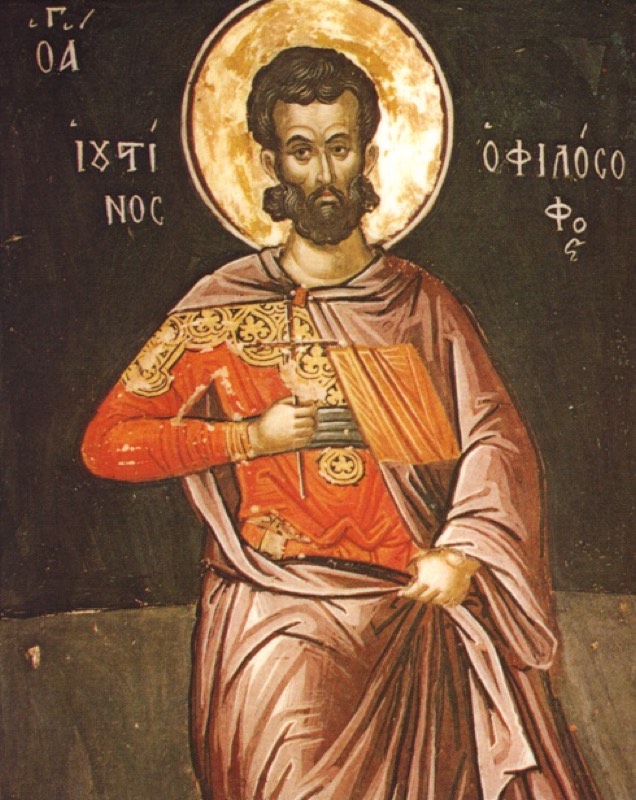
| Time | Born about 100; beheaded about 165 |
|---|---|
| Where | Born at Flavia Neapolis (today Nablus, in the West Bank), in Samaria. At Ephesus (today in Turkey) according to Eusebius, then at Rome, Italy. |
| What he was | A layman, a philosopher, a teacher who ran a Christian school at Rome, and a martyr. He is not known to have held any office of clergy. |
| Language | Greek |
| Known as | Justin the Philosopher; Justin Martyr. Pope Benedict XVI calls him "the most important of the second-century apologist Fathers". |
| Honoured | Saint and martyr. Roman calendar: memorial on 1 June (from the time of Leo XIII until the calendar reform of the 1960s it was 14 April). Byzantine tradition: 1 June. Syro-Malabar calendar: 1 June. Other Churches' calendars may differ. |
His life
Birth and family. In the opening line of his First Apology Justin tells us who he is: the son of Priscus and grandson of Bacchius, from Flavia Neapolis in Palestine. The Romans had founded this city near ancient Shechem, in Samaria, about the year 72. His family names suggest pagans of Greek or Roman culture. He calls himself uncircumcised, and he was brought up outside both Judaism and Christianity. Benedict XVI gives his birth as about the year 100.
The search. Justin tells his own story at the start of the Dialogue with Trypho. He wanted to know God, and so he went to the philosophers. A Stoic told him that knowledge of God was not necessary. A Peripatetic wanted to settle his fee first, which made Justin doubt he was a philosopher at all. A Pythagorean told him he must first study music, astronomy and geometry. Then a Platonist gave him great joy, and Justin came to think he would soon look upon God. Scholars note that he has arranged the story to make a point, but the search itself was real.
The old man by the sea. One day he walked alone in a field near the sea to think. An old man, gentle and venerable, followed him and began to question him. How can the soul see God by its own power? Did the philosophers really know? He pointed Justin to the prophets, who were older than the philosophers and spoke by the Spirit of God and foretold the Christ. He told him to pray "that, above all things, the gates of light may be opened to you" (Dialogue 7). Then he went away, and Justin never saw him again. Justin writes: "straightway a flame was kindled in my soul" (Dialogue 8). He came to love the prophets and "those men who are friends of Christ".
What else moved him. In the Second Apology (ch. 12) he gives one more reason. He had heard the slanders against Christians, but he saw them without fear before death and everything people dread. People like that, he reasoned, could not be living in the wickedness the rumours described.
He was converted at the latest about the year 130, according to the Catholic Encyclopedia. We do not know where.
The philosopher who stayed a philosopher. He did not give up the life of a thinker: "Thus, and for this reason, I am a philosopher" (Dialogue 8). Eusebius says that he preached the word of God "in the guise of a philosopher". He seems to have gone on wearing the philosopher's cloak, as Trypho's first remark to him suggests. He travelled and discussed, as philosophers did.
Ephesus and Trypho. Eusebius says the conversation with Trypho took place at Ephesus. The Dialogue itself mentions a walk in the colonnades, and Trypho, a Jew who had fled the recent war in Judaea, the Bar Kokhba revolt of 132 to 135. So the meeting belongs to about that time, though Justin wrote the book up much later, before 161.
Rome. Justin lived at Rome twice. There he opened a school where, as Benedict XVI says, he took no fee and taught the new religion as the true philosophy. At his trial he said he lived above a certain Martinus, near a bath, and that anyone who came to him heard the doctrines of truth. His best known student was Tatian, an Assyrian who later wrote the Diatessaron, a single Gospel woven from the four. Irenaeus tells us that after Justin's death Tatian left the Church's teaching.
The petitions. About the years 153 to 155 he wrote his First Apology, addressed to the Emperor Antoninus Pius, his adopted sons, the Senate and the people of Rome. In it he asks for one simple thing: that Christians should be tried for crimes they have done, not punished merely for the name. Soon after, he added the shorter Second Apology. It was provoked by a case he had just seen at Rome. A woman became a Christian and left her debauched life. Her husband denounced her and then her teacher Ptolemaeus. The prefect Urbicus sentenced Ptolemaeus to death only because he confessed he was a Christian. A man named Lucius protested, and he too was condemned.
Crescens. Justin knew what was coming. In the Second Apology (ch. 3) he says he expects to be plotted against, perhaps by Crescens, a Cynic philosopher whom he had beaten in public debate. Tatian and Eusebius report that Crescens did plot against him. The Catholic Encyclopedia calls this credible but not certain.
The trial, about 165. The record of his trial has come down to us, the Acts of Justin, and it is among the most moving of early documents. Justin and six companions were brought before Rusticus, prefect of Rome, under the Emperor Marcus Aurelius. They were Chariton; Charito, a woman; Euelpistus, a slave of the imperial household, whose parents were in Cappadocia; Hierax, from Iconium; Paeon; and Liberianus. Rusticus told him to obey the gods. Justin said he had tried to learn every doctrine and had settled at last on the true doctrine of the Christians. Asked where they met, he would not give any place. Rusticus asked each of the others. Hierax said, "Christ is our true father, and faith in Him is our mother". Paeon said his parents had taught him the good confession.
Rusticus turned to Justin: "if you are scourged and beheaded, do you believe you will ascend into heaven?" Justin answered that he hoped, if he endured, to have God's gifts. Asked again whether he supposed he would ascend to receive a reward, Justin answered: "I do not suppose it, but I know and am fully persuaded of it." The sentence was scourging and beheading. They went to the usual place and were put to death, and some of the faithful secretly took the bodies and buried them.
The world he lived in
Justin lived in the middle of the second century, under the Antonine emperors, a time that Romans remembered as peaceful and well governed. Christians were still a small group in the empire, and they lived with a strange legal position. There was no general hunt for them, but if someone brought an accusation and they would not deny their faith, they could be put to death. Their refusal to honour the gods earned them the charge of "atheism". Rumours spread that they ate human flesh and held wicked gatherings at night.
Greek philosophy was the serious culture of the age, and an emperor like Marcus Aurelius was himself a Stoic writer. The schools were competing for the souls of thoughtful young men. Many educated people looked on Christians as simple folk who believed without reason. The question of the day was whether a Christian could speak to such people as an equal.
There was also a question within. Marcion was teaching at Rome that the God of the Old Testament was not the Father of Jesus. The groups we now call Gnostic were spreading secret teachings. Justin's Roman years were years of great confusion, and he wrote against these errors as well.
The Jewish people had just lived through a catastrophe. After the Bar Kokhba war, Jews were barred from Jerusalem. It was a time of great suffering for them and of painful separation between the synagogue and the Church. Justin's Dialogue must be read against that background.
What he taught
- The Word and the seeds of truth. This is the idea he is most famous for. Christ is the Word (Greek Logos), the eternal Reason of God. "Every race of men" shares in him (First Apology 46), and there is a "seed of reason" planted in all people (Second Apology 8). So those who lived by reason before Christ, like Socrates and Heraclitus among the Greeks, partly knew him. "Whatever things were rightly said among all men, are the property of us Christians" (Second Apology 13). What others saw in part, the Church has received whole in the Person of Christ.
- Faith and reason belong together. Philosophy is not an enemy. But he insists that the highest knowledge of God is received and not achieved: the prophets spoke by the Spirit, and one must pray for the gates of light to open. Thus Christianity is "this philosophy alone" that is safe and profitable (Dialogue 8).
- God and the Trinity. Christians worship the Father, the Son, and the prophetic Spirit (First Apology 6 and 13). He defends the Son's distinct existence from the Father from the Old Testament appearances of God (Dialogue 56 and following).
- Baptism. In First Apology 61 he describes it plainly: those who believe, fast and pray, are led to water and are "regenerated" in the name of the Father, of the Son and of the Holy Spirit. The washing is called "illumination". He cites John 3:5.
- The Eucharist. This is the most quoted part of his writing. "Not as common bread and common drink do we receive these", he tells the emperor. The food over which thanks is given is "the flesh and blood of that Jesus who was made flesh" (First Apology 66). Only those who believe, are baptised and live as Christ commanded may receive. In the Dialogue (41 and 117) he also speaks of it as the sacrifice foretold by Malachi 1:11, offered in remembrance of the Lord's passion.
- Sunday. His description of Sunday in First Apology 65 to 67 is the oldest detailed account we have of the order of the Mass, outlined in the table below.
- Mary, the new Eve. He may be the first writer we know who draws this contrast: Eve, a virgin, received the word of the serpent and brought forth disobedience and death; the Virgin Mary received faith and joy when the angel brought her the good news (Dialogue 100). St Irenaeus takes this up after him.
- Prophecy fulfilled. The longest part of his works sets out the Old Testament prophecies of Christ, in the First Apology (31 to 53) and in most of the Dialogue.
- Human responsibility. God's foreknowledge does not take away our choice. People are answerable for what they do (First Apology 43 and 44). He wants to defeat the idea that fate rules all.
- The Christian life. He tells the emperor how Christians live: they share their goods and pray for their enemies, and they do not expose their babies as others did (First Apology 14 and 27).
The Mass as Justin described it to the emperor
| Step | What he reports (First Apology 65 to 67) |
|---|---|
| Sunday gathering | On the day called Sunday, those in towns and countryside come together in one place. He gives two reasons: on that day God began to create, and on that day Jesus Christ rose. |
| Readings | The memoirs of the apostles, which "are called Gospels", or the writings of the prophets are read, as long as time allows. |
| Homily | The one presiding speaks, and urges them to imitate these good things. |
| Prayers | All stand and pray for themselves, for the newly baptised, and for all people everywhere. |
| Kiss of peace | After the prayers they greet one another with a kiss. |
| Bread and cup | Bread and a cup of wine mixed with water are brought to the one presiding. |
| Great thanksgiving | He offers praise and glory to the Father through the Son and the Holy Spirit, at length. The people answer, "Amen". |
| Communion | Deacons give the Eucharist to those present and take it to those who are absent. |
| Collection | Those who can give do so. The one presiding uses it for orphans, widows, the sick, prisoners and strangers. |
Almost nineteen centuries later, any Catholic reader will recognise this outline, in any rite. The Catechism quotes it at length (CCC 1345).
Where the Church does not follow him
- The language of the Trinity. Justin wrote before the Council of Nicaea (325) and before the words of later doctrine were settled. When he speaks of the Son "in the second place" and the Spirit "in the third" (First Apology 13), or sees the Son's generation as linked with the creation of the world, his words fall short of the exactness that the Church reached later. He was not denying the Son's divinity, for he adored him. The Church reads him as an honest pioneer, and today's believer follows Nicaea.
- The thousand years. He held that the saints would reign for a thousand years in a rebuilt Jerusalem, though he adds that many true Christians thought otherwise (Dialogue 80 and 81). The Church has since rejected this idea of a kingdom within history, "even modified forms" of it (CCC 676).
- The word about demons. He held that demons inspired the pagan myths and imitated the Christian sacraments (First Apology 66, on Mithras). Today the Church, in Nostra Aetate, looks on other religions with greater respect, and rejects nothing true and holy in them, although Christians still cannot worship idols.
- Hard words to Jews. The Dialogue, like many writings of its age, contains severe charges against the Jewish people of his time. These are not the Church's teaching today. The Council teaches that the Jews are not to be presented as rejected or accursed by God (Nostra Aetate 4).
How he taught
He taught like a philosopher: he reasoned aloud, in conversation. The Dialogue is a long discussion over two days, with friends of Trypho coming and going. It is often repetitive, and he himself apologises for going over points again. He has no great beauty of style. An older scholar quoted in the Catholic Encyclopedia says he was no genius. What he has is honesty, patience and courage.
His method is to meet people on their own ground. With the rulers, whose heir he addresses as "the Philosopher", he reasons about justice. With pagans, he cites Socrates and Plato. With Trypho, he goes through the Hebrew prophets line by line. He will not hide Christian practice, and he tells the emperor exactly what happens on Sunday. That openness is itself his argument: we have nothing to hide.
And he finishes with courtesy. The Dialogue ends with Trypho saying that he has enjoyed it more than he expected, and asking Justin to "remember us as friends" (Dialogue 142). Justin leaves them with a prayer for their salvation. They disagreed, and they parted as friends.
His works
Surviving, and accepted as his
First Apology (about 153 to 155): a petition to the Emperor Antoninus Pius, in 68 chapters. Defends Christians and explains belief, prophecy, baptism and the Eucharist.
Second Apology (soon after): shorter, written after the case of Ptolemaeus. The surviving text is addressed to the Romans or Senate. Eusebius and Benedict XVI link it with Marcus Aurelius.
Dialogue with Trypho (before 161): a long discussion with a learned Jew, set out in 142 chapters. The manuscript has gaps.
Known by name, now lost
Against All Heresies, which he mentions in First Apology 26.
Against Marcion, known from Eusebius and Irenaeus.
Against the Greeks and Refutation, as listed by Eusebius.
On the Sovereignty of God, Eusebius's title.
The Psalmist (Psaltes).
On the Soul.
Fragments, disputed
On the Resurrection: fragments preserved by a later writer. The Catholic Encyclopedia of 1910 thought them probably authentic, but scholars debate this.
Falsely under his name
Exhortation to the Greeks, Discourse to the Greeks, On Monarchy, Exposition of the Faith, Letter to Zenas and Serenus, Answers to the Orthodox, Christian Questions to the Greeks, Greek Questions to the Christians, Refutation of Certain Aristotelian Theses, and the Letter to Diognetus, a fine early work which one manuscript gave to him. Later works carry his name because of his fame. Some have the same titles as his lost books, but they are other writings.
Nearly all that we have comes from one damaged manuscript (Paris, gr. 450), finished on 11 September 1364. The only other copy is taken from it. Benedict XVI lists the two Apologies and the Dialogue as "his only surviving works".
A short taste
From the Ante-Nicene Fathers translation (Dods, Reith, and others):
"Pray that, above all things, the gates of light may be opened to you" (Dialogue 7, the old man's parting words).
"Whatever things were rightly said among all men, are the property of us Christians" (Second Apology 13).
What the Popes and the Church say of him
- Benedict XVI spoke on him at the General Audience of 21 March 2007. He calls him "the most important of the second-century apologist Fathers". He says that Justin's work marks the early Church's option for philosophy and reason and against the pagan religion's myths, and he draws a lesson against relativism. He ends by repeating the old man's words on the gates of light.
- St John Paul II, in Fides et Ratio 38 (1998), calls him a pioneer in engaging with philosophy, with careful discernment. In Dies Domini 27 and 46 (1998), he uses Justin's witness to explain Sunday.
- Sacramentum Caritatis 72 (2007), by Benedict XVI, speaks of the Sunday gathering "according to the account of Saint Justin Martyr".
- The Catechism quotes his account of the Mass at length (CCC 1345).
- Leo XIII had a Mass and Office composed in his honour, with a feast for the whole Latin Church on 14 April. The calendar reform of the 1960s moved it to 1 June, the date on which the Byzantine tradition had long kept it.
- The Second Vatican Council uses the same phrase when it speaks of the "seeds of the Word" hidden among other peoples (Ad Gentes 11).
Why he matters today
For anyone who has searched long and thought too much: Justin shows that a restless mind can be a road to Christ. Faith does not ask the mind to stop.
For Christians in India and other lands of ancient cultures: he gives us a way to honour what is true in other traditions without giving up the claim that Christ is the fullness of truth. He gives a way to respect people of other faiths while being honest about our own.
For lay people: here is a Christian teacher who, as far as we know, was never ordained, who taught the faith at his own cost, and who died for it. When the state demanded to know his teaching, he told it.
For anyone who goes to Mass on Sunday: his few lines remind us that we are doing what Christians were doing about the year 150. It is the same order and the same care for the poor.
Sit with this
- What did I once seek that brought me, in the end, to Christ? Have I thanked God for that road?
- Whom do I know who is searching? Can I speak to them as patiently as the old man spoke to Justin?
- "I know and am fully persuaded of it." What do I know that deeply?
Timeline
| Date | Event |
|---|---|
| About 100 | Born at Flavia Neapolis in Samaria. |
| At the latest about 130 | Converted to Christ after his search among the philosophers. |
| 132 to 135 | Bar Kokhba war. The Dialogue sets its meeting with Trypho in this period, at Ephesus according to Eusebius. |
| About 150 | Teaching at Rome, in his school above Martinus. |
| About 153 to 155 | First Apology to Antoninus Pius. |
| Soon after | Second Apology, after the condemnation of Ptolemaeus and Lucius. |
| Before 161 | Dialogue with Trypho, in its written form. |
| About 165 | Tried before Rusticus and beheaded with six companions, under Marcus Aurelius. |
| 1364 | The Paris manuscript is finished. |
| Under Leo XIII (1878 to 1903) | Mass and Office in his honour; feast on 14 April. |
| 1960s | Roman calendar reform moves his memorial to 1 June. |
| 21 March 2007 | Benedict XVI's catechesis. |
Sources: Benedict XVI, General Audience, 21 March 2007; First Apology, Second Apology and Dialogue with Trypho (Ante-Nicene Fathers, New Advent); The Martyrdom of Justin (ANF, CCEL); Eusebius, Church History 4; Catholic Encyclopedia (J. Lebreton, 1910); Dies Domini; Sacramentum Caritatis; Catechism 1345, 676; Nostra Aetate. Dates for this period are approximate. Syro-Malabar day: the official calendar (Syro-Malabar Liturgical Calendar, Second Set).