Origen of Alexandria
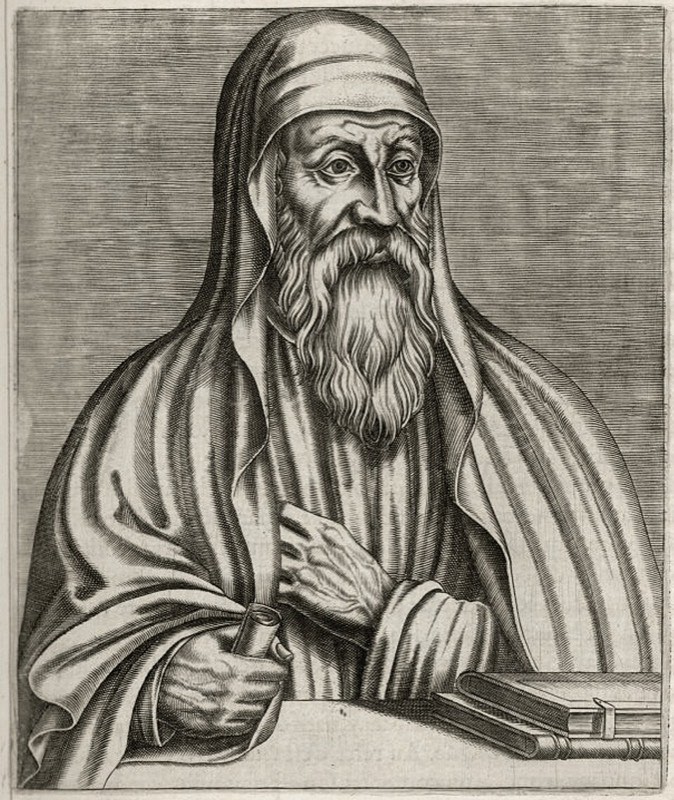
| Time | Born about 185; died about 253 or 254, aged about 69 |
|---|---|
| Where | Alexandria (Egypt) until about 232; then Caesarea in Palestine (today Caesarea Maritima, Israel); died at Tyre (today Sour, Lebanon), according to later report |
| What he was | Layman and teacher for most of his life; priest from about 231; head of the catechetical school; biblical scholar and preacher; confessor of the faith under torture |
| Language | Greek; he learned Hebrew as well |
| Known as | Adamantius, "man of steel"; the most prolific author of Christianity's first three centuries, in the words of Benedict XVI |
| Honoured | Not a saint. He has no feast in any tradition we could find. Why, told without harshness: he is one of the very greatest Christian teachers, and he suffered for Christ; but teachings linked to his name were condemned in 543, and his name stands in the eleventh anathema of the Second Council of Constantinople in 553. How far this touches the man himself is disputed. See "What was condemned" below. Pope Benedict XVI calls him "a great master of faith". |
His life
Our main source is the sixth book of the Church History of Eusebius of Caesarea, who admired him, and who collected a hundred of his letters. As Benedict XVI notes, Eusebius is an enthusiastic biographer. We add the farewell speech of his pupil St Gregory the Wonderworker, and what Jerome, Rufinus, Epiphanius and Photius report.
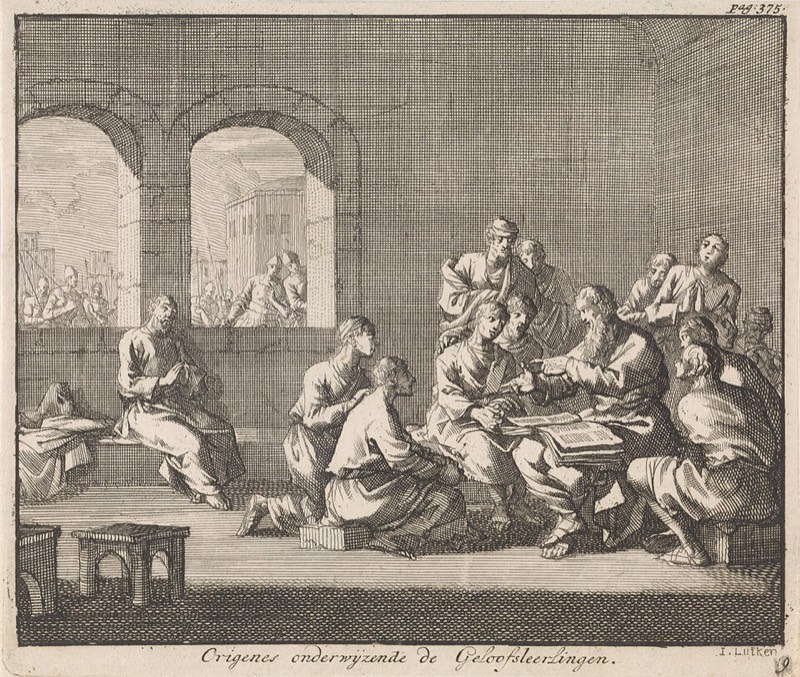
A martyr's son, 185 to 202. He was born at Alexandria to Christian parents, the eldest of seven sons. His father Leonides taught him Scripture before Greek learning and made him recite it daily. The boy pestered him with questions about deeper meanings. His father scolded him to his face, says Eusebius, and thanked God in private, and would go and kiss the sleeping child's breast as a temple of the Spirit. In 202, the tenth year of Septimius Severus, the persecution broke out. Clement, his teacher, left the city. Leonides was arrested. Origen wanted to run to martyrdom with him. His mother hid all his clothes, and so he stayed at home, and he wrote to his father: do not change your mind on our account. Leonides was beheaded and the family's goods were taken.
Teacher at eighteen. At not quite seventeen he supported his mother and six brothers by teaching Greek literature, helped for a time by a rich lady. Since all the catechists had fled, pagans came to him to hear about the faith. Bishop Demetrius soon gave him charge of the school. He sold his secular books for an income of four obols a day, and he lived in great poverty, with little sleep, much fasting, and for years without shoes. He stayed by the martyrs in prison and on the way to death, and many of them were his own pupils: Plutarch, Serenus, Heraclides, Heron, a second Serenus and the catechumen Herais. Crowds nearly killed him more than once.
A hard report. Eusebius says that in those years he took the words of Mt 19:12 too literally and made himself a eunuch, partly to avoid scandal in teaching women as well as men. Eusebius calls this the act of an immature mind. Some modern scholars accept the story. Others doubt it, since Origen never mentions it and, in his own commentary on that verse, condemns the literal reading. It remains unproved.
Scholar and traveller, about 203 to 231. He attended the school of the philosopher Ammonius Saccas, and he studied Plato and the Stoics. He learned Hebrew, and he began to gather the Greek versions of the Bible. About 213 he went to Rome, "to see the most ancient church of Rome", in his own phrase. Then he went to Arabia at the governor's request. About 215 he went to Palestine, where the bishops Alexander of Jerusalem and Theoctistus of Caesarea asked him to preach while he was a layman, which angered Demetrius. About 218 or about 232, the empress mother Julia Mamaea sent for him to Antioch under a military escort. A wealthy convert named Ambrose paid for more than seven secretaries in shifts, as well as copyists and girls skilled in writing, and he pushed him to write. Origen playfully called him his taskmaster. These years gave us On First Principles, the early books on John and on Genesis, and the Stromateis.
The break with Alexandria, about 231 to 232. On a journey to Greece on Church business he passed through Palestine, and the two bishops ordained him a priest. Demetrius, not consulted, was deeply offended. According to Photius, who read the lost part of the Apology, two councils at Alexandria followed: one banished him from the city and the other deposed him from the priesthood. Jerome says expressly that he was not condemned on a point of doctrine. Demetrius died soon after, and Heraclas, Origen's own pupil, became bishop, but Origen did not return.
Caesarea, 232 to 250. At Caesarea he opened a new school and built up a famous library. St Gregory the Wonderworker and his brother studied there for five years. He preached often, Pamphilus says nearly every day. During the persecution of Maximinus (235 to 237) he stayed with St Firmilian in Cappadocia. He went to Athens, and twice to Arabia. In Arabia he won Bishop Beryllus of Bostra back from error by gentle argument. The papyri found at Tura show him doing the same with Bishop Heraclides, in a remarkably friendly debate. In his sixties he at last let stenographers take down his sermons, and he wrote Against Celsus and the long Commentary on Matthew. He wrote to Pope Fabian about his orthodoxy, and to the Emperor Philip and his wife.
Torture, 250. When Decius began the great persecution, Origen was arrested. Eusebius tells of the iron collar, the dungeon, the stocks with his feet stretched four spaces apart, and threats of fire. The judge, says Eusebius, tried hard not to let him die. He did not give way. Benedict XVI says that this was the "irresistible yearning" for martyrdom "granted to him, at least in part".
Death. He survived Decius, broken in body, and he died about 253 or 254. He was buried with honour as a confessor, and his tomb behind the high altar of the cathedral of Tyre was long visited by pilgrims, by the Catholic Encyclopedia's account. Today the place is unknown. Modern scholars treat the Tyre story with some reserve.
The world he lived in
Alexandria had a great library, Greek philosophers, a large Jewish community, and Gnostic teachers such as Valentinus. Educated pagans like Celsus mocked Christians as ignorant. Marcion and the Gnostics separated the God of the Old Testament from the Father of Jesus. Much of what Christians now take for granted had not yet been worked out: there was no Creed of Nicaea, and no agreed language for the Trinity. Origen says so himself: the apostles handed on what is necessary and left other questions open for study. He worked in that open space. This is the first thing to remember when reading his boldest pages.
The Roman state was by turns tolerant and murderous. He lived through Severus, Maximinus and Decius. Between them came years when the emperor's mother and the Emperor Philip showed kindness to Christians. All his life he carried his father's example, and he never thought that study could replace the cross.
What he taught
- Theology is the explanation of Scripture. This is what Benedict XVI calls his "irreversible turning point": "a perfect symbiosis between theology and exegesis".
- The senses of Scripture. Benedict XVI lists three: the literal sense, the moral sense ("what we must do in living the word"), and the spiritual sense, by which all of Scripture speaks of Christ. Origen compares the Bible to a walnut with a bitter skin, a hard shell, and a kernel that feeds the soul (Homilies on Numbers 9.7). The Church keeps a form of this teaching today (CCC 115 to 118), with the literal sense as the foundation.
- The Old Testament is Christian Scripture. Against the Marcionites and Gnostics he held the two Testaments together. Read in the Spirit, "the Law is ever new" (Homilies on Numbers 9.4). Note that he is speaking of how Christians read, and he says nothing against the Jewish people here; he was in touch with rabbis to understand the Hebrew.
- Scripture is to be read with prayer. In his Letter to Gregory he tells his pupil to knock, seek and ask. Prayer "is absolutely necessary for understanding divine things". This is an early use of the phrase lectio divina. Benedict XVI says that Origen had a "primordial role" in its history, passing through Ambrose to Augustine and the monks.
- Knowing God is loving God. In the Homilies on the Song of Songs he tells of the Bridegroom coming and going in his own soul.
- The priesthood of all the baptized. "This discourse concerns us all" (Homilies on Leviticus 9). All believers offer sacrifice with a pure life, faith and knowledge of Scripture, and martyrdom is the height of it. Benedict XVI adds that these conditions hold all the more for the ministerial priesthood.
- Prayer. On Prayer is a great early Christian treatise on the subject, including a commentary on the Our Father. The Catechism uses it (CCC 2745, 2825, 2847).
- The Church is the rule of faith. "That alone is to be believed as truth which in nothing differs from the Church's and apostolic tradition", in substance (On First Principles, preface). He accepts only four Gospels, because tradition receives only four, and he defends the Baptism of infants as an apostolic tradition (see CCC 113 for his phrase on the Church's reading of Scripture).
- The Trinity. The three Persons alone are fully spiritual, all-knowing and holy in their own being. The Son is eternally from the Father. His language about rank between the Persons was later used by Arians, but St Athanasius defended him on this point.
- Christ and the defence of the faith. Against Celsus answers a pagan attack point by point, including the slanders on the birth of Jesus (see CCC 498). St John Paul II calls him "outstanding" among early Christians who used philosophy with a critical mind (Fides et Ratio 39).
What was condemned, and what is disputed
He said himself that he was exploring and not defining. Much of the trouble comes from On First Principles, which survives whole only in the Latin of Rufinus, who changed what he thought others had falsified. The Greek fragments in the anti-Origenist writers may be slanted the other way. So it is often hard to know what he himself wrote.
The chief teachings at issue, which are not the faith of the Church:
- The pre-existence of souls. All spirits were created equal, then fell by different degrees, and those who fell became angels, humans or demons. The Church teaches that each soul is created by God for its own body (CCC 366).
- Worlds without end. God created from eternity, in a series of worlds, with spirits rising and falling. The Church confesses that the world had a beginning (CCC 338), and that there is one life and no return (CCC 1013).
- The final restoration of all (apokatastasis). God will in the end bring all creatures to one end. The Church teaches the reality and eternity of hell, while praying that all be saved (CCC 1033 to 1037). The Catholic Encyclopedia notes that elsewhere Origen says the opposite, and that he grew angry when he was accused of teaching that the devil would be saved.
When these were condemned:
| Date | What happened | What is disputed |
|---|---|---|
| About 231 to 232 | Alexandrian councils under Demetrius remove him from the city and from the priesthood. | A matter of discipline, by Jerome's testimony, not of doctrine. Eusebius sees envy. |
| About 375 to 403 | First crisis. St Epiphanius attacks his teaching. St Jerome, once an admirer, turns against Rufinus. In 400 Theophilus of Alexandria has his books condemned at a local council. Pope Anastasius I, saying that Origen was unknown to him, condemns propositions drawn from his works. | Personal and political quarrels were tangled in it. Theophilus used it against St John Chrysostom, and later went on reading Origen himself. |
| 543 | Emperor Justinian writes a book against Origen, with ten anathemas, and Patriarch Mennas has the bishops at Constantinople sign them. Pope Vigilius and the other patriarchs accept it, by the reports of Liberatus and Cassiodorus. | A local synod. The target was monks in Palestine in Justinian's day, and scholars ask how far their views were Origen's own. |
| 553 | Second Council of Constantinople, the fifth ecumenical council. Its eleventh anathema names him with Arius, Eunomius, Macedonius, Apollinarius, Nestorius and Eutyches. | The council was called for another matter, the Three Chapters. Some scholars suspect a later addition. Others accept it as it stands. |
| 553 | Fifteen anathemas on Origenist teaching, signed by bishops at Constantinople about the time of the council. | Tanner's standard edition leaves them out, saying that recent study shows they cannot be attributed to the council. The Catholic Encyclopedia calls them an extra-conciliar sentence, which the Pope was not asked to approve. Many of them seem aimed at later Origenists, drawing on Evagrius, more than at Origen. |
Popes Vigilius, Pelagius I, Pelagius II and St Gregory the Great, when they speak of the fifth council, deal only with the Three Chapters, and they do not mention Origenism, as the Catholic Encyclopedia observes. But two later ecumenical councils do speak of it. The Third Council of Constantinople (680 to 681) says that the fifth council met against Theodore of Mopsuestia, Origen, Didymus and Evagrius. The Second Council of Nicaea (787) anathematizes the speculations of Origen, Evagrius and Didymus, as the fifth council did. So later centuries, East and West, treated Origen as condemned by that council, and the Catholic reader should take the text of the eleventh anathema seriously. The text does not settle how far his own thought was what later Origenists taught. He died as a confessor, having asked to be measured by the Church's rule of faith. How God has judged him, we leave to God.
How he taught
He taught in three overlapping ways, by Benedict XVI's analysis. First he established the text. Then he explained it line by line, with notes of language and doctrine, in the commentaries. Then he preached it, adapting to the crowd.
His school was a whole formation. His pupil St Gregory describes how he started with logic, went on to nature, geometry and astronomy, then to ethics, then to the philosophers, and finally to Scripture. In substance, he had them read widely without giving themselves to any one school.
He is careful to mark his ideas as trial. He often sets out arguments on both sides, and then tells the reader to judge. St Athanasius and St Jerome both warn that what he proposes as an exercise should not be read as what he dogmatically holds. His opponents, then and later, did not always do so.
In debate he is courteous. The account of his dialogue with Heraclides, and of his dealing with Beryllus, shows a man who would rather win a brother than a point.
His works
Jerome's list has 320 books and 310 homilies, as Benedict XVI recalls, and Epiphanius speaks of six thousand writings, surely counting every small piece. Most are lost, largely because of the later condemnations. Much of what we have is in Latin, through Rufinus and Jerome.
On the text of the Bible
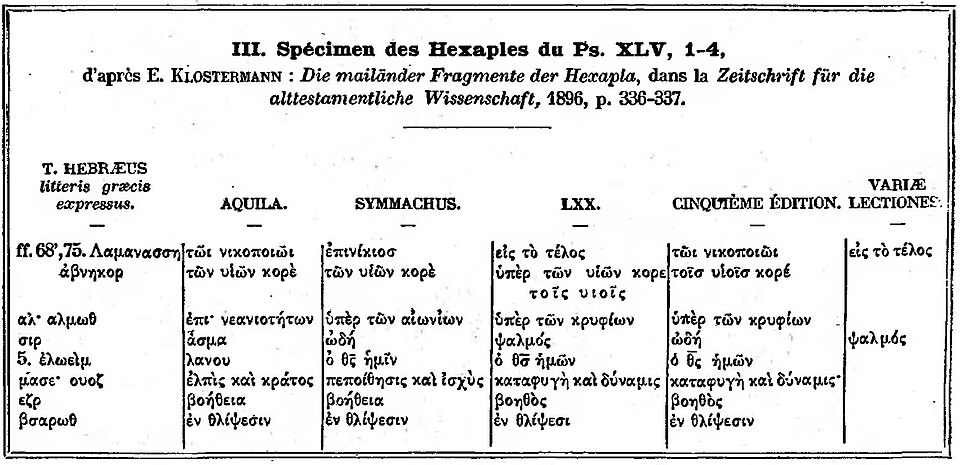
Hexapla ("six columns"): Hebrew, Hebrew in Greek letters, and four Greek versions side by side; for the Psalms he added more. Eusebius also mentions the shorter Tetrapla. Almost entirely lost; fragments survive, and a Syriac translation of its Greek column.
Commentaries, large and verse by verse
On John: 32 books; nine survive in Greek. On Matthew: 25 books; eight survive in Greek, with an old Latin version of a further part. On Romans: only in Rufinus's Latin abridgment, in ten books, with Greek fragments from Tura. On the Song of Songs: ten books; three and a half survive in Rufinus's Latin. Lost or fragmentary: Genesis (12 books), the Psalms, Lamentations, Isaiah (30), Ezekiel (25), the Twelve Prophets (25) and Paul's letters.
Homilies
In Greek: 20 on Jeremiah, and one on the witch of Endor (1 Sm 28), by the older count. In Latin: about 118 by Rufinus and 78 by Jerome, on Genesis, Exodus, Leviticus, Numbers, Joshua, Judges, the Psalms, Song of Songs, Isaiah, Jeremiah, Ezekiel and Luke. On the Psalms in Greek: 29 homilies were identified in 2012 by Marina Molin Pradel in a Munich manuscript (Codex Monacensis Graecus 314), with the identification confirmed by Lorenzo Perrone and others.
Scholia
Short notes on hard words and passages. All but a few fragments have perished.
Theology
On First Principles (Peri Archon), four books, at Alexandria: God, the world, the human person and the power of choice, and Scripture. Whole only in Rufinus's Latin; Greek in the Philocalia and elsewhere. Jerome's more literal version is lost. On the Resurrection, two books, and Stromateis, ten books: lost.
Defence of the faith
Against Celsus, eight books, in Greek: complete. A careful reply to a learned pagan, written in his old age.
The spiritual life
On Prayer: complete in Greek. Exhortation to Martyrdom, written under Maximinus (235 to 237) for Ambrose and the priest Protoctetus: complete in Greek.
Found at Tura, Egypt, 1941
Dialogue with Heraclides and On the Pascha, both previously unknown, in papyri.
Letters
Eusebius collected over a hundred. Two survive whole, by the Catholic Encyclopedia's count: to St Gregory the Wonderworker on the reading of Scripture, and to Julius Africanus on the Greek parts of Daniel. Fragments of others survive, including one defending his philosophical study.
Collections
Philocalia: selections from him, by St Basil and St Gregory Nazianzen. Apology for Origen, by St Pamphilus and Eusebius: book one survives in Rufinus's Latin.
Not his
The twenty Tractatus Origenis, by the Catholic Encyclopedia's judgment, are not his, though they use him. Some other homilies and catena fragments under his name remain uncertain.
A short taste
"How I would like this assembly here to receive a similar testimony, and the eyes of all ... to look at Jesus." (Homilies on Luke 32.6, as quoted by Benedict XVI, General Audience, 2 May 2007)
"If I renounce all my possessions, take up my cross and follow Christ, I offer my holocaust on the altar of God." (Homilies on Leviticus 9.9, the same audience)
What the Popes and the Church say of him
Benedict XVI gave him two catecheses, on 25 April and 2 May 2007. He calls him "a figure crucial to the whole development of Christian thought", a true "maestro", and "an exemplary witness of the doctrine he passed on". He closes by inviting us "to welcome into your hearts the teaching of this great master of faith". In both talks he speaks only of the method, prayer and teaching on the Church; he does not raise the condemnations. Neither does he call him "Saint".
St John Paul II: Origen's work is cited in Fides et Ratio 39, where the Pope says that "Origen is certainly outstanding" among early Christian thinkers who critically took up philosophy.
The Catechism cites him nine times by the Vatican's concordance, in CCC 113, 137, 498, 817, 2071, 2114, 2745, 2825 and 2847. Verbum Domini (2010) of Benedict XVI cites him on the abbreviated Word, on the newness of the Law read in the Spirit, and on prayer with Scripture.
Saints who drew on him. St Pamphilus the martyr defended him. St Gregory the Wonderworker was his pupil. St Athanasius cited him. St Basil and St Gregory Nazianzen collected him. St Ambrose learned from him how to read Scripture. St Jerome translated him, then opposed him, and owed him much. St Methodius and St Epiphanius wrote against him.
Modern study. In the twentieth century Catholic scholars such as Henri de Lubac (Histoire et Esprit, 1950) and Jean Daniélou (Origène, 1948) brought fresh attention to him, and they showed how much the Church's own way of reading Scripture owes to him. Other scholars are more cautious, and the debate continues.
Why he matters today
Anyone who prays with the Bible stands in his debt. He tells us to know the text exactly, to ask what it requires of us, and to look for Christ in every page, and to do all this on our knees. A parish Bible group does these things.
He teaches respect for the text and for learning from others. He consulted Jewish teachers about Hebrew, and he read pagan philosophers for what was true in them.
He also teaches caution. Brilliance can go beyond what has been handed down. He knew this, and he asked to be corrected by the rule of faith. The Church did correct what was taught under his name, and she may be trusted in it. She also keeps reading him.
And he leaves a question that has no neat answer. A man can suffer for Christ, teach saints, and shape the Church's reading of the Bible for all time, and still not be named a saint. The Church does not canonize everyone she owes. Sanctity in the calendar is one thing, and the judgment of God is another, and that belongs to God alone.
Sit with this
- Do I come to Scripture to master it, or to knock, seek and ask?
- If my best ideas were wrong, would I want the Church to correct me?
- What does "this discourse concerns us all" ask of me, as one baptized?
Timeline
| Date | Event |
|---|---|
| About 185 | Born at Alexandria |
| 202 | Father Leonides martyred; Clement leaves Alexandria |
| About 203 | Head of the catechetical school at about eighteen |
| About 213 | Visits Rome under Pope Zephyrinus |
| About 215 to 216 | Preaches in Palestine while a layman |
| About 218 or about 232 | Called to Antioch by the empress mother Mamaea |
| About 231 | Ordained priest at Caesarea |
| About 231 to 232 | Banished and deposed at Alexandria; settles in Caesarea |
| 235 to 237 | Persecution of Maximinus; with St Firmilian in Cappadocia |
| After he was sixty | Against Celsus; Commentary on Matthew |
| 250 | Arrested and tortured under Decius |
| About 253 or 254 | Dies, by later report at Tyre |
| 309 | St Pamphilus, who wrote in his defence, is martyred |
| 400 | Council at Alexandria under Theophilus |
| 543 | Justinian's edict; synod at Constantinople |
| 553 | Second Council of Constantinople; his name in the eleventh anathema |
| 680 to 681, and 787 | Third Council of Constantinople and Second Council of Nicaea name him as condemned by the fifth council |
| 1941 | Papyri found at Tura |
| 25 April and 2 May 2007 | Benedict XVI's two catecheses |
| 2012 | Greek homilies on the Psalms identified at Munich |
Sources: Benedict XVI, General Audiences of 25 April 2007 and 2 May 2007; Verbum Domini; St John Paul II, Fides et Ratio 39; Catechism concordance, "Origen"; F. Prat, "Origen and Origenism", Catholic Encyclopedia (1911); Eusebius, Church History book 6; St Jerome, On Illustrious Men 54; Second Council of Constantinople, Tanner's text and note; Wikipedia, "Origenist crises" and "Origen" for the summary of modern debate; Alin Suciu on the Munich find. Third Council of Constantinople and Second Council of Nicaea, Tanner's text at papalencyclicals.net. Dates for early writers are approximate.