St Polycarp of Smyrna
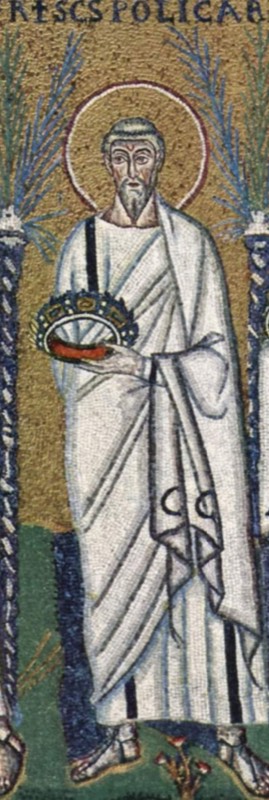
| Time | About 69 to about 155 (some scholars prefer about 167 for his death) |
|---|---|
| Where | Smyrna (today Izmir, Turkey). Visited Rome, Italy, about 154 to 155. |
| What he was | Bishop of Smyrna, martyr, disciple of St John according to Irenaeus; one of the Apostolic Fathers |
| Language | Greek |
| Known as | "The teacher of Asia" (what the crowd called him in the account of his martyrdom); "father of the Christians" (same account) |
| Honoured | Saint and martyr. Latin Church and Byzantine Churches: 23 February (Latin date was 26 January until 1969). Syro-Malabar and Syro-Malankara calendars: 23 February. He is not a Doctor of the Church. |
His life
We know Polycarp from four sources, as the Catholic Encyclopedia says: the letters of Ignatius, his own letter to the Philippians, passages in St Irenaeus, and a letter from his Church on his death. A later Life by "Pionius", from about the fourth century, is judged worthless as history, so nothing here comes from it.
A boy in Smyrna
His age comes from his own words at his trial: "Eighty and six years have I served Him." If he meant from birth, he was born about 69. Vatican News gives 69 to 70, of Christian parents. We have no earlier details that can be trusted.
Disciple of the Apostles
St Irenaeus knew him as a boy. Writing to a friend named Florinus, he recalled exactly where Polycarp sat when he taught, how he came and went, how he looked, and how he told of his talks "with John and with the others who had seen the Lord" (Eusebius, Church History 5.20). Irenaeus adds that Polycarp was appointed bishop of Smyrna by Apostles (Against Heresies 3.3.4). Tertullian says that St John placed him there (Prescription against Heretics 32).
Benedict XVI, speaking of Irenaeus on 28 March 2007, called Polycarp a disciple of the Apostle John, and said the Gospel Irenaeus preached was the one he was taught by Polycarp. So the line runs: John, Polycarp, Irenaeus.
Ignatius comes through
About 107, the chained bishop of Antioch stopped at Smyrna. Polycarp welcomed him. Ignatius later wrote to him from Troas as to a younger bishop, with fatherly advice, calling him to stand "as does an anvil which is beaten" (Polycarp 3). He asked Polycarp to send word to other Churches (Polycarp 7 and 8).
Polycarp did as he asked. He gathered Ignatius's letters and sent copies to Philippi when asked (Philippians 13). Without him, we might not have them.
Long years as bishop
For more than forty years he led the Church of Smyrna. Irenaeus says that he wrote to nearby Churches and to individual Christians to strengthen and correct them (Eusebius 5.20). All of those letters but one are lost. Irenaeus also recalls his habit, when he heard a false teaching, of crying out, "O good God, unto what times have you spared me" and walking away.
The journey to Rome
Very old, he went to Rome in the time of Pope Anicetus, about 154 or 155, if the usual dates hold. The chief matter was the date of Easter. The Churches of Asia kept the feast on the fourteenth day of the Jewish month of Nisan, on whatever weekday it fell, following what they had received from John. Rome and others kept it always on Sunday. Neither could persuade the other. They remained in communion, and Anicetus let Polycarp celebrate the Eucharist in his own church as a mark of respect. They parted in peace (Irenaeus, in Eusebius 5.24). Decades later Irenaeus held this up to Pope Victor as the way to behave.
While at Rome he brought many who had followed Valentinus and Marcion back to the Church. Irenaeus tells of his meeting with Marcion, who asked "Do you know us?" He answered, "I know the first-born of Satan" (Against Heresies 3.3.4). That was his way of guarding the truth in a hard fight. He is not a model for how we should speak of people today.
His martyrdom
The account comes from a letter sent by the Church of Smyrna to the Church at Philomelium, which is among the oldest accounts of a martyrdom we have. Eusebius copied much of it (4.15). It tells the story this way.
- The games. A festival was on in Smyrna. A Christian named Germanicus faced the beasts bravely. The crowd cried out: "Away with the Atheists; let Polycarp be sought out!" (3). Christians were called atheists because they would not honour the gods.
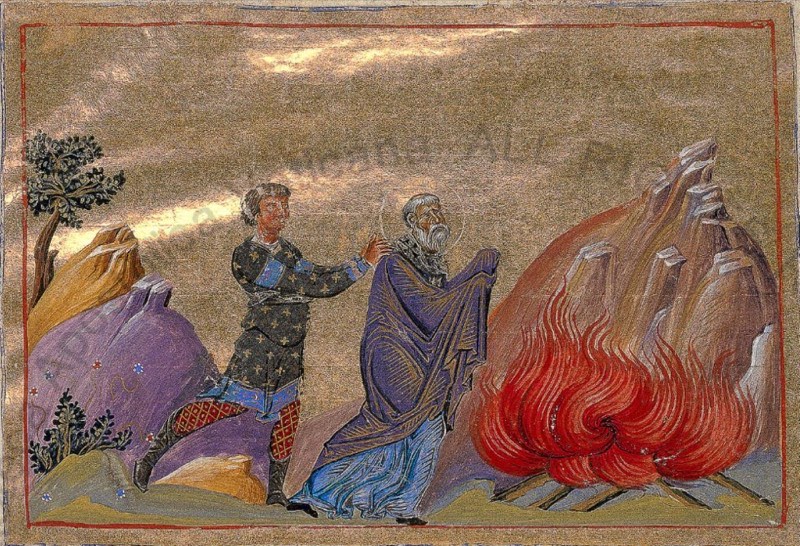
- The farm. Polycarp wanted to stay, but friends persuaded him to go to a farm. There he prayed night and day for all, and for the Churches throughout the world. Three days before his arrest he saw his pillow on fire, and said, "I must be burnt alive" (5).
- Betrayal. A young servant was tortured and told where he was. A police captain, oddly called Herod, led the search (6).
- Supper for the guards. On a Friday evening they found him in an upper room. He could have fled, and said, "The will of God be done." He came down, ordered food and drink for them, and asked only for an hour to pray. He prayed for two hours, standing, remembering everyone he had ever met and the whole Catholic Church. Some of the men were sorry they had come (7 and 8).
- The chariot. They put him on a donkey for the road to the city. The captain and his father tried to talk him round: "What harm is there in saying, Lord Caesar?" He said no, and they pushed him from the chariot, hurting his leg (8).
- In the stadium. As he entered, Christians heard a voice: "Be strong, and show yourself a man, O Polycarp!" (9).
- The trial. The proconsul urged him to think of his age, to swear by Caesar's fortune, and to say "Away with the atheists". Polycarp waved his hand at the crowd and said it, looking up to heaven and groaning. Told to curse Christ, he gave the words that have lasted: "Eighty and six years have I served Him, and He never did me any injury: how then can I blaspheme my King and my Saviour?" (9). Threatened with beasts and fire, he spoke of the fire that burns for an hour and the judgment to come (11).
- The sentence. The crowd in the stadium, in fury, cried out against "the teacher of Asia, the father of the Christians", and called for fire (12). The people hurried to gather wood.
- The prayer. He refused to be nailed, saying that God would hold him still. Bound, he prayed a long thanksgiving: "I give You thanks that You have counted me worthy of this day and this hour" (14).
- The fire. According to the writers, the flames formed an arch like a sail about his body. He looked "as bread that is baked". A sweet smell rose. An executioner then stabbed him. Much blood came and put out the fire (15 and 16).
- His bones. His body was burned. The Christians gathered his bones, "more precious than the most exquisite jewels", and laid them in a fitting place to keep his anniversary each year (18). This is one of the earliest clear witnesses to the Church's yearly feast of a martyr's death.
This old letter uses hard words about some of the people of the town, as writings of that bitter age often did. We do not repeat them. No people may be blamed for a martyr's death.
The date
The letter's last lines give a date: the second of the month Xanthicus, a great Sabbath, the eighth hour, under the proconsul Statius Quadratus. The Catholic Encyclopedia reckons this as Saturday, 23 February, and after Waddington and Lightfoot, it accepts about 155. Eusebius, however, places it under Marcus Aurelius, about 166 to 167, and some still follow him. The closing lines may be a later addition. The range is honest.
His memory in Izmir
Izmir still has a Catholic church named for him, built in 1625 and rebuilt after the fire of 1922. His relics are claimed by more than one place; these claims remain uncertain.
The world he lived in
Smyrna. A rich port of Roman Asia on the Aegean, loyal to Rome. It is one of the seven Churches written to in the Book of Revelation (Revelation 2:8 to 11). Benedict XVI, recalling Irenaeus, places it where Izmir stands today.
The emperors. From Trajan through Hadrian and Antoninus Pius, Christians lived in uneasy peace broken by local trials. A mob could demand a Christian's death, and a governor could give way. Refusing to honour the emperor was treated as disloyalty.
The great teachers of error. In Polycarp's old age, groups such as those of Marcion and Valentinus were strong. Marcion rejected the Old Testament and its God. Valentinus taught secret knowledge. Polycarp's great value was that he could say: this is what I heard from those who saw the Lord.
A Church becoming older. He is a bridge. When he was young, the last witnesses were still alive. When he died, the New Testament writings were being read everywhere, and his own letter cites many of them.
What he taught
- Christ came in the flesh and rose. "Whosoever does not confess that Jesus Christ has come in the flesh, is antichrist" (Philippians 7, echoing 1 John 4:3). He will return to judge (2).
- Saved by grace. "By grace you are saved, not of works" (1), with Ephesians 2. Then we must do his will, love what he loved, and walk in his commands (2).
- Hold what was handed down. "Let us return to the word which has been handed down to us from the beginning" (7). Irenaeus says this was the whole of his preaching.
- Righteousness and love of neighbour. Faith, hope and love are the fulfilment of the command of righteousness (3). The love of money is the root of all evils (4), a warning he repeats with sorrow over Valens, a presbyter who had gone astray (11). Even then he asks for mercy: do not count such people as enemies, but call them back (11).
- Duties of each person. He gives counsel for wives and widows (4), deacons, young men and virgins (5), and presbyters, who must visit the sick and bring back those who wander (6). A deacon is like the Lord, "the servant of all" (5); Lumen Gentium 29 cites this passage.
- Patience after Christ's own pattern. Christ endured everything for us; "let us then be imitators of His patience" (8). He points to Ignatius, Zosimus, Rufus, Paul and the Apostles (9).
- Give alms. When you can do good, do not put it off, for "alms delivers from death" (10, citing Tobit).
- Pray for everyone. For the saints, kings, rulers, those who persecute you, and the enemies of the cross (12).
- The Trinity in prayer. His last prayer gives glory through Christ "with whom, to You, and the Holy Ghost" (Martyrdom 14). It may have been shaped by the Church's prayer.
- Honour of the martyrs. "Him indeed, as being the Son of God, we adore; but the martyrs... we worthily love" (Martyrdom 17). This is an early statement of the difference between worship of Christ and honour of the saints. The Catechism quotes it at 957.
- Do not rush into danger. The same letter warns against Christians who give themselves up, "seeing the Gospel does not teach so to do" (Martyrdom 4).
Did he err? On the date of Easter, the Asian custom later gave way. The Council of Nicaea in 325 asked all to keep one date. But he was never blamed for this; the point of the story is his peace with Anicetus.
How he taught
By handing on. He does not try to be clever. He says humbly that neither he nor anyone else can match the wisdom of the blessed Paul (3). He is not sure of his own learning in Scripture (12).
With the words of others. The letter is short but full of echoes of 1 Peter, Paul, the Gospels and 1 John. The Catholic Encyclopedia, quoting Lightfoot, notes that his quotations are far more numerous and exact than those of Ignatius. Eusebius noticed his use of 1 Peter (4.14).
By his bearing. People remembered how he sat, how he walked, how he looked. His life was the lesson. Feeding the guards is a whole sermon on Christ's words about enemies.
Plainly. Next to the fire and imagery of Ignatius, Polycarp is plain and practical. Lightfoot used this difference as evidence that one forger could not have written both.
His works
His own
Letter to the Philippians. 14 chapters. Praised by Irenaeus as "very powerful" (in Eusebius 4.14). Greek copies are defective and incomplete; the whole letter survives only in Latin; Eusebius quotes chapters 9 and 13 in Greek (3.36).
One letter or two?
Chapter 9 seems to know that Ignatius is dead. Chapter 13 asks for news of him. In 1936 P. N. Harrison proposed that chapter 13 (perhaps with 14) was an early note and chapters 1 to 12 a later letter. Some accept this; others see no need for it.
Lost
Other letters to neighbouring Churches and to Christians, mentioned by Irenaeus (Eusebius 5.20).
About him
Martyrdom of Polycarp: a letter of the Church of Smyrna, written by one Evarestus and sent by Marcus (20). It is the first text to use "martyr" for someone who dies for the faith, says Vatican News. Later copyists added notes on how it passed down through Irenaeus (22).
Life of Polycarp by Pseudo-Pionius: a late work without historical value.
A short taste
"Eighty and six years have I served Him, and He never did me any injury: how then can I blaspheme my King and my Saviour?" (Martyrdom of Polycarp 9; Roberts and Donaldson's translation in the Ante-Nicene Fathers)
"I give You thanks that You have counted me worthy of this day and this hour." (Martyrdom 14, same translation)
What the Popes and the Church say of him
Benedict XVI gave Polycarp no General Audience of his own in the series on the Fathers. He appears in the Audience on Ignatius (14 March 2007), as bishop of Smyrna, "a disciple of St John"; and in the Audience on Irenaeus (28 March 2007), who says the Gospel he preached is the one he learned from Polycarp, going back to John.
The Second Vatican Council cites his letter on deacons in Lumen Gentium 29.
The Catechism quotes the Martyrdom at 957 on the honour due to martyrs, and at 2474 with his last prayer, among the Church's witnesses to the truth.
Vatican News gives his memorial on 23 February, calling him a disciple of St John, and the account of his death one of the oldest and most authentic of the Acts of the Martyrs.
The Latin Church keeps his memorial on 23 February. In 1969 the date was moved from 26 January, to the day given in the account of his death.
Why he matters today
- The chain of memory. One long life joins St John to St Irenaeus. Our faith has reached us hand to hand, and he shows how few hands that was.
- Peace in disagreement. Polycarp and Anicetus could not agree, and they stayed together at the altar. There are few better examples for Christians who differ over practice, including the Churches of East and West today.
- Old age. He was over eighty when he crossed the sea for the Church, and when he faced the stadium. Old age here is not retirement.
- Courage without hatred. He feeds those who come to arrest him. He tells the proconsul that Christians honour authority where they can (10). He prays for all.
- Simple faithfulness. Eighty-six years, and "He never did me any injury." Many of us could learn to pray in those words.
Sit with this
- Who handed the faith on to me? Have I thanked God for them by name?
- With whom do I disagree in the Church? Could I still share the table with them, as Polycarp did with Anicetus?
- Looking back over my own years, can I say that he never did me any injury?
Timeline
| Date | Event |
|---|---|
| About 69 | Birth, from his "eighty and six years" |
| Before about 100 | Hears St John and others, according to Irenaeus; made bishop of Smyrna by Apostles |
| About 107 | Ignatius of Antioch stays with him at Smyrna, then writes to him from Troas |
| Soon after | Letter to the Philippians, sending Ignatius's letters (or chapter 13 alone, if Harrison is right) |
| About 135 to 150 | The boy Irenaeus listens to him at Smyrna (Lightfoot's reckoning) |
| About 154 to 155 | Visit to Pope Anicetus at Rome; meeting with Marcion |
| 23 February, about 155 | Martyred at Smyrna at the age of about 86 (or about 167, following Eusebius) |
| About 190 | Irenaeus recalls him in his letter to Pope Victor on Easter |
| 1625 | Church of St Polycarp built at Izmir |
| 1936 | P. N. Harrison's two-letter theory |
| 1969 | Latin feast moved from 26 January to 23 February |
Sources: Martyrdom of Polycarp and Letter to the Philippians (Ante-Nicene Fathers, New Advent); Ignatius, Letter to Polycarp; Benedict XVI, General Audiences of 14 March 2007 and 28 March 2007; Catholic Encyclopedia, St Polycarp; Irenaeus, Against Heresies 3.3; Eusebius, Church History, book 4 and book 5; Tertullian, Prescription against Heretics; Vatican News, St Polycarp; Catechism 957; Lumen Gentium; feast dates, relic and Harrison details checked in Wikipedia, Polycarp and Epistle of Polycarp; Saint Polycarp Church. Syro-Malabar and Syro-Malankara days: the official calendars (Syro-Malabar Liturgical Calendar, Second Set; Syro-Malankara Panchangam 2026-27).