Tertullian of Carthage
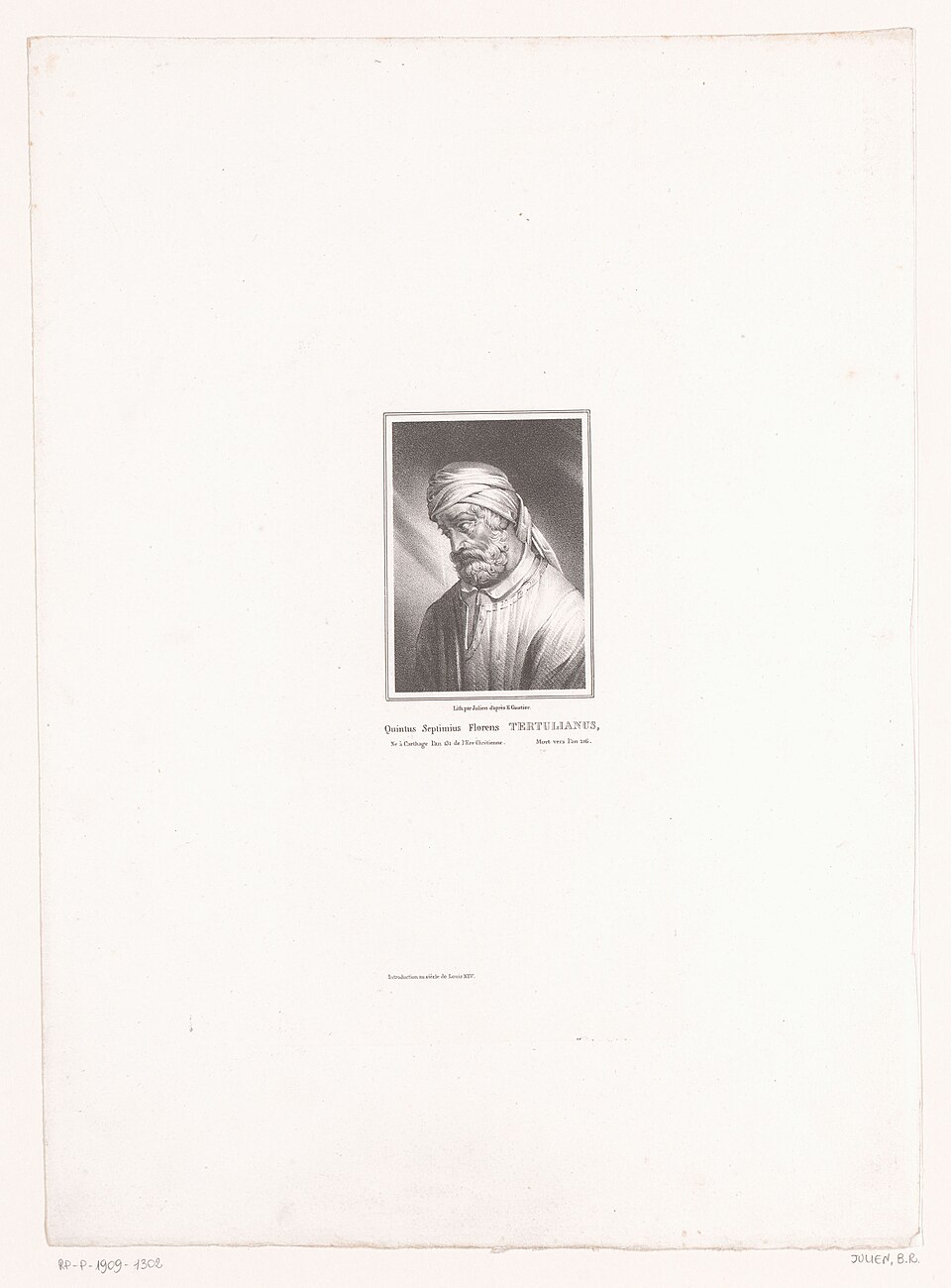
| Time | Born about 155 to 160; writing from 197 to after about 218; death unknown. Benedict XVI says plainly that we do not know the exact dates of his birth and death. |
|---|---|
| Where | Carthage, Roman Africa (today near Tunis, Tunisia) |
| What he was | Convert, lawyer by training according to many historians, Christian writer. St Jerome calls him a presbyter (priest); some modern scholars doubt it. |
| Language | Latin. He also wrote in Greek, but those works are lost. |
| Known as | The first great Christian writer in Latin; the man who gave Latin theology the words "one substance" and "three Persons" |
| Honoured | He is not a saint and has no feast in any tradition we could find. He is an ecclesiastical writer, not usually named a Father in the full sense, though he is studied with the Fathers. The reason is a sad one: in later life he joined the rigorous Montanist movement and, by the usual account, drew apart from the communion of the Church. Yet the Catechism still quotes him often. |
His life
Almost all we know of Tertullian comes from his own books and from one short notice by St Jerome, written more than a century and a half later. So much of his story has to be told with "probably".
Youth at Carthage. Quintus Septimius Florens Tertullianus was born at Carthage, probably about 160 according to the Catholic Encyclopedia; other reference works say about 155. Jerome says that his father was a centurion in the service of the proconsul. Benedict XVI tells us that he received "a solid education in rhetoric, philosophy, history and law" from his pagan parents and tutors. His books show a close knowledge of Roman legal language, and many historians think he worked as an advocate. Whether he is the same man as a jurist named Tertullian quoted in Roman law books is doubtful.
Conversion. He was a pagan until he was a grown man, and he says that he had shared the pagan contempt for Christians. He became a Christian not later than 197. Benedict XVI says that he was drawn "so it seems, by the example of the Christian martyrs". He threw himself into the faith with his whole fiery nature. He was married, and he wrote two books to his wife.
The great writer, 197 to about 206. In 197 he published To the Martyrs, To the Nations and his masterpiece, the Apology. About 200 came The Prescription of Heretics. Then came a run of short books for those preparing for Baptism: on prayer, Baptism, repentance, patience, the public shows, idols and modest dress.
Priest or layman? Jerome calls him "the presbyter". The Catholic Encyclopedia accepts this and suggests ordination about 200. Some modern scholars, following T. D. Barnes, point out that Tertullian never calls himself ordained and seems to count himself among the laity. The question is open.
Montanism, after about 206. Montanus and two prophetesses, Priscilla and Maximilla, had preached in Asia Minor a "new prophecy", with severe fasts and a sharp expectation of the end. Long after their death Tertullian came to believe that the Holy Spirit truly spoke in them. At first this was a movement inside the Church at Carthage. His books grew steadily more severe. He came to condemn all second marriage, all flight in persecution, and the forgiveness of the gravest sins.
The break, about 211 to 213. The Catholic Encyclopedia, following Harnack and Monceaux, dates his separation from the Church of Carthage to about 211 or 213. In On Flight in Persecution he begins to call Catholics "the psychics", the unspiritual. The cause of the break is not recorded. The same encyclopedia thinks it unlikely that he left of his own act, and that the Church of Carthage more probably put out the more violent Montanists. Jerome blames "the envy and abuse of the clergy of the Roman church", which is Jerome's own opinion.
Last years. His last book that can be dated is On Modesty, written about or after 218 against a bishop who issued a decree of pardon, probably Pope Callistus. St Augustine later knew of a group called Tertullianists at Carthage who returned to the Church in his day, and he says that Tertullian broke with the Montanists too. Jerome says that he lived to an extreme old age. No one knows where or how he died.
Did he truly leave? Here modern study has moved. Many scholars now doubt that there was a clean exit from the Church, and some think that Augustine was mistaken about the Tertullianists. One scholar, Geoffrey Dunn, says that the question "continues to be debated". Benedict XVI gives the plain Catholic reading: he was gradually led "away from communion with the Church to belong to the Montanist sect", and he ended isolated.
The world he lived in
Carthage was the great Latin city of Africa, rebuilt by Rome after its ancient destruction. It was rich, learned and proud of its schools of speech and law. The Church there was young and growing fast, mostly among people who still lived in a pagan city with pagan feasts, shows and offices.
To be Christian was dangerous. Under Roman law the name alone could bring death, though governors differed in how hard they pressed it. Christians were accused of killing babies, of incest, and of bringing floods and famine by angering the gods. In 203 Perpetua and her companions died at Carthage. In 212 the proconsul Scapula renewed the persecution, and Tertullian wrote to warn him.
At the same time the Church was fighting for her own mind. Marcion rejected the God of the Old Testament. Valentinus and other Gnostics taught a secret knowledge and despised the body. Praxeas blurred the Father and the Son. Tertullian wrote against each of them, and in so doing he had to make a Christian Latin that did not yet exist. He is the first witness to a Latin Bible in use in Africa, though he often seems to translate from Greek as he writes.
What he taught
- The Holy Trinity. He gave Latin the formula of one substance and three Persons (Against Praxeas). Benedict XVI calls this "an enormous step in the development of Trinitarian dogma". Father, Son and Holy Spirit are distinct, and each is God. Here he was not yet exact in everything; see below.
- Christ, true God and true man. He teaches two "substances" in one Person, without mixing (Against Praxeas; On the Flesh of Christ). This comes long before the great councils that settled the matter.
- God is one and the Creator. "If God is not one, he is not God", in substance, against Marcion (Against Marcion 1.3; cited in CCC 228). The rule of faith confesses one God who made all things from nothing through his Word (Prescription 13).
- The goodness of the body and its resurrection. "The flesh is the hinge of salvation" (On the Resurrection of the Flesh 8; quoted in CCC 1015). The flesh will rise, whole and in its own identity (chapter 63).
- The soul reaches for God. The soul is "naturally Christian" (Apology 17). Ordinary people cry out "God grant" and "God sees" without thinking (The Testimony of the Soul).
- The apostolic Church holds the Scriptures. Heretics have no right to argue from the Bible, because the faith came down through the churches founded by the apostles (Prescription). The Church is always "mother" to him, as Benedict XVI notes, even after he joined the Montanists.
- Prayer. The Lord's Prayer is the summary of the whole Gospel (On Prayer 1; CCC 2761).
- Baptism and the sacramental life. On Baptism is a very early treatise on the subject. It mentions Easter and Pentecost as the proper days, with fasting and vigil before, and with anointing and laying on of hands after. In one famous line he joins Baptism, anointing, signing, the laying on of hands and the Lord's Body and Blood, in which the flesh is washed, anointed and fed so that the soul may be cleansed, consecrated and nourished (On the Resurrection 8).
- Repentance. As a Catholic, he taught a "second plank" after Baptism, public confession and penance for grave sin (On Repentance; see CCC 1446).
- The Eucharist. He speaks of the Lord's Body "in the bread" (On Prayer 6). One line in Against Marcion says that Christ made the bread his Body, "that is, the figure of my body". This has been much argued over. The Catholic Encyclopedia holds that, in its context, the line proves nothing either way about the Real Presence. The Church's faith in the Real Presence (CCC 1374) does not rest on this line.
- Mary. He calls her the new Eve: what Eve lost by believing the serpent, Mary won back by believing the angel (On the Flesh of Christ 17). He firmly defends the virginal conception of Jesus. On her lasting virginity, see where he erred below.
- Marriage. A beautiful passage in To His Wife (2.8) praises the home of two Christian spouses, who pray and fast together. CCC 1642 draws on it.
- Life before birth. He holds that it is murder to destroy the unborn child (Apology 9; cited in CCC 2271).
- Love of enemies. "The Christian cannot hate, not even his enemies" (see Apology 37, as cited by Benedict XVI).
- Martyrs. "The blood of Christians is effective seed" (Apology 50.13; see CCC 852).
Where he erred
The Church honours what is true in him and does not follow him in the rest. These points are stated from the Catholic Encyclopedia and the Catechism, without any wish to shame him.
- Too harsh on sinners. As a Montanist he held that some grave sins could not be forgiven by the Church at all, against what he had earlier taught and against the Church's own practice (On Modesty). The Catholic faith holds that there is no offence so serious that the Church cannot forgive it (see CCC 982).
- Too harsh on marriage and on the persecuted. He condemned second marriage outright (On Monogamy) and flight in persecution (On Flight). The Church does neither.
- The soul and God as "body". He seems to teach that everything real, even God, is in some sense a body (On the Soul; Against Praxeas). The Catholic Encyclopedia blames in part his unfamiliarity with the language of philosophy.
- The origin of the soul. He taught that souls come down from parents as bodies do, a view called traducianism. The Church teaches that every spiritual soul is created immediately by God (CCC 366).
- The Son before creation. He writes that there was a time when God was not yet Father, a way of speaking which the Church could not keep after Nicaea.
- Mary. He seems to deny her virginity in giving birth, and to think that she had other children. This is not the faith of the Church, which confesses Mary ever virgin (CCC 499 to 501).
- Too much severity with soldiers and with the world. He argued that a Christian could not be a soldier (The Crown; On Idolatry), and he would let a Christian attend no public shows at all.
How he taught
He argued like a lawyer in court. The Prescription of Heretics takes its name from a Roman legal plea that stops a case before it begins. The Apology is a speech for the defence, addressed to the rulers of the empire: you torture others until they confess, he says, but you torture us until we deny.
He wrote short, hard, ringing sentences, full of paradox and wit. Later ages keep repeating them. The Catholic Encyclopedia says that he outdid Tacitus as a maker of phrases. His irony could wound, and he knew it. He begins his book on patience by admitting that it is an impudence for him, of all people, to write on that virtue.
He was suspicious of philosophy, even as he used it: "What does Athens have in common with Jerusalem?" St John Paul II quotes this line and reads it not as a rejection of thinking, but as a sign of "the critical consciousness" with which early Christians met the philosophers (Fides et Ratio 41).
He had to invent. How many Latin church words he himself coined no one can tell, but Benedict XVI says flatly that he "started the use of theology in Latin".
His works
Thirty-one treatises survive, all in Latin. Their order and exact dates are argued over; the outline below is the usual one, grouped by kind. Those marked M show Montanist influence, on the usual reckoning; his later books against error show traces of it too.
For the outside world
Apology (197): the defence of Christians · To the Nations, two books (197): the earlier, rougher attack on slanders and on the gods · The Testimony of the Soul: the soul's natural witness to God · To Scapula (212): an open letter warning a persecuting proconsul
For the suffering
To the Martyrs (197): to prisoners awaiting death · The Antidote for the Scorpion's Sting (Scorpiace): against those who said God does not want martyrdom · On Flight in Persecution (M): flight forbidden
Against errors
The Prescription of Heretics (about 200) · Against Marcion, five books (final version from 207): his largest surviving work · Against Hermogenes · Against the Valentinians · Against Praxeas (M): the Trinity · On the Flesh of Christ · On the Resurrection of the Flesh · On the Soul · On Baptism, written against a woman teacher who denied its need · Against the Jews: a sharp argument from prophecy, in the manner of his time; the Church today rejects any contempt for the Jewish people (Nostra Aetate 4)
For the Christian life
On Prayer: with an early commentary on the Our Father · On Repentance · On Patience · To His Wife, two books · On the Dress of Women, two books · On the Shows · On Idolatry · On the Veiling of Virgins (M) · Exhortation to Chastity (M) · The Crown (211, M) · On the Pallium (209): a witty defence of his wearing the philosopher's cloak · On Monogamy (M) · On Fasting (M) · On Modesty (M)
Lost or spurious
- Lost: about fifteen works, by one modern count, among them On Paradise; his defence of Montanist prophecy, On Ecstasy, in six books with a seventh against Apollonius; On the Hope of the Faithful, known from Jerome; and his Greek writings, including one on the veil.
- Uncertain: the latter half of Against the Jews is nearly identical with part of the third book of Against Marcion. The Catholic Encyclopedia thinks that he reused his own earlier draft; others have asked whether another hand finished it.
A short taste
"The blood of Christians is effective seed." (Apology 50.13, in the translation used by Benedict XVI, General Audience, 30 May 2007)
"See, they exclaim, how they love one another." (Apology 39, as given in the Catholic Encyclopedia)
St Cyprian of Carthage, a martyr and a saint, read him every day. Jerome heard from an old man who had been Cyprian's secretary that he would ask for the book with the words "Give me the master".
What the Popes and the Church say of him
Benedict XVI gave him a whole catechesis on 30 May 2007, in his series on the great figures of the early Church. He does not call him a saint. He says that Tertullian's work "brought decisive benefits which it would be unforgivable to underestimate". Then he turns to the sorrow of the story. Tertullian became "increasingly exigent", demanding heroism of everyone, and ended isolated. The Pope's own judgment deserves to be remembered: "The essential characteristic of a great theologian is the humility to remain with the Church, to accept his own and others' weaknesses, because actually only God is all holy."
St John Paul II quotes his question about Athens and Jerusalem in Fides et Ratio 41.
The Catechism of the Catholic Church cites him fifteen times by the Vatican's own concordance, on God's oneness (228), the seed of the martyrs (852), the resurrection of the flesh (991, 1015), repentance (1446), marriage (1642), the unborn (2271), and the Lord's Prayer (2761 and following).
Was he condemned? We found no solemn judgment by a Pope or Council against him by name. He was left out of the calendar of saints because of how his life and teaching went, not by a sentence read against him. The Gelasian Decree, a Latin list of books from about the sixth century which bears the name of Pope Gelasius but is not his, does place his writings among those not to be received. That is a caution about books, not a sentence on the man.
Why he matters today
Every time a Latin Christian says "three Persons in one God", the shape of the phrase owes something to him. Latin theology, and the language of the Roman Rite itself, begins in part at his writing desk.
His defence of Christians still reads as a plea for religious liberty: he says that it is no part of religion to force religion (To Scapula 2). Christians in many lands today know the courts he describes, where the only crime is a name.
And his life is a warning that speaks to every serious believer. It is possible to love the truth, to suffer for it, to be right on many things, and still to grow unable to bear the weakness of others. Benedict XVI asks us to learn from him both ways: from his gifts, and from what he lacked. We may entrust him gladly to the mercy of God, about whose mercy he was sometimes too strict.
Sit with this
- Where has being right made me hard on others?
- Am I able to stay with a Church full of weak people, of whom I am one?
- Is there a sentence of faith I repeat every Sunday without knowing how much it cost to find those words?
Timeline
| Date | Event |
|---|---|
| About 155 to 160 | Born at Carthage |
| By 197 | Becomes a Christian |
| 197 | To the Martyrs, To the Nations, Apology |
| About 200 | The Prescription of Heretics; perhaps ordained, if he was ordained |
| 200 to 206 | Short books for those preparing for Baptism |
| 203 | Sts Perpetua and Felicity martyred at Carthage |
| After 206 | Comes to accept the Montanist prophecy |
| From 207 | Against Marcion in its final form |
| 209 | On the Pallium |
| 211 to 213 | Separation from the Church of Carthage, by the usual dating |
| 212 | To Scapula |
| After about 218 | On Modesty, his last datable work |
| After about 220 | Death, date and place unknown; Jerome says in extreme old age |
| Middle of the third century | St Cyprian reads him daily and calls him "the master" |
| Early 5th century | Augustine's time: the remaining Tertullianists at Carthage return to the Church, by Augustine's account |
| 1992 | The Catechism appears, and it cites him often |
| 30 May 2007 | Benedict XVI's catechesis |
Sources: Benedict XVI, General Audience, 30 May 2007; St John Paul II, Fides et Ratio 41; Catechism concordance, "Tertullian"; J. Chapman, "Tertullian", Catholic Encyclopedia (1912); St Jerome, On Illustrious Men 53; Tertullian, To Scapula; New Schaff-Herzog Encyclopedia, "Tertullian"; Wikipedia, "Tertullian", for the summary of modern debate (Barnes, Dunn, Tabbernee, Powell). Gelasian Decree in Latin: thelatinlibrary.com/decretum.html. Dates for early writers are approximate.